Search


Citas y referencias (90)
Invitrogen™
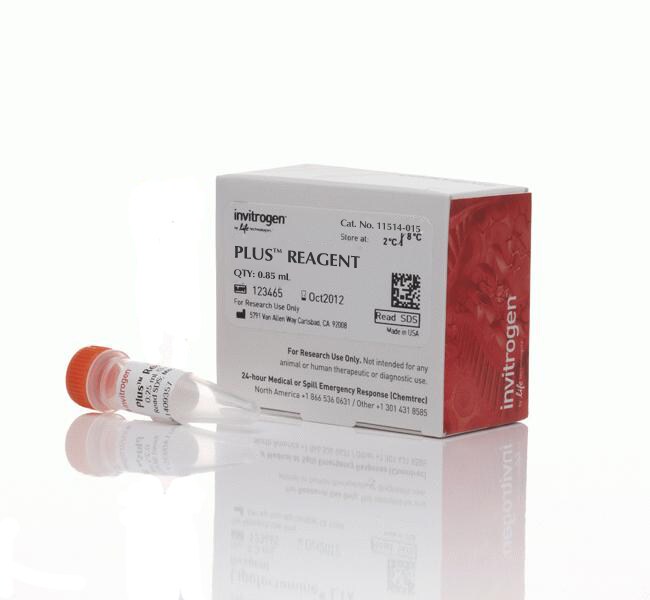
Reactivo PLUS™
El reactivo PLUS™ se utiliza junto con diversos reactivos de transfección, como el reactivo Lipofectamine™, para mejorar la eficacia deMás información
| Número de catálogo | Cantidad |
|---|---|
| 11514015 | 0,85 mL |
Número de catálogo 11514015
Precio (MXN)
-
Cantidad:
0,85 mL
El reactivo PLUS™ se utiliza junto con diversos reactivos de transfección, como el reactivo Lipofectamine™, para mejorar la eficacia de transfección en líneas de células adherentes.
Uso del reactivo PLUS™
Algunos clientes descubren que al utilizar el reactivo PLUS™, es necesaria una menor optimización de la concentración de ADN para lograr un alto rendimiento de transfección. La adición del reactivo PLUS™ también puede reducir la cantidad de ADN y lípidos necesarios en aproximadamente la mitad cuando se compara solo con los lípidos. El reactivo PLUS™ se ha diseñado específicamente para ampliar la matriz de tipos celulares transfectables. Cuando se utiliza con el reactivo Lipofectamine™, el reactivo PLUS™ ha puesto de manifiesto que mejora la transfección de BHK-21, NIH 3T3 y otras estirpes celulares.
Uso del reactivo PLUS™
Algunos clientes descubren que al utilizar el reactivo PLUS™, es necesaria una menor optimización de la concentración de ADN para lograr un alto rendimiento de transfección. La adición del reactivo PLUS™ también puede reducir la cantidad de ADN y lípidos necesarios en aproximadamente la mitad cuando se compara solo con los lípidos. El reactivo PLUS™ se ha diseñado específicamente para ampliar la matriz de tipos celulares transfectables. Cuando se utiliza con el reactivo Lipofectamine™, el reactivo PLUS™ ha puesto de manifiesto que mejora la transfección de BHK-21, NIH 3T3 y otras estirpes celulares.
Para uso exclusivo en investigación. No apto para uso en procedimientos diagnósticos.
Especificaciones
Para utilizar con (aplicación)Transfección
Compatibilidad de alto rendimientoNo compatible con alto rendimiento (manual)
Línea de productosPLUS
Tipo de productoReactivo
Cantidad0,85 mL
Compatible con sueroSí
Condiciones de envíoHielo húmedo
Tipo de célulaLíneas de células establecidas, células madre, células primarias, células difíciles de transfeccionar
FormatoPlaca de 6 pocillos, placa de 12 pocillos, placa de 24 pocillos, placa de 48 pocillos, placa de 96 pocillos, matraces
Tipo de muestraADN plasmídico, plásmidos de ARNi (shRNA, miR)
Transfection TechniqueTransfección basada en lípidos
Unit SizeEach
Contenido y almacenamiento
Contiene un vial (0,85 ml) de reactivo PLUS™. Almacenar a 4 °C. No la congele.
Preguntas frecuentes
I accidentally left my lipid reagent at room temperature. Can I still use it?
Do you offer a reagent for the transfection of endothelial cells?
Can I use the PLUS Reagent with Lipofectamine RNAiMAX?
Why do I have to dilute my DNA in medium before adding the PLUS Reagent? Can I just add them together?
What is the PLUS Reagent?
Citations & References (90)
Citations & References
Abstract
c-Jun is a JNK-independent coactivator of the PU.1 transcription factor.
Journal:J Biol Chem
PubMed ID:9988737
The ETS domain transcription factor PU.1 is necessary for the development of monocytes and regulates, in particular, the expression of the monocyte-specific macrophage colony-stimulating factor (M-CSF) receptor, which is critical for monocytic cell survival, proliferation, and differentiation. The bZIP transcription factor c-Jun, which is part of the AP-1 transcription factor
A
Journal:J Biol Chem
PubMed ID:11973330
The large size (six membrane-spanning repeats in each of four domains) and asymmetric architecture of the voltage-dependent Na+ channel has hindered determination of its structure. With the goal of determining the minimum structure of the Na+ channel permeation pathway, we created two stable cell lines expressing the voltage-dependent rat skeletal
Vesicle-associated membrane protein-2/synaptobrevin binding to synaptotagmin I promotes O-glycosylation of synaptotagmin I.
Journal:J Biol Chem
PubMed ID:12048209
Synaptotagmin I (Syt I), an evolutionarily conserved integral membrane protein of synaptic vesicles, is now known to regulate Ca2+-dependent neurotransmitter release. Syt I protein should undergo several post-translational modifications before maturation and subsequent functioning on synaptic vesicles (e.g. N-glycosylation and fatty acylation in vertebrate Syt I), because the apparent molecular
Receptor-selective effects of endogenous RGS3 and RGS5 to regulate mitogen-activated protein kinase activation in rat vascular smooth muscle cells.
Journal:J Biol Chem
PubMed ID:12006602
Regulators of G protein signaling (RGS) proteins compose a highly diverse protein family best known for inhibition of G protein signaling by enhancing GTP hydrolysis by Galpha subunits. Little is known about the function of endogenous RGS proteins. In this study, we used synthetic ribozymes targeted to RGS2, RGS3, RGS5,
Extracellular Export of Sphingosine Kinase-1 Enzyme. SPHINGOSINE 1-PHOSPHATE GENERATION AND THE INDUCTION OF ANGIOGENIC VASCULAR MATURATION.
Journal:J Biol Chem
PubMed ID:11741921
The enzyme sphingosine kinase (SK) catalyzes the formation of sphingosine 1-phosphate (S1P), a bioactive lipid that acts extracellularly on G protein-coupled receptors of the S1P(1)/EDG-1 subfamily. Although S1P is formed in the cytosol of various cells, S1P release is not understood and is controversial because this lipid mediator is also