Search


Citas y referencias (27)
Gibco™
DMEM, alto contenido en glucosa
El DMEM (medio Eagle modificado de Dulbecco) se utiliza ampliamente como un medio basal para favorecer el crecimiento de diferentesMás información
Have Questions?
Cambiar vista

| Número de catálogo | Cantidad |
|---|---|
| 11965118 | 10 x 500 mL |
| 11965092 | 500 mL |
| 11965084 | 1000 mL |
| 11965126 | 6 x 1000 mL |
| 11965167 | 5 L |
| 11965175 | 10 L |
Número de catálogo 11965118
Precio (MXN)
7,518.00
Each
Cantidad:
10 x 500 mL
Precio (MXN)
7,518.00
Each
El DMEM (medio Eagle modificado de Dulbecco) se utiliza ampliamente como un medio basal para favorecer el crecimiento de diferentes células de mamífero. Las células cultivadas con éxito en DMEM incluyen fibroblastos primarios, neuronas, células gliales, HUVEC y células de músculo liso, así como líneas de células HeLa, 293, cos-7 y PC-12. Life Technologies ofrece diversas modificaciones de DMEM para una serie de aplicaciones de cultivos celulares. Busque la formulación adecuada mediante la herramienta de selección de medios.
Está disponible la formulación completa.
Uso de DMEM
El medio DMEM es único en comparación con otros medios, ya que contiene 4 veces la concentración de aminoácidos y vitaminas del medio esencial mínimo de Eagle. DMEM se formuló originalmente con bajas cantidades de glucosa (1 g/l) y piruvato sódico, pero a menudo se utiliza con niveles de glucosa más altos, y con o sin piruvato sódico. DMEM no contiene proteínas, lípidos ni factores de crecimiento. Por lo tanto, el DMEM requiere suplementación, generalmente con suero fetal bovino (SFB) al 10 %. DMEM utiliza un sistema de tampones de bicarbonato sódico (3,7 g/l) y, por tanto, requiere un ambiente con un 5–10 % de CO2 para mantener el pH fisiológico.
Sistema cGMP de fabricación y calidad
DMEM se elabora en unas instalaciones que cumplen con las buenas prácticas de fabricación actuales ubicadas en Grand Island, Nueva York (EE. UU.). Las instalaciones se han registrado en la Agencia estadounidense de alimentos y medicamentos (FDA) como fabricante de dispositivos médicos y tienen la certificación según la norma ISO 13485. Para la continuidad de la cadena de suministro, Life Technologies ofrece un producto de DMEM idéntico fabricado en nuestra planta de Escocia (41965-039). Estas instalaciones también están registradas en la Agencia estadounidense de alimentos y medicamentos (FDA), calificadas como punto de fabricación de dispositivos médicos y están certificadas según la norma ISO 13485.
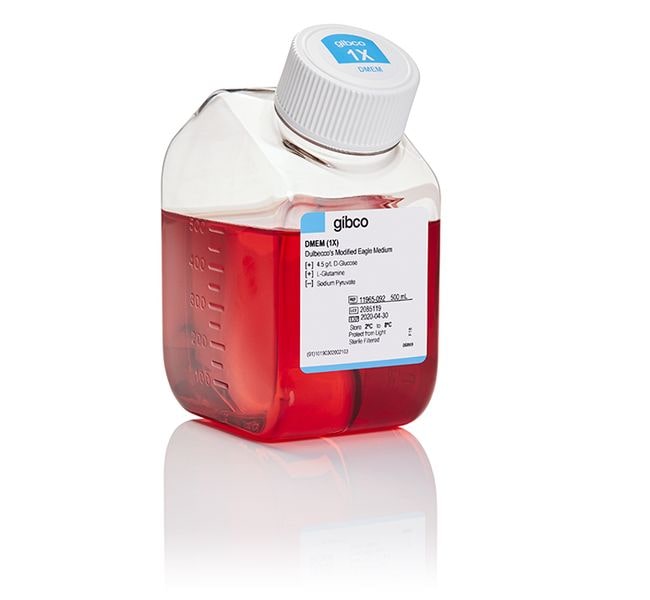
Esta DMEM se ha modificado de la manera siguiente:
| Con | Sin | |
| • Alto contenido en glucosa | • Piruvato sódico | |
| • L-glutamina | • Ácido 4-(2-hidroxietil)piperazin-1-iletanosulfónico (HEPES) | |
| • Rojo de fenol |
Está disponible la formulación completa.
Uso de DMEM
El medio DMEM es único en comparación con otros medios, ya que contiene 4 veces la concentración de aminoácidos y vitaminas del medio esencial mínimo de Eagle. DMEM se formuló originalmente con bajas cantidades de glucosa (1 g/l) y piruvato sódico, pero a menudo se utiliza con niveles de glucosa más altos, y con o sin piruvato sódico. DMEM no contiene proteínas, lípidos ni factores de crecimiento. Por lo tanto, el DMEM requiere suplementación, generalmente con suero fetal bovino (SFB) al 10 %. DMEM utiliza un sistema de tampones de bicarbonato sódico (3,7 g/l) y, por tanto, requiere un ambiente con un 5–10 % de CO2 para mantener el pH fisiológico.
Sistema cGMP de fabricación y calidad
DMEM se elabora en unas instalaciones que cumplen con las buenas prácticas de fabricación actuales ubicadas en Grand Island, Nueva York (EE. UU.). Las instalaciones se han registrado en la Agencia estadounidense de alimentos y medicamentos (FDA) como fabricante de dispositivos médicos y tienen la certificación según la norma ISO 13485. Para la continuidad de la cadena de suministro, Life Technologies ofrece un producto de DMEM idéntico fabricado en nuestra planta de Escocia (41965-039). Estas instalaciones también están registradas en la Agencia estadounidense de alimentos y medicamentos (FDA), calificadas como punto de fabricación de dispositivos médicos y están certificadas según la norma ISO 13485.
Para su uso en investigación o procesos de fabricación posteriores. No apto para uso diagnóstico ni para la administración directa en seres humanos ni en animales.
Especificaciones
Línea de célulasHeLa, 293, Cos-7, and PC-12
Tipo de célulaMammalian Cells
Concentración1X
Entorno de cultivoCO2
Para utilizar con (aplicación)Mammalian Cell Culture
FormatoBottles
Concentración de glucosa4500 mg/L
Calidad de fabricacióncGMP-compliant under the ISO 13485 standard
Línea de productosGibco
Tipo de productoDMEM (Dulbecco's Modified Eagle Medium)
Cantidad10 x 500 mL
Duración de almacenamiento12 Months From Date of Manufacture
Condiciones de envíoTemperatura ambiente
ClasificaciónAnimal Origin-free
Culture TypeMammalian Cell Culture
FormularioLíquido
Serum LevelSuplementos de suero estándar
EsterilidadEstéril con filtro
Sterilization MethodSterile-filtered
Con aditivosHigh Glucose, Glutamine, Phenol Red
Sin aditivosNo HEPES, No Sodium Pyruvate
Unit SizeEach
Contenido y almacenamiento
Condiciones de almacenamiento: De 2 °C a 8 °C (proteger de la luz)
Condiciones de envío: Ambiente
Vida útil: 12 meses a partir de la fecha de fabricación
Condiciones de envío: Ambiente
Vida útil: 12 meses a partir de la fecha de fabricación
Preguntas frecuentes
My cells will not grow in DMEM, what other type of culture media can be used with the Photoreactive Amino Acids?
What is the osmolality of DMEM, high glucose (Cat. No. 11965xxx)?
What is the manganese concentration in DMEM? Do you offer manganese-free DMEM?
How long can I keep my media after supplementing with serum?
My medium was shipped at room temperature but it is supposed to be stored refrigerated. Is it okay?
Citations & References (27)
Citations & References
Abstract
Identification of a novel redox-sensitive gene, Id3, which mediates angiotensin II-induced cell growth.
Journal:Circulation
PubMed ID:12021231
BACKGROUND: Reactive oxygen species, such as superoxide (O(2)(-)), are involved in the abnormal growth of various cell types. Angiotensin II (Ang II) is one of the most potent inducers of oxidative stress in the vasculature. The molecular events involved in Ang II-induced proliferation of vascular smooth muscle cells (VSMCs) are
Human cytomegalovirus-encoded interleukin-10 homolog inhibits maturation of dendritic cells and alters their functionality.
Journal:J Virol
PubMed ID:15280480
Interleukin-10 (IL-10) suppresses the maturation and cytokine production of dendritic cells (DCs), key regulators of adaptive immunity, and prevents the activation and polarization of naïve T cells towards protective gamma interferon-producing effectors. We hypothesized that human cytomegalovirus (HCMV) utilizes its viral IL-10 homolog (cmvIL-10) to attenuate DC functionality, thereby subverting
Protocol to generate human liver spheroids to study liver fibrosis induced by metabolic stress.
Journal:STAR protocols
PubMed ID:38833372
Currently, there is no effective treatment for obesity and alcohol-associated liver diseases, partially due to the lack of translational human models. Here, we present a protocol to generate 3D human liver spheroids that contain all the liver cell types and mimic âlivers in a dish.â We describe strategies to induce
Shedding of the Interleukin-6 (IL-6) Receptor (gp80) Determines the Ability of IL-6 to Induce gp130 Phosphorylation in Human Osteoblasts.
Journal:J Biol Chem
PubMed ID:11884403
'Human osteoblasts produce interleukin-6 (IL-6) and respond to IL-6 in the presence of soluble IL-6 receptor (sIL-6R), but the cell surface expression of IL-6R and the mechanism of sIL-6R production are largely unknown. Three different human osteoblast-like cell lines (MG-63, HOS, and SaOS-2) and bone marrow-derived primary human osteoblasts expressed
Active nuclear import and export pathways regulate E2F-5 subcellular localization.
Journal:J Biol Chem
PubMed ID:12089160
'Epidermal keratinocyte differentiation is accompanied by differential regulation of E2F genes, including up-regulation of E2F-5 and its concomitant association with the retinoblastoma family protein p130. This complex appears to play a role in irreversible withdrawal from the cell cycle in differentiating keratinocytes. We now report that keratinocyte differentiation is also