Search

Gibco™
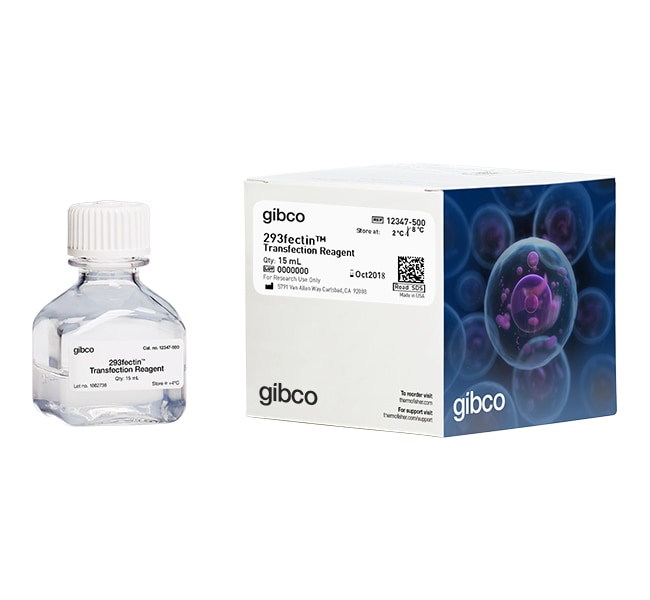
Reactivo de transfección 293fectin™
293fectin™ Transfection Reagent is a proprietary, cationic lipid-based formulation for transfecting DNA into eukaryotic cells.
Have Questions?
Cambiar vista

| Número de catálogo | Cantidad |
|---|---|
| 12347500 también denominado 12347-500 | 15 mL |
| 12347019 | 1 ml |
| 12347750 también denominado 12347-750 | 10 x 15 ml |
Número de catálogo 12347500
también denominado 12347-500
Precio (MXN)
-
Cantidad:
15 mL
El reactivo de transfección 293fectin™ es una formulación exclusiva basada en lípidos catiónicos para la transfección de ADN a células eucariotas. Este reactivo está optimizado para la transfección de células renales embrionarias humanas 293 de suspensión (p. ej., células FreeStyle™ 293-F, n.° de cat. R790-07) en el medio de expresión definido y sin suero FreeStyle™ 293 (n.° de cat. 12338-018) y está pensado para usarse con el sistema de expresión FreeStyle™ 293 (n.° K9000-01). El reactivo de transfección 293fectin™ ofrece las siguientes ventajas:
• Demuestra una alta eficacia de transfección en células 293 de suspensión y también es adecuado para la transfección de células 293 adherentes
• Las células de suspensión FreeStyle™ 293-F pueden transfectarse en el medio de expresión FreeStyle™ 293; no se requiere cambio de medio.
• Los complejos del reactivo 293fectin™ se añaden directamente a las células del medio de cultivo
• No es necesario quitar complejos, ni cambiar o agregar medios después de la transfección
• Demuestra una alta eficacia de transfección en células 293 de suspensión y también es adecuado para la transfección de células 293 adherentes
• Las células de suspensión FreeStyle™ 293-F pueden transfectarse en el medio de expresión FreeStyle™ 293; no se requiere cambio de medio.
• Los complejos del reactivo 293fectin™ se añaden directamente a las células del medio de cultivo
• No es necesario quitar complejos, ni cambiar o agregar medios después de la transfección
Para uso exclusivo en investigación. No apto para uso en procedimientos diagnósticos.
Especificaciones
Para utilizar con (aplicación)Transfección
Compatibilidad de alto rendimientoNo compatible con alto rendimiento (manual)
Línea de productos293fectin
Tipo de productoReactivos para transfección
Cantidad15 mL
Compatible con sueroSí
Tipo de célulaLíneas de células establecidas
FormatoTubo
Tipo de muestraADN plasmídico
Transfection TechniqueTransfección basada en lípidos
Unit SizeEach
Contenido y almacenamiento
Cada unidad contiene un vial de reactivo. Almacenar a +4 °C. Se garantiza que 293fectin™ permanece estable durante 6 meses cuando se almacena correctamente.