Search

Invitrogen™
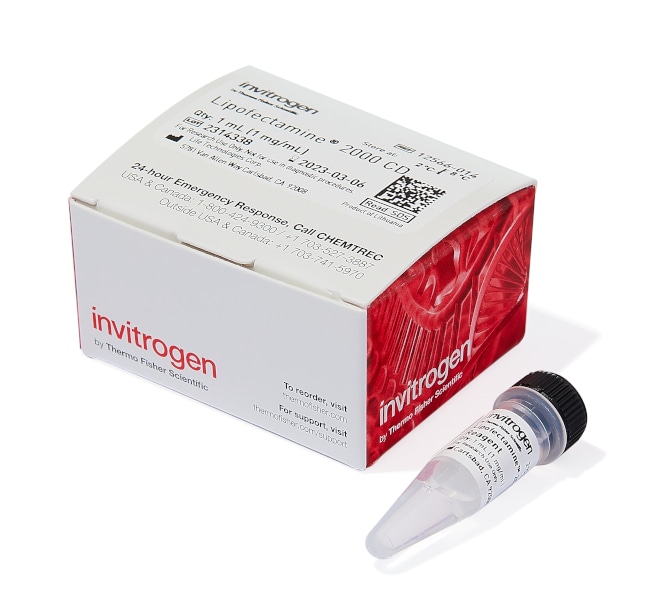
Lipofectamine™ 2000 CD Transfection Reagent
El reactivo de transfección (definido químicamente) Lipofectamine™ 2000 CD es una formulación patentada libre de origen animal para transfectar ácidosMás información
| Número de catálogo | Cantidad |
|---|---|
| 12566014 | 1 ml |
Número de catálogo 12566014
Precio (MXN)
-
Cantidad:
1 ml
El reactivo de transfección (definido químicamente) Lipofectamine™ 2000 CD es una formulación patentada libre de origen animal para transfectar ácidos nucleicos en células eucariotas. La utilización del reactivo Lipofectamine™ 2000 CD para la transfección proporciona las siguientes ventajas:
• La más alta eficacia de transfección en muchos tipos y formatos de células.
• La formulación libre de origen animal garantiza que los cultivos de células de mamíferos y los procesos de bioproducción estén libres de materiales de origen animal.
• Los complejos de ADN-Lipofectamine™ 2000 CD se pueden añadir directamente a las células del medio de cultivo.
• No es necesario extraer complejos ni cambiar o añadir el medio después de la transfección, pero los complejos pueden eliminarse pasadas entre cuatro y seis horas.
• La más alta eficacia de transfección en muchos tipos y formatos de células.
• La formulación libre de origen animal garantiza que los cultivos de células de mamíferos y los procesos de bioproducción estén libres de materiales de origen animal.
• Los complejos de ADN-Lipofectamine™ 2000 CD se pueden añadir directamente a las células del medio de cultivo.
• No es necesario extraer complejos ni cambiar o añadir el medio después de la transfección, pero los complejos pueden eliminarse pasadas entre cuatro y seis horas.
Para uso exclusivo en investigación. No apto para uso en procedimientos diagnósticos.
Especificaciones
ClasificaciónLibre de material de origen animal, definido químicamente
Para utilizar con (aplicación)Transfección
Compatibilidad de alto rendimientoNo compatible con alto rendimiento (manual)
Línea de productosLipofectamine
Tipo de productoReactivos para transfección
Cantidad1 ml
Compatible con sueroSí
Condiciones de envíoHielo húmedo
Tipo de célulaLíneas de células establecidas
Tipo de muestraADN plasmídico
Transfection TechniqueTransfección basada en lípidos
Unit SizeEach
Contenido y almacenamiento
Cada reactivo debe almacenarse a entre 2 y 8 °C tras la recepción. Se garantiza la estabilidad de los reactivos durante seis meses si se almacenan adecuadamente.