Search


Citas y referencias (10)
Gibco™
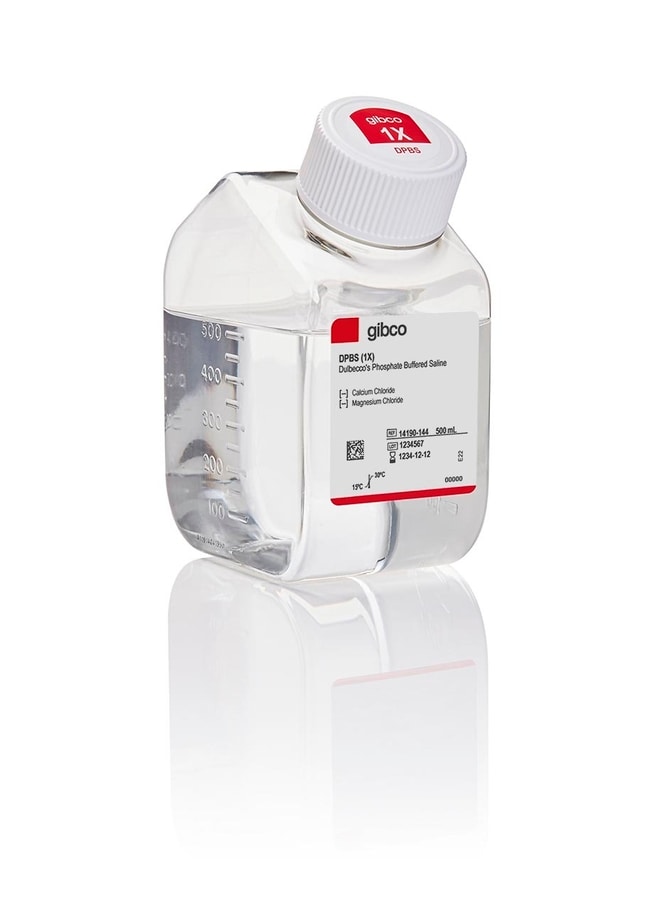
DPBS, sin calcio, sin magnesio
La solución salina tamponada con fosfato de Dulbecco (DPBS) es una solución salina equilibrada utilizada para diversas aplicaciones de cultivosMás información
Have Questions?
Cambiar vista

| Número de catálogo | Cantidad | Envase |
|---|---|---|
| 14190144 | 500 mL | Frasco |
| 14190185 también denominado 14190-185 | 20 mL x 100 mL | Frasco |
| 14190094 también denominado 14190-094 | 500 mL | Frasco |
| 14190250 | 10 x 500 mL | Frasco |
| 14190169 también denominado 14190-169 | 10 x 500 mL | Frasco |
| 14190136 | 1000 mL | Frasco |
| 14190235 | 6 x 1000 mL | Frasco |
| 14190342 | 5 L | Bolsa |
| 14190359 | 10 L | Bolsa |
| 14190367 | 20 L | Bolsa |
Número de catálogo 14190144
Precio (MXN)
-
Cantidad:
500 mL
Envase:
Frasco
La solución salina tamponada con fosfato de Dulbecco (DPBS) es una solución salina equilibrada utilizada para diversas aplicaciones de cultivos celulares, tales como el lavado de células antes de la disociación, el transporte de muestras de células o tejidos, la dilución de células para el recuento y la preparación de reactivos. Las formulaciones sin calcio ni magnesio para enjuagar los quelantes del cultivo antes de la disociación celular.
Ofrecemos una gran variedad de formulaciones DPBS Gibco™ para una amplia gama de aplicaciones de cultivos celulares.
La formulación completa está disponible.
Sistema cGMP de fabricación y calidad
La solución DPBS Gibco™ se fabrica en unas instalaciones, conformes con cGMP, ubicadas en Grand Island, Nueva York. Las instalaciones se han registrado en la Agencia estadounidense de alimentos y medicamentos (FDA) como fabricante de dispositivos médicos y tienen la certificación según la norma ISO 13485. Para la continuidad de la cadena de suministro, ofrecemos un producto Gibco™ DPBS idéntico realizado en nuestras instalaciones de Escocia (14190-240). Estas instalaciones también están registradas en la Agencia estadounidense de alimentos y medicamentos (FDA), calificadas como punto de fabricación de dispositivos médicos y están certificadas según la norma ISO 13485.
Ofrecemos una gran variedad de formulaciones DPBS Gibco™ para una amplia gama de aplicaciones de cultivos celulares.
Este DPBS se ha modificado de la siguiente manera:
| Sin |
| • Calcio |
| • Magnesio |
| • Rojo de fenol |
La formulación completa está disponible.
Sistema cGMP de fabricación y calidad
La solución DPBS Gibco™ se fabrica en unas instalaciones, conformes con cGMP, ubicadas en Grand Island, Nueva York. Las instalaciones se han registrado en la Agencia estadounidense de alimentos y medicamentos (FDA) como fabricante de dispositivos médicos y tienen la certificación según la norma ISO 13485. Para la continuidad de la cadena de suministro, ofrecemos un producto Gibco™ DPBS idéntico realizado en nuestras instalaciones de Escocia (14190-240). Estas instalaciones también están registradas en la Agencia estadounidense de alimentos y medicamentos (FDA), calificadas como punto de fabricación de dispositivos médicos y están certificadas según la norma ISO 13485.
Para su uso en investigación o procesos de fabricación posteriores. No apto para uso diagnóstico ni para la administración directa en seres humanos ni en animales.
Especificaciones
Nombre del producto químico o materialSolución salina tamponada con fosfato de Dulbecco (DPBS)
ColorTransparente
IncluyeSin piruvato sódico
Calidad de fabricacióncGMP-compliant under the ISO 13485 standard
Osmolalidad270 - 300 mOsm/kg
EnvaseFrasco
Almacenamiento recomendadoCondiciones de almacenamiento: De 15 ° a 30 °C, Condiciones de envío: Temperatura ambiente, Vida útil: 36 meses a partir de la fecha de fabricación
EsterilidadEstéril con filtro
Método de esterilizaciónSterile-filtered
Concentración1X
Para utilizar con (aplicación)Cultivo de células de mamíferos
GradoCell Culture
Forma físicaLíquido
Línea de productosGibco
Cantidad500 mL
Tipo de soluciónSolución salina tamponada con fosfato de Dulbecco
pHentre 7,0 y 7,3
Unit SizeEach
Preguntas frecuentes
What procedures are recommended for the preparation of beta amyloid-containing samples?
What is the shelf life of DPBS after it has been opened?
What is the shelf life of DPBS (Cat. No. 14190136)?
Does Diploid Growth Serum-Reduced Medium (SRM) contain L-glutamine?
Do I have to adjust my infection parameters when using Diploid Production Serum-Free Medium (SFM)?
Citations & References (10)
Citations & References
Abstract
Efficient intracellular assembly of papillomaviral vectors.
Journal:J Virol
PubMed ID:14694107
Although the papillomavirus structural proteins, L1 and L2, can spontaneously coassemble to form virus-like particles, currently available methods for production of L1/L2 particles capable of transducing reporter plasmids into mammalian cells are technically demanding and relatively low-yield. In this report, we describe a simple 293 cell transfection method for efficient
Macrophage foam cell formation with native low density lipoprotein.
Journal:J Biol Chem
PubMed ID:12118008
'This investigation has elucidated a mechanism for development of macrophage foam cells when macrophages are incubated with native low density lipoprotein (LDL). LDL is believed to be the main source of cholesterol that accumulates in monocyte-derived macrophages within atherosclerotic plaques, but native LDL has not previously been shown to cause
Effects of an indole derivative on cell proliferation, transfection, and alternative splicing in production of lentiviral vectors by transient co-transfection.
Journal:PloS one
PubMed ID:38833479
Lentiviral vectors derived from human immunodeficiency virus type I are widely used to deliver functional gene copies to mammalian cells for research and gene therapies. Post-transcriptional splicing of lentiviral vector transgene in transduced host and transfected producer cells presents barriers to widespread application of lentiviral vector-based therapies. The present study
Microfluidic single-cell real-time PCR for comparative analysis of gene expression patterns.
Journal:Nat Protoc
PubMed ID:22481529
'Single-cell quantitative real-time PCR (qRT-PCR) combined with high-throughput arrays allows the analysis of gene expression profiles at a molecular level in approximately 11 h after cell sample collection. We present here a high-content microfluidic real-time platform as a powerful tool for comparatively investigating the regulation of developmental processes in single
A comparison between different human hepatocyte models reveals profound differences in net glucose production, lipid composition and metabolism in vitro.
Journal:Experimental cell research
PubMed ID:38499143