Search


Citas y referencias (20)
Invitrogen™
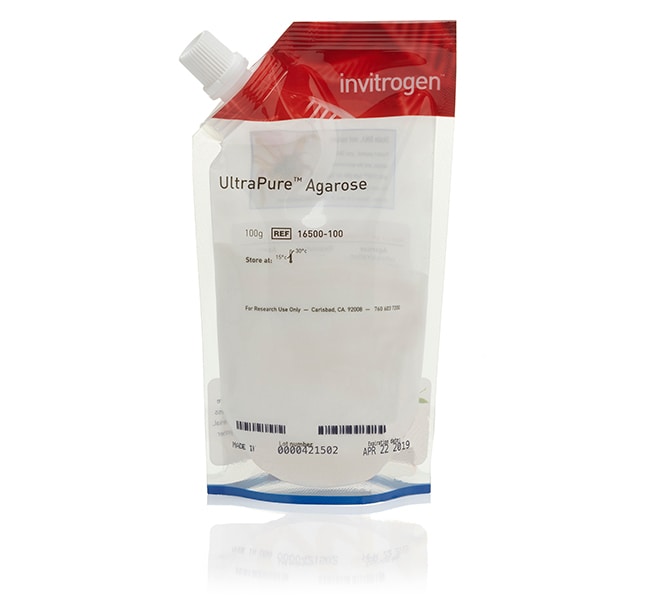
Agarosa UltraPure™
La agarosa UltraPure™ es un polisacárido utilizado para la separación basada en el tamaño de ácidos nucleicos en aplicaciones deMás información
Have Questions?
Cambiar vista

| Número de catálogo | Cantidad |
|---|---|
| 16500100 | 100 g |
| 16500500 | 500 g |
Número de catálogo 16500100
Precio (MXN)
6,224.04
Each
Cantidad:
100 g
Precio (MXN)
6,224.04
Each
La agarosa UltraPure™ es un polisacárido utilizado para la separación basada en el tamaño de ácidos nucleicos en aplicaciones de electroforesis en gel de agarosa. La agarosa UltraPure™ es ideal para resolver fragmentos de ADN y ARN de 100 bp a > 30 kb. Características de la agarosa UltraPure™:
• Ideal para el análisis y la recuperación de ADN y ARN para aplicaciones rutinarias
• Fuerte estructura de gel que permite una mejor manipulación y menos roturas
• Se puede utilizar en aplicaciones de electroforesis de proteínas, como pruebas de Ouchterlony (ensayo de interacción antígeno-anticuerpo) y de inmunodifusión radial (RID) (ensayo de cuantificación de antígenos)
Embalaje mejorado
El nuevo embalaje respetuoso con el medio ambiente utiliza un 75 % menos de plástico que los frascos originales. Por lo tanto, se emplean menos materias primas y energía en la fabricación, y se generan menos residuos. Además, la boquilla de fácil uso reduce la probabilidad de que se produzcan derrames y contaminación.
Pruebas de rendimiento y calidad
El rendimiento de la agarosa UltraPure™ se evalúa para satisfacer las especificaciones establecidas en apariencia, humedad, resistencia del gel, temperatura de gelificación, temperatura de fusión, contenido de sulfato, electroendósmosis y actividad de la DNasa/RNasa.
• Ideal para el análisis y la recuperación de ADN y ARN para aplicaciones rutinarias
• Fuerte estructura de gel que permite una mejor manipulación y menos roturas
• Se puede utilizar en aplicaciones de electroforesis de proteínas, como pruebas de Ouchterlony (ensayo de interacción antígeno-anticuerpo) y de inmunodifusión radial (RID) (ensayo de cuantificación de antígenos)
Embalaje mejorado
El nuevo embalaje respetuoso con el medio ambiente utiliza un 75 % menos de plástico que los frascos originales. Por lo tanto, se emplean menos materias primas y energía en la fabricación, y se generan menos residuos. Además, la boquilla de fácil uso reduce la probabilidad de que se produzcan derrames y contaminación.
Pruebas de rendimiento y calidad
El rendimiento de la agarosa UltraPure™ se evalúa para satisfacer las especificaciones establecidas en apariencia, humedad, resistencia del gel, temperatura de gelificación, temperatura de fusión, contenido de sulfato, electroendósmosis y actividad de la DNasa/RNasa.
Para uso exclusivo en investigación. No apto para uso en procedimientos diagnósticos.
Especificaciones
Para utilizar con (aplicación)Electroforesis en gel
FormularioPolvo
Compatibilidad del gelGeles de agarosa
Punto de fusiónPunto de fusión estándar
Cantidad100 g
Condiciones de envíoTemperatura ambiente
Línea de productosUltrapuro
Tipo de productoAgarosa
Intervalo de separación100 bp a >30 kb
Unit SizeEach
Contenido y almacenamiento
Contenido: 1 bolsa contiene 100 g de agarosa UltraPure™
Almacenamiento: 15°C a 30°C
Almacenamiento: 15°C a 30°C
Preguntas frecuentes
I want to pour my own gels. Which agarose should I use?
Citations & References (20)
Citations & References
Abstract
Proteomic analysis reveals presence of platelet microparticles in endothelial progenitor cell cultures.
Journal:Blood
PubMed ID:19369228
'The concept of endothelial progenitor cells (EPCs) has attracted considerable interest in cardiovascular research, but despite a decade of research there are still no specific markers for EPCs and results from clinical trials remain controversial. Using liquid chromatography-tandem mass spectrometry, we analyzed the protein composition of microparticles (MPs) originating from
A phantom for diffusion-weighted MRI (DW-MRI).
Journal:J Magn Reson Imaging
PubMed ID:23576443
'PURPOSE: To develop tissue-equivalent diffusivity materials and build a spherical diffusion phantom which mimics the conditions typically found in biological tissues. Also, to assess the reproducibility of ADC measurements from a whole-body diffusion protocol. MATERIALS AND METHODS: Nickel-doped agarose/sucrose gels were manufactured and used to build a spherical diffusion phantom
Determinants of nucleosome organization in primary human cells.
Journal:Nature
PubMed ID:21602827
'Nucleosomes are the basic packaging units of chromatin, modulating accessibility of regulatory proteins to DNA and thus influencing eukaryotic gene regulation. Elaborate chromatin remodelling mechanisms have evolved that govern nucleosome organization at promoters, regulatory elements, and other functional regions in the genome. Analyses of chromatin landscape have uncovered a variety
Controlling cell position in complex heterotypic 3D microtissues by tissue fusion.
Journal:Biotechnol Bioeng
PubMed ID:19012266
'Tissue fusion and cell sorting are processes fundamental to developmental biology with applications in tissue engineering. We have designed a fusion assay to investigate the factors governing the fusion of microtissues and the cell sorting that occurs after fusion. Normal human fibroblast (NHF) spheroids were self-assembled and cultured for 1,
Host alternation of chikungunya virus increases fitness while restricting population diversity and adaptability to novel selective pressures.
Journal:J Virol
PubMed ID:21047966
'The mechanisms by which RNA arboviruses, including chikungunya virus (CHIKV), evolve and maintain the ability to infect vertebrate and invertebrate hosts are poorly understood. To understand how host specificity shapes arbovirus populations, we studied CHIKV populations passaged alternately between invertebrate and vertebrate cells (invertebrate ? vertebrate) to simulate natural alternation