Search


Citas y referencias (2)
Gibco™
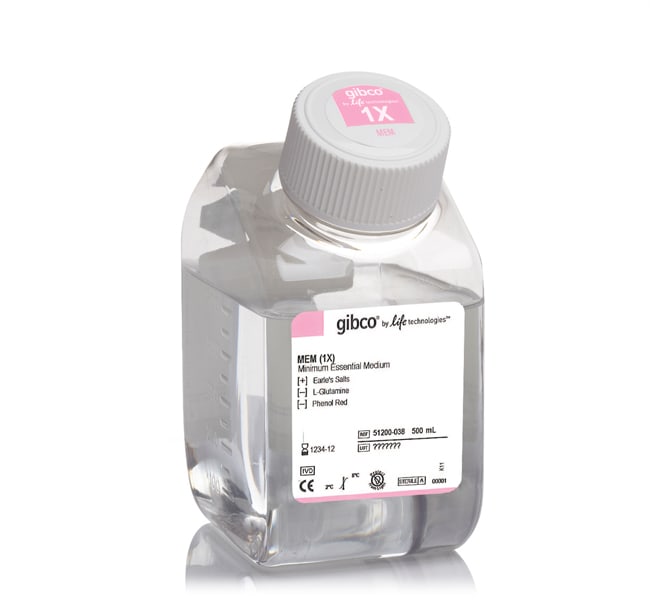
MEM, sin glutamina, sin rojo fenol
El MEM (medio esencial mínimo) es uno de los medios de cultivo celular más utilizados. El MEM se puede usarMás información
| Número de catálogo | Cantidad |
|---|---|
| 51200038 | 500 mL |
Número de catálogo 51200038
Precio (MXN)
-
Cantidad:
500 mL
El MEM (medio esencial mínimo) es uno de los medios de cultivo celular más utilizados. El MEM se puede usar con diversas células de mamíferos adherentes o en suspensión, como HeLa, BHK-21, 293, HEP-2, HT-1080, MCF-7, fibroblastos y astrocitos de rata primarios. Ofrecemos una variedad de modificaciones de MEM para diversas aplicaciones de cultivos celulares. Busque la formulación adecuada mediante la herramienta de selección de medios.
Este MEM se ha modificado de la manera siguiente:
Está disponible la formulación completa.
Uso del MEM
El MEM lo desarrolló Harry Eagle, que se basó en su formulación anterior de medio basal Eagle (MEB). Posteriormente, se han producido numerosas modificaciones del MEM, como el MEM de Glasgow, el MEM α, el DMEM y la modificación de Temin.’’ El MEM está disponible con sales de Earle para usar con una incubadora de CO2 o con sales de Hanks para usar sin CO2. Este producto se ha formulado con sales de Earle.’ MEM no contiene proteínas, lípidos ni factores de crecimiento. Por lo tanto, el MEM requiere suplementación, por lo general con un 10 % de suero fetal bovino (SFB). MEM utiliza un sistema de tampones de bicarbonato sódico (2,2 g/l) y, por tanto, requiere un ambiente con un 5–10 % de CO2 para mantener el pH fisiológico.
Sistema cGMP de fabricación y calidad
MEM se fabrica en unas instalaciones que cumplen con las buenas prácticas de fabricación actuales ubicadas en Grand Island, Nueva York (EE. UU.). Las instalaciones se han registrado en la Agencia estadounidense de alimentos y medicamentos (FDA) como fabricante de dispositivos médicos y tienen la certificación según la norma ISO 13485. Para la continuidad de la cadena de suministro, ofrecemos un producto MEM idéntico fabricado en nuestras instalaciones de Escocia (51200-046). Estas instalaciones también están registradas en la Agencia estadounidense de alimentos y medicamentos (FDA), calificadas como punto de fabricación de dispositivos médicos y están certificadas según la norma ISO 13485.
Este MEM se ha modificado de la manera siguiente:
| Sin |
| • L-glutamina |
| • Ácido 4-(2-hidroxietil)piperazin-1-iletanosulfónico (HEPES) |
| • Rojo de fenol |
Está disponible la formulación completa.
Uso del MEM
El MEM lo desarrolló Harry Eagle, que se basó en su formulación anterior de medio basal Eagle (MEB). Posteriormente, se han producido numerosas modificaciones del MEM, como el MEM de Glasgow, el MEM α, el DMEM y la modificación de Temin.’’ El MEM está disponible con sales de Earle para usar con una incubadora de CO2 o con sales de Hanks para usar sin CO2. Este producto se ha formulado con sales de Earle.’ MEM no contiene proteínas, lípidos ni factores de crecimiento. Por lo tanto, el MEM requiere suplementación, por lo general con un 10 % de suero fetal bovino (SFB). MEM utiliza un sistema de tampones de bicarbonato sódico (2,2 g/l) y, por tanto, requiere un ambiente con un 5–10 % de CO2 para mantener el pH fisiológico.
Sistema cGMP de fabricación y calidad
MEM se fabrica en unas instalaciones que cumplen con las buenas prácticas de fabricación actuales ubicadas en Grand Island, Nueva York (EE. UU.). Las instalaciones se han registrado en la Agencia estadounidense de alimentos y medicamentos (FDA) como fabricante de dispositivos médicos y tienen la certificación según la norma ISO 13485. Para la continuidad de la cadena de suministro, ofrecemos un producto MEM idéntico fabricado en nuestras instalaciones de Escocia (51200-046). Estas instalaciones también están registradas en la Agencia estadounidense de alimentos y medicamentos (FDA), calificadas como punto de fabricación de dispositivos médicos y están certificadas según la norma ISO 13485.
Para su uso en investigación o procesos de fabricación posteriores. No apto para uso diagnóstico ni para la administración directa en seres humanos ni en animales.
Especificaciones
Línea de célulasHeLa, BHK-21, 293, HEP-2, HT-1080, MCF-7 y fibroblastos
Tipo de célulaAstrocitos de rata primarios
Concentración1 X
Calidad de fabricacióncGMP-compliant under the ISO 13485 standard
Línea de productosGibco
Tipo de productoMEM (medio esencial mínimo)
Cantidad500 mL
Duración de almacenamiento12 meses a partir de la fecha de fabricación
Condiciones de envíoTemperatura ambiente
ClasificaciónLibre de material de origen animal
FormularioLíquido
Serum LevelSuplementos de suero estándar
EsterilidadEstéril con filtro
Con aditivosBajo nivel de glucosa
Sin aditivosSin glutamina, Sin HEPES, Sin rojo fenol, Sin piruvato sódico
Unit SizeEach
Contenido y almacenamiento
Condiciones de almacenamiento: De 2 a 8 °C. Proteger de la luz
Condiciones de envío: Ambiente
Vida útil: 12 meses a partir de la fecha de fabricación
Condiciones de envío: Ambiente
Vida útil: 12 meses a partir de la fecha de fabricación
Preguntas frecuentes
Where can I find the osmolality for MEM Medium?
I understand that some media are worse than others for fluorescence imaging. How do I choose?
Should I be concerned about phenol red in my media when labeling my live cells with fluorescent dyes?
How long can I keep my media after supplementing with serum?
My medium was shipped at room temperature but it is supposed to be stored refrigerated. Is it okay?
Citations & References (2)
Citations & References
Abstract
Astrocytes in culture produce anandamide and other acylethanolamides.
Journal:J Biol Chem
PubMed ID:11916961
'Anandamide (arachidonylethanolamide) is an endocannabinoid that belongs to the acylethanolamide lipid family. It is produced by neurons in a calcium-dependent manner and acts through cannabinoid CB1 receptors. Other members of the acylethanolamide lipid family are also produced by neurons and act through G-protein-coupled receptors: homo-gamma-linolenylethanolamide (HEA) and docosatetraenylethanolamide (DEA) act
Contact and encirclement of glioma cells in vitro is an intrinsic behavior of a clonal human neural stem cell line.
Journal:PLoS One
PubMed ID:23240066
Pathotropic neural stem and/or progenitor cells (NSCs) can potentially deliver therapeutic agents to otherwise inaccessible cancers. In glioma, NSCs are found in close contact with tumor cells, raising the possibility that specificity of NSC contact with glioma targets originates in the tumor cells themselves. Alternatively, target preferences may originate, at