Search


Citas y referencias (3)
Thermo Scientific™
Kit de fraccionamiento subcelular de proteínas para tejido
El kit de fraccionamiento subcelular de proteínas para tejido Thermo Scientific incluye todos los reactivos y tamices de tejido necesariosMás información
| Número de catálogo | Cantidad |
|---|---|
| 87790 | 1 kit |
Número de catálogo 87790
Precio (MXN)
-
Cantidad:
1 kit
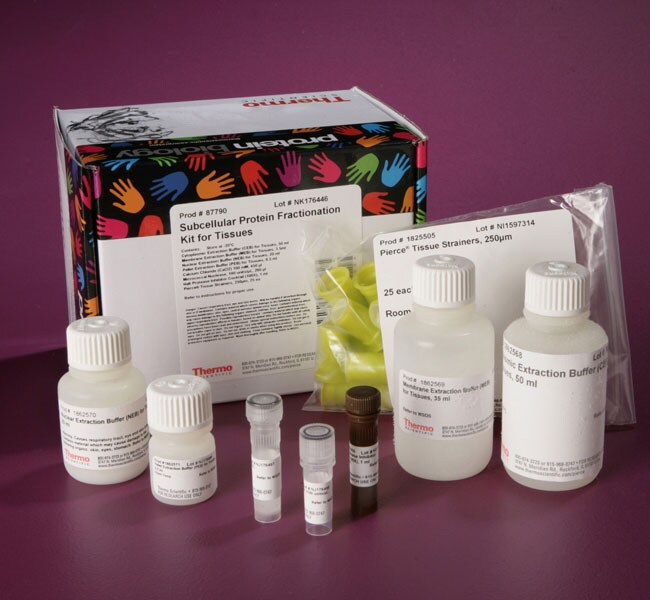
El kit de fraccionamiento subcelular de proteínas para tejido Thermo Scientific incluye todos los reactivos y tamices de tejido necesarios para realizar un fraccionamiento celular y enriquecimiento de proteínas de cinco diferentes compartimentos celulares en 2 horas.
Características del kit de fraccionamiento subcelular de proteínas para tejido:
• Optimizado: formulaciones y protocolos específicos para el fraccionamiento de tejidos
• Completo: obtenga fracciones de proteínas citoesqueléticas, unidas a cromatina, nucleares solubles, de membrana y citoplasmáticas a partir de un solo kit
• Eficaz: extracción de fracciones de proteínas sin ultracentrifugación en aproximadamente 2 horas
• Cómodo: tamiz celular único que permite una rápida eliminación de residuos de tejido
• Compatible: utilice extractos para aplicaciones posteriores, como ensayos de proteínas, inmunotransferencias (Western blotting), ensayos electroforéticos de cambio de movilidad y ensayos de genes indicadores y de actividad enzimática.
• Versátil: extrae proteíonas de una variedad de tipos de tejidos, incluidos hígado, corazón, cerebro, riñón, pulmón y bazo
Aplicaciones:
• Obtenga proteínas citoplasmáticas, nucleares solubles, ligadas a la cromatina, de membrana y citoesqueléticas a partir de la misma muestra de tejido
• Perfil del estado de la enfermedad frente a tejidos normales para proteínas del citoplasma, núcleo, membrana y citoesqueleto; estudio de la translocación de proteínas en los tejidos
• Estudio de la translocación de proteínas en los tejidos
El kit de fraccionamiento subcelular de proteínas para tejido incluye un tamiz de tejido único de 250 µm para facilitar la rápida separación de la suspensión de células de los residuos de tejido tras la homegeneización. Los reactivos optimizados permiten la posterior extracción gradual de proteínas citoplasmáticas, de membrana, solubles en energía nuclear, ligadas a la cromatina y citoesqueléticas de las células recuperadas con menos del 15 % de contaminación cruzada.
El kit de fraccionamiento subcelular de proteínas para tejido contiene cuatro tampones de extracción, tamices de tejido, una nucleasa estabilizadora y el cóctel inhibidor de proteasas Halt Thermo Scientific. Cada kit tiene suficientes reactivos y tamices de tejido para procesar y fraccionar 25 muestras de tejido de hasta 200 mg cada una. El tejido se homogeniza en el primer reactivo, lo que provoca una permeabilidad selectiva de la membrana, liberando contenido citoplasmático soluble. Este homogeneizado se transfiere a un filtro de tejido para eliminar el exceso de residuos de tejido. El segundo reactivo disuelve las membranas de ER-golgi, mitocondrias y plasma, pero no solubiliza las membranas nucleares. Tras recuperar por centrifugación los núcleos intactos, un tercer reactivo produce el extracto nuclear soluble. Se realiza una extracción nuclear adicional con nucleasas de micrococos para liberar las proteínas nucleares unidas a cromatina. El sedimento no soluble recuperado se extrae con el reactivo final para aislar las proteínas citoesqueléticas.
Más datos del producto
• Fraccionamiento subcelular de proteínas para muestras de tejido
Productos relacionados
Kit de fraccionamiento subcelular para células cultivadas
Características del kit de fraccionamiento subcelular de proteínas para tejido:
• Optimizado: formulaciones y protocolos específicos para el fraccionamiento de tejidos
• Completo: obtenga fracciones de proteínas citoesqueléticas, unidas a cromatina, nucleares solubles, de membrana y citoplasmáticas a partir de un solo kit
• Eficaz: extracción de fracciones de proteínas sin ultracentrifugación en aproximadamente 2 horas
• Cómodo: tamiz celular único que permite una rápida eliminación de residuos de tejido
• Compatible: utilice extractos para aplicaciones posteriores, como ensayos de proteínas, inmunotransferencias (Western blotting), ensayos electroforéticos de cambio de movilidad y ensayos de genes indicadores y de actividad enzimática.
• Versátil: extrae proteíonas de una variedad de tipos de tejidos, incluidos hígado, corazón, cerebro, riñón, pulmón y bazo
Aplicaciones:
• Obtenga proteínas citoplasmáticas, nucleares solubles, ligadas a la cromatina, de membrana y citoesqueléticas a partir de la misma muestra de tejido
• Perfil del estado de la enfermedad frente a tejidos normales para proteínas del citoplasma, núcleo, membrana y citoesqueleto; estudio de la translocación de proteínas en los tejidos
• Estudio de la translocación de proteínas en los tejidos
El kit de fraccionamiento subcelular de proteínas para tejido incluye un tamiz de tejido único de 250 µm para facilitar la rápida separación de la suspensión de células de los residuos de tejido tras la homegeneización. Los reactivos optimizados permiten la posterior extracción gradual de proteínas citoplasmáticas, de membrana, solubles en energía nuclear, ligadas a la cromatina y citoesqueléticas de las células recuperadas con menos del 15 % de contaminación cruzada.
El kit de fraccionamiento subcelular de proteínas para tejido contiene cuatro tampones de extracción, tamices de tejido, una nucleasa estabilizadora y el cóctel inhibidor de proteasas Halt Thermo Scientific. Cada kit tiene suficientes reactivos y tamices de tejido para procesar y fraccionar 25 muestras de tejido de hasta 200 mg cada una. El tejido se homogeniza en el primer reactivo, lo que provoca una permeabilidad selectiva de la membrana, liberando contenido citoplasmático soluble. Este homogeneizado se transfiere a un filtro de tejido para eliminar el exceso de residuos de tejido. El segundo reactivo disuelve las membranas de ER-golgi, mitocondrias y plasma, pero no solubiliza las membranas nucleares. Tras recuperar por centrifugación los núcleos intactos, un tercer reactivo produce el extracto nuclear soluble. Se realiza una extracción nuclear adicional con nucleasas de micrococos para liberar las proteínas nucleares unidas a cromatina. El sedimento no soluble recuperado se extrae con el reactivo final para aislar las proteínas citoesqueléticas.
Más datos del producto
• Fraccionamiento subcelular de proteínas para muestras de tejido
Productos relacionados
Kit de fraccionamiento subcelular para células cultivadas
For Research Use Only. Not for use in diagnostic procedures.
Especificaciones
TampónTampón de extracción de tejidos, tampón de lisis
Cantidad1 kit
Tipo de reactivoTampón de extracción de tejidos, solución detergente, tampón de lisis celular, fraccionamiento subcelular
Suficiente para25 muestras
FormularioLíquido
Tipo de productoKit de fraccionamiento de proteínas subcelulares
Unit SizeEach
Contenido y almacenamiento
Upon receipt store kit at -20°C or store individual components as indicated above. Kit is shipped with dry ice.
Preguntas frecuentes
Can you provide the shelf-life for the Subcellular Protein Fractionation Kit for Tissues?
What kits do you offer for cell fractionation?
Why is cell fractionation important?
Citations & References (3)
Citations & References
Abstract
Global subcellular characterization of protein degradation using quantitative proteomics.
Journal:Mol Cell Proteomics
PubMed ID:23242552
'Protein degradation provides an important regulatory mechanism used to control cell cycle progression and many other cellular pathways. To comprehensively analyze the spatial control of protein degradation in U2OS osteosarcoma cells, we have combined drug treatment and SILAC-based quantitative mass spectrometry with subcellular and protein fractionation. The resulting data set
ApoB-100-containing lipoproteins are major carriers of 3-iodothyronamine in circulation.
Journal:J Biol Chem
PubMed ID:22128163
3-Iodothyronamine (T(1)AM) is a biogenic amine derivative of thyroid hormone present in tissue and blood of vertebrates. Approximately 99% of the circulating thyroid hormones are bound to plasma proteins, including three major thyroid hormone-binding proteins, and the question arises as to whether circulating T(1)AM is also bound to serum factors.
Long term potentiation is impaired in membrane glycoprotein CD200-deficient mice: a role for Toll-like receptor activation.
Journal:J Biol Chem
PubMed ID:21835925
The membrane glycoprotein CD200 is expressed on several cell types, including neurons, whereas expression of its receptor, CD200R, is restricted principally to cells of the myeloid lineage, including microglia. The interaction between CD200 and CD200R maintains microglia and macrophages in a quiescent state; therefore, CD200-deficient mice express an inflammatory phenotype