Search



Thermo Scientific™
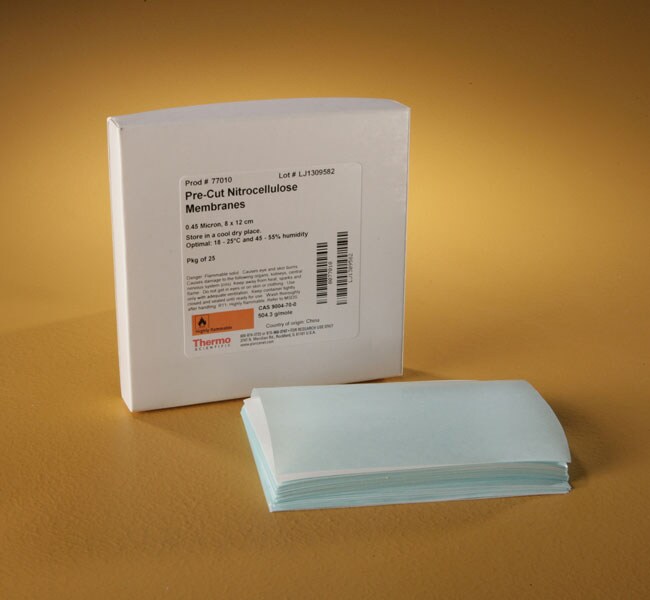
Nitrocellulose Membranes, 0.45 μm
Nitrocellulose is a popular binding matrix for western blotting because of its high affinity for proteins and compatibility with a variety of detection methods (western blotting, dot-blot assays, and other protein or nucleic acid methods).
Have Questions?
Cambiar vista

| Número de catálogo | Dimensions (LxW) | Formato | Suficiente para |
|---|---|---|---|
| 88014 | 7,9 cm x 10,5 cm | Hoja | 15 transferencias de minigel |
| 88025 | 8 x 8 cm | Hoja | 15 transferencias de minigel |
| 77010 | 8 cm x 12 cm | Hoja | 25 transferencias de minigel |
| 88018 | 30 cm x 3,5 m | Rollo | Al menos 120 transferencias de minigel cuando se corta a 8 x 10 cm |
Número de catálogo 88014
Precio (MXN)
-
Dimensions (LxW):
7,9 cm x 10,5 cm
Formato:
Hoja
Suficiente para:
15 transferencias de minigel
Nitrocellulose is a popular binding matrix for western blotting because of its high affinity for proteins and compatibility with a variety of detection methods (western blotting, dot-blot assays, and other protein or nucleic acid methods). The 0.45-μm pore size is well-suited for a wide range of western blotting conditions and ideal for the transfer of most proteins (>20 kDa) and nucleic acids (>300 bp).
Features include:
• 100% pure nitrocellulose membrane
• Convenient—save time with pre-cut sheets or choose the roll format for the flexibility to cut to the ideal size
• Compatible with commonly used transfer conditions and detection methods such as staining, immunodetection, chemiluminescence, fluorescence, and radiolabeling
• High-binding affinity—provides excellent protein binding, blocks easily, and does not require pre-wetting with alcohol
• Low background: produce high-quality data with low background signal in both chemiluminescent and fluorescent western blotting
For Research Use Only. Not for use in diagnostic procedures.
Especificaciones
DescripciónMembrana de nitrocelulosa Pierce, 0,45 um, 7,9cm x 10,5cm
Cantidad15 Pre-cut Membranes
Condiciones de envíoTemperatura ambiente
Dimensions (LxW)7,9 cm x 10,5 cm
FormatoHoja
Longitud (métrico)10,5 cm
MaterialNitrocelulosa
Tamaño de poro0,45 μm
Suficiente para15 transferencias de minigel
Anchura (métrico)7,9 cm
Unit SizeEach
Contenido y almacenamiento
Almacene las membranas a temperatura ambiente, lejos de vapores químicos. Algunos vapores de disolventes pueden disolver de manera parcial las membranas, lo que interrumpirá la estructura de los poros. Mantenga las membranas alejadas de la luz solar directa. La luz solar puede hacer que la nitrocelulosa se seque y se vuelva quebradiza. Nota: Los filtros de membrana de nitrocelulosa son muy inflamables. Mantenga el producto alejado del calor, las chispas y el fuego. El punto de inflamación es de aproximadamente 2 °C. Las membranas pueden esterilizarse mediante autoclave a vapor a 121 °C.