Search




Thermo Scientific™
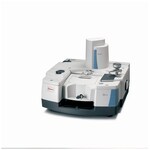
Espectrómetro FTIR Nicolet™ iS™ 50
Thermo Scientific™ Nicolet™ iS™50, que incorpora un software integrado y accesorios diseñados con fines específicos para resolver fácilmente problemas analíticos, es un sistema de análisis de materiales todo en uno.
| Número de catálogo | Verificación del rendimiento | Intervalo espectral |
|---|---|---|
| 912A0760 | ASTM E1421 para satisfacer los requisitos ISO/GLP del cliente, | De 15 a 27.000 cm¹ |
Número de catálogo 912A0760
Precio (MXN)
-
Verificación del rendimiento:
ASTM E1421 para satisfacer los requisitos ISO/GLP del cliente,
Intervalo espectral:
De 15 a 27.000 cm¹
Supere los retos analíticos con facilidad con el espectrómetro FTIR Nicolet™ iS™ 50, que ofrece un software integrado y accesorios diseñados para fines específicos, lo que lo convierte en una estación de trabajo de análisis de materiales todo en uno.
El espectrómetro FTIR Nicolet iS 50 , que cuenta con un diseño de gran flexibilidad, puede actualizarse a partir de un simple equipo de espectroscopía por infrarrojos por transformada de Fourier (FT-IR) a un sistema completamente automatizado con un intervalo multiespectral que puede adquirir desde espectros infrarrojos lejanos a espectros visibles. Puede iniciar los novedosos módulos ATR, Raman y NIR con solo pulsar un botón. De este modo, obtendrá acceso a estas técnicas sin cambiar de forma manual los componentes del sistema.
El espectrómetro FT-IR Nicolet iS 50 es la solución definitiva si es fundamental la existencia de un diagrama de trabajo rápido y sencillo en su laboratorio analítico.
Características del espectrómetro Nicolet iS50 FT-IR:
- Capacidad de doble fuente
- Fuente de IR con una larga vida útil Polaris™
- Fuente de luz blanca Tingsteno-Halógena
- Tres detectores en el compartimento de muestras principal
- Alta resolución estándar
- Rueda de validación estándar
- Óptica de oro estándar (disponible en aluminio)
- Compatibilidad completa con accesorios existentes
- Pantallas de energía motorizadas para alta resolución (estándar)
- Obturadores de purga opcionales
- Filtros motorizados opcionales
- Polarizador motorizado opcional
- Toma de emisión focalizada o colimada
Las ofertas que ya conoce, como la de los accesorios inteligentes, han aumentado con los siguientes módulos opcionales:
- ATR de diamante incorporado con capacidad de IR medio y lejano
- Intercambiador automático de divisores de haz (ABX)
- Accesorio Raman en el compartimento de muestras
- Módulo NIR con conexiones de fibra óptica y esfera integradora
- Accesorio TGA-IR
- Módulo GC-IR
Puede visitar la biblioteca técnica y visualizar el catálogo y la hoja de especificaciones para obtener más información.
- Dimensiones (solo la base): 62,6 x 69,8 x 27,6 cm (25 x 27 x 11 pulg)
- Peso (solo la base): 60 kg (132 lb)
- Dimensiones (incluido ABX): 62,6 x 69,8 x 50,8 cm (25 x 27 x 20 pulg)
- Peso (solo la base): incluido ABX: 64 kg (141 lb)
- No hay espacio adicional para el Raman y el ATR dedicado
- Solo 27,9 cm (11 pulg) más con el módulo Nicolet iS50 NIR
Recomendado para:
- Polímeros y materiales de caucho
- Estudios forenses
- Fármacos
- Pigmentos/pinturas/tintas
- Alimentos/Aromas/Aceites
- Laboratorios multianalíticos
Espectroscopía FTIR basada en la nube
Todos los espectrómetros FTIR Nicolet le permiten almacenar, compartir e interpretar los datos espectrales en cualquier momento, lugar y dispositivo. Los investigadores, técnicos de laboratorio, educadores y alumnos pueden utilizar la cuenta de Thermo Fisher Connect, con tecnología de Thermo Fisher Cloud, para acceder fácilmente a sus datos con la aplicación OMNIC Anywhere.
- Exporte, observe y comparta los datos: visualice los archivos espectrales .spa Nicolet, etiquete picos espectrales y corrija las líneas bases espectrales en la aplicación OMNIC Anywhere en su PC, equipo Apple o dispositivo Android o iOS.
- Añada más espacio de almacenamiento: empiece con 10 GB de almacenamiento gratuito y, a continuación, aumente la capacidad según sea necesario por un precio mínimo. Puede almacenar archivos OMNIC .spa, así como de otro tipo (por ejemplo, documentos de informes, .xls, etc.) en su cuenta Thermo Fisher Connect
- Proteja sus datos: Thermo Fisher Connect utiliza Amazon Web Service™, la plataforma de informática en la nube para la seguridad y la protección de datos líder del sector, por lo que no tendrá que preocuparse por el robo o la pérdida de datos.
Especificaciones
Divisor de hazIntercambiador automático de divisores de haz (ABX)
ComponentesFuentes; detectores; divisores de haz
Fondo (imperial)27 pulg
Fondo (métrico)69,8 cm
DescripciónEl Nicolet iS50, que incorpora un software integrado y accesorios diseñados con fines específicos para resolver fácilmente problemas analíticos, es un sistema de análisis de materiales “todo en uno”.
Tipo de detectorHasta 9 detectores seleccionables por el usuario
Requisitos eléctricos100-240 V, 50/60 Hz
Para utilizar con (aplicación)Polímeros y materiales de caucho; estudios forenses; industria farmacéutica.
Para utilizar con (equipo)accesorios inteligentes, TGA-IR, microscopio Continuum, fotoacústica, todos los accesorios estándar; celdas de gas; GC-IR; FT-Raman; ABX; NIR; ATR incorporado
Altura (imperial)11 pulg
Altura (métrico)27,6 cm
HumedadSellado herméticamente para resistir la humedad ambiente.
InterfazPC USB 2.0
LáserHeNe
Tipo de productoEspectrómetro analítico FTIR Nicolet iS50 y software
Tipo de fuenteCapacidad de doble fuente: Fuente de IR Polaris™ con una larga vida útil
Intervalo espectralDe 15 a 27.000 cm¹
Resolución espectralSuperior a 0,09 cm¹
Peso (imperial)132 lb
Peso (métrico)60 kg
Anchura (imperial)25 pulg
Anchura (métrico)62,6 cm
Verificación del rendimientoASTM E1421 para satisfacer los requisitos ISO/GLP del cliente,
Tensión100/240 V
Unit SizeEach