Search


Citas y referencias (7)
Invitrogen™
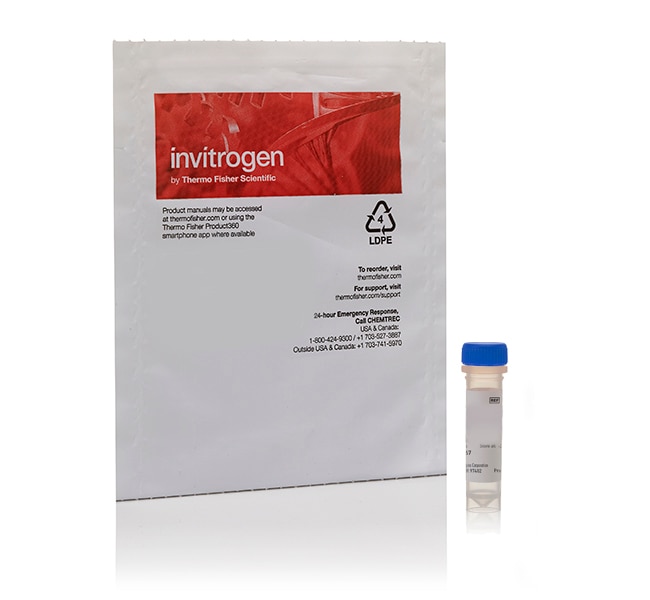
Alexa Fluor™ 488 Alkyne (Alexa Fluor™ 488 5-Carboxamido-(Propargyl), Bis(Triethylammonium Salt)), 5-isomer
El alquino Alexa Fluor® 488 verde fluorescente reacciona con azidas mediante una reacción clic catalizada con cobre. Además de serMás información
| Número de catálogo | Cantidad |
|---|---|
| A10267 | 0,5 mg |
Número de catálogo A10267
Precio (MXN)
-
Cantidad:
0,5 mg
El alquino Alexa Fluor® 488 verde fluorescente reacciona con azidas mediante una reacción clic catalizada con cobre. Además de ser un fluoróforo extremadamente brillante y fotoestable para su uso en citometría de flujo, microscopía y detección de alto contenido (HCS), Alexa Fluor® 488 también se puede utilizar como hapteno biortogonal o biológicamente único para su uso en aplicaciones que requieren amplificación de la señal.
Para uso exclusivo en investigación. No apto para uso en procedimientos diagnósticos.
Especificaciones
Reactividad químicaAzida
Método de detecciónFluorescente
FormatoSólido
Etiqueta o tinteAlexa Fluor™ 488
Peso molecular773,91 Da
Tipo de productoAlquino
Cantidad0,5 mg
Grupo reactivoAlquino
Fracción reactivaAlquino
Condiciones de envíoTemperatura ambiente
SolubilidadDMSO (dimetilsulfóxido)
ColorVerde
Tipo de etiquetaColorantes Alexa Fluor
Línea de productosAlexa Fluor, Molecular Probes
Unit SizeEach
Contenido y almacenamiento
Almacenar a ≤ - 20 °C, desecado y protegido de la luz.
Citations & References (7)
Citations & References
Abstract
The RNA-binding protein Fus directs translation of localized mRNAs in APC-RNP granules.
Journal:
PubMed ID:24297750
'RNA localization pathways direct numerous mRNAs to distinct subcellular regions and affect many physiological processes. In one such pathway the tumor-suppressor protein adenomatous polyposis coli (APC) targets RNAs to cell protrusions, forming APC-containing ribonucleoprotein complexes (APC-RNPs). Here, we show that APC-RNPs associate with the RNA-binding protein Fus/TLS (fused in sarcoma/translocated
Repression of global protein synthesis by Eif1a-like genes that are expressed specifically in the two-cell embryos and the transient Zscan4-positive state of embryonic stem cells.
Journal:DNA Res
PubMed ID:23649898
'Mouse embryonic stem (ES) cells are prototypical stem cells that remain undifferentiated in culture for long periods, yet maintain the ability to differentiate into essentially all cell types. Previously, we have reported that ES cells oscillate between two distinct states, which can be distinguished by the transient expression of Zscan4
Neurotrophin-mediated dendrite-to-nucleus signaling revealed by microfluidic compartmentalization of dendrites.
Journal:Proc Natl Acad Sci U S A
PubMed ID:21690335
'Signaling from dendritic synapses to the nucleus regulates important aspects of neuronal function, including synaptic plasticity. The neurotrophin brain-derived neurotrophic factor (BDNF) can induce long-lasting strengthening of synapses in vivo and this effect is dependent on transcription. However, the mechanism of signaling to the nucleus is not well understood. Here
Smaug1 mRNA-silencing foci respond to NMDA and modulate synapse formation.
Journal:J Cell Biol
PubMed ID:22201125
'Mammalian Smaug1/Samd4A is a translational repressor. Here we show that Smaug1 forms mRNA-silencing foci located at postsynapses of hippocampal neurons. These structures, which we have named S-foci, are distinct from P-bodies, stress granules, or other neuronal RNA granules hitherto described, and are the first described mRNA-silencing foci specific to neurons.
Click-mediated labeling of bacterial membranes through metabolic modification of the lipopolysaccharide inner core.
Journal:Angew Chem Int Ed Engl
PubMed ID:22323101
Metabolic glycan labeling has recently emerged as a very powerful method for studying cell-surface glycans, which has applications that range from imaging glycans in living multicellular organisms, such as zebrafish or mice, to the identication of metastasis-associaed cell-surface sialoglycoproteins.