Search


Citas y referencias (20)
Invitrogen™
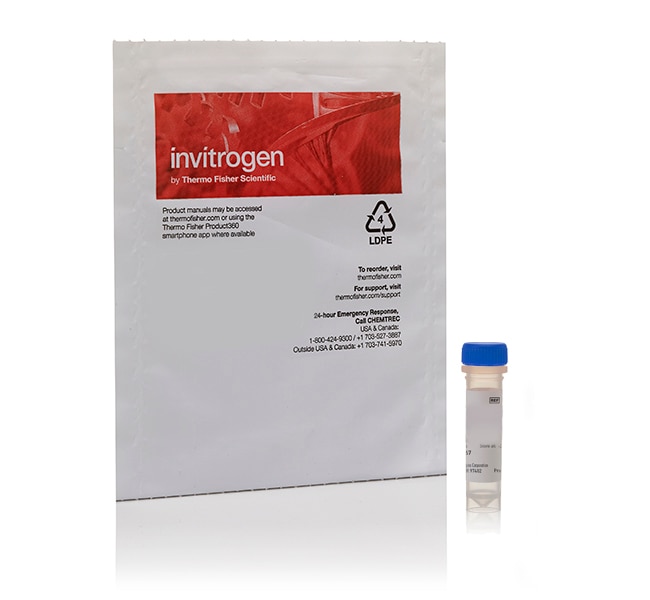
Avidin, Alexa Fluor™ 488 conjugate
Avidina, conjugado Alexa Fluor™ 488
| Número de catálogo | Cantidad |
|---|---|
| A21370 | 1 mg |
Número de catálogo A21370
Precio (MXN)
-
Cantidad:
1 mg
Nuestra avidina, el conjugado Alexa Fluor™ 488 es una sonda brillante y fotoestable con características de excitación y emisión similares a las de la fluoresceína. La avidina es una proteína glucosilada de unión de biotina que tiene un punto isoeléctrico básico y se utiliza ampliamente para detectar sondas biotiniladas.
Para uso exclusivo en investigación. No apto para uso en procedimientos diagnósticos.
Especificaciones
Etiqueta o tinteColorantes Alexa Fluor
Cantidad1 mg
Condiciones de envíoTemperatura ambiente
ConjugadoAlexa Fluor 488
FormularioSólido
Línea de productosAlexa Fluor
Unit SizeEach
Contenido y almacenamiento
Almacenar en el congelador (de -5 a -30 °C) y proteger de la luz.
Citations & References (20)
Citations & References
Abstract
Association of excitatory amino acid transporters, especially EAAT2, with cholesterol-rich lipid raft microdomains: importance for excitatory amino acid transporter localization and function.
Journal:J Biol Chem
PubMed ID:15187084
In the present study, we investigated the role of membrane cholesterol in the function of glutamate transporters. Depletion of membrane cholesterol by methyl-beta-cyclodextrin resulted in reduced Na(+)-dependent glutamate uptake in primary cortical cultures. Glial glutamate transporter EAAT2-mediated uptake was more sensitive to this effect. Cell surface biotinylation and immunostaining experiments
Identification of a subpopulation of cells with cancer stem cell properties in head and neck squamous cell carcinoma.
Journal:Proc Natl Acad Sci U S A
PubMed ID:17210912
'Like many epithelial tumors, head and neck squamous cell carcinoma (HNSCC) contains a heterogeneous population of cancer cells. We developed an immunodeficient mouse model to test the tumorigenic potential of different populations of cancer cells derived from primary, unmanipulated human HNSCC samples. We show that a minority population of CD44(+)
Prototype protein assembly as scaffold for time-resolved fluoroimmuno assays.
Journal:J Am Chem Soc
PubMed ID:17542581
'Turnip yellow mosaic virus (TYMV) is an icosahedral plant virus with an average diameter of 28 nm and can be isolated in gram quantities from turnip or Chinese cabbage inexpensively. In this study, it was selected as a prototype bionanoparticle for time-resolved fluoroimmuno assay (TRFIA). Two types of reactive amino
Protein cargo delivery properties of cell-penetrating peptides. A comparative study.
Journal:Bioconjug Chem
PubMed ID:15546190
'Application of cell-penetrating peptides for delivering various hydrophilic macromolecules with biological function into cells has gained much attention in recent years. We compared the protein transduction efficiency of four cell-penetrating peptides: penetratin, Tat peptide, transportan, and pVEC and studied the effects of various medium parameters on the uptake. Depletion of
The role of alpha and beta chains in ligand recognition by beta 7 integrins.
Journal:J Biol Chem
PubMed ID:10837471
'Integrins alpha(E)beta(7) and alpha(4)beta(7) are involved in localization of leukocytes at mucosal sites. Although both alpha(E)beta(7) and alpha(4)beta(7) utilize the beta(7) chain, they have distinct binding specificities for E-cadherin and mucosal addressin cell adhesion molecule-1 (MAdCAM-1), respectively. We found that mutation of the metal ion-dependent adhesion site (MIDAS) in the