Search


Citas y referencias (6)
Invitrogen™
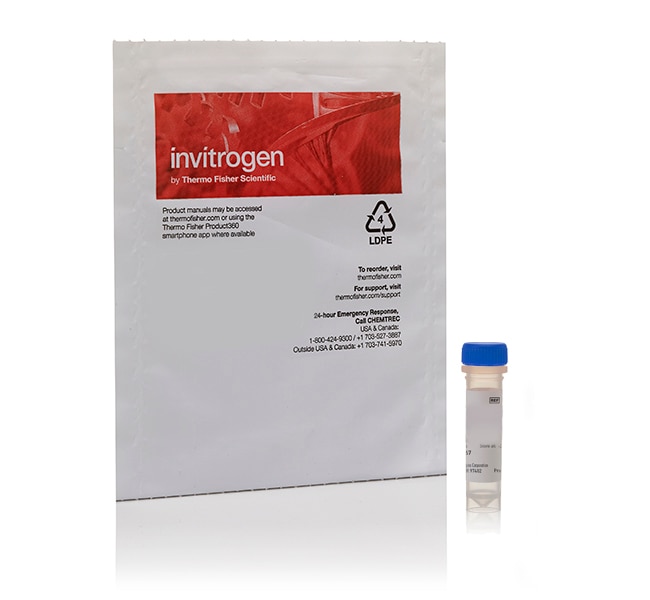
Avidin, NeutrAvidin™, Oregon Green™ 488 conjugate
Avidina, NeutrAvidin™, conjugado Oregon Green™ 488
| Número de catálogo | Cantidad |
|---|---|
| A6374 | 1 mg |
Número de catálogo A6374
Precio (MXN)
-
Cantidad:
1 mg
Our Oregon Green™ 488 conjugate of NeutrAvidin™ biotin-binding protein - a form of avidin that has been processed to remove carbohydrate and to lower its isoelectric point - can substantially decrease background due to nonspecific binding. The method used to deglycosylate the avidin retains its specific binding. This bright, green-fluorescent reagent (absorption/emission maxima ∼496/524 nm) is ideal for detecting biotinylated targets in fluorescence microscopy and flow cytometry applications.
Nuestro conjugado Oregon Green™ 488 NeutrAvidin™ de proteína de unión de biotina (una forma de avidina que ha sido procesada para eliminar carbohidratos y reducir su punto isoeléctrico) puede disminuir sustancialmente el fondo debido a una unión no específica. El método utilizado para desglicosilar la avidina conserva su unión específica. Este reactivo fluorescente verde brillante (absorción/emisión máxima de ∼ 496/524 nm) es ideal para detectar objetivos biotinilados en aplicaciones de microscopía de fluorescencia y citometría de flujo.
Para uso exclusivo en investigación. No apto para uso en procedimientos diagnósticos.
Especificaciones
Cantidad1 mg
Condiciones de envíoTemperatura ambiente
ConjugadoOregon Green 488
Línea de productosNeutrAvidin, Oregon Green
Unit SizeEach
Contenido y almacenamiento
Almacenar en el congelador (de -5 a -30 °C) y proteger de la luz.
Citations & References (6)
Citations & References
Abstract
Rapid transport of internalized P-selectin to late endosomes and the TGN: roles in regulating cell surface expression and recycling to secretory granules.
Journal:J Cell Biol
PubMed ID:11018057
'Prior studies on receptor recycling through late endosomes and the TGN have suggested that such traffic may be largely limited to specialized proteins that reside in these organelles. We present evidence that efficient recycling along this pathway is functionally important for nonresident proteins. P-selectin, a transmembrane cell adhesion protein involved
Quantitative analysis of sex-pheromone coding in the antennal lobe of the moth Agrotis ipsilon: a tool to study network plasticity.
Journal:J Exp Biol
PubMed ID:19329752
'To find a mating partner, moths rely on pheromone communication. Released in very low amounts, female sex pheromones are used by males to identify and localize females. Depending on the physiological state (i.e. age, reproductive state), the olfactory system of the males of the noctuid moth Agrotis ipsilon is ''switched
Quantified power Doppler US of tumor blood flow correlates with microscopic quantification of tumor blood vessels.
Journal:Radiology
PubMed ID:11274552
'To evaluate the ability of a quantified power Doppler ultrasonography (US) system to help quantitate differences in tumor vascularity after radiation therapy and administration of tumor necrosis factor (TNF). Murine glioblastoma tumors were grown in the thighs of two sets of 25 mice each. Each mouse was assigned to one
Potentiation of Fas-mediated apoptosis of murine granulosa cells by interferon-gamma, tumor necrosis factor-alpha, and cycloheximide.
Journal:Endocrinology
PubMed ID:9832422
'The Fas antigen is a transmembrane receptor belonging to the tumor necrosis factor-alpha (TNF) receptor family that, when activated by Fas ligand or agonistic antibodies, induces death by apoptosis. Although the presence of Fas antigen in ovarian tissues has been demonstrated, little is known about whether Fas antigen is functional
Responsiveness of mouse corpora luteal cells to Fas antigen (CD95)-mediated apoptosis.
Journal:Biol Reprod
PubMed ID:10859241
Regression of the corpus luteum (CL) occurs by apoptosis. The Fas antigen (Fas) is a cell surface receptor that induces apoptosis in sensitive cells when bound to Fas ligand or agonistic anti-Fas monoclonal antibodies (Fas mAb). A potential role for Fas to induce apoptosis in dispersed CL cell preparations was