Search


Citas y referencias (21)
Invitrogen™
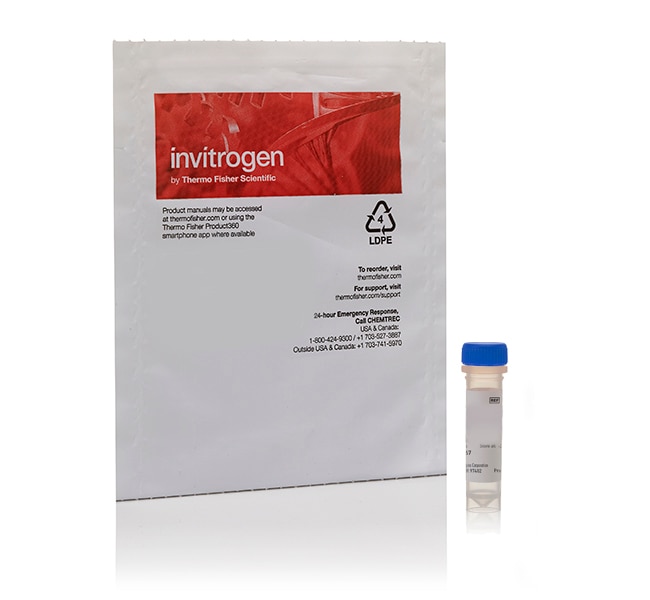
Click-IT™ L-Homopropargylglycine (HPG)
La homopropargilglicina (HPG) Click-iT® proporciona una alternativa rápida, sensible, no tóxica y, lo que es más importante, no radiactiva aMás información
| Número de catálogo | Cantidad |
|---|---|
| C10186 | 5 mg |
Número de catálogo C10186
Precio (MXN)
-
Cantidad:
5 mg
La homopropargilglicina (HPG) Click-iT® proporciona una alternativa rápida, sensible, no tóxica y, lo que es más importante, no radiactiva a la técnica tradicional, la 35S metionina, para la detección de la síntesis de proteínas nacientes. La HPG es un análogo de aminoácido que contiene una modificación muy pequeña, específicamente una fracción de alquino que se puede alimentar a células cultivadas e incorporar en proteínas durante la síntesis de proteínas activas. La detección utiliza la ligación quimioselectiva o reacción «clic» entre una azida y un alquino donde la proteína con modificación de alquino se detecta con un colorante que contiene azida o hapteno junto con el kit de tampones de reacción celular Click-iT® o el kit de tampones de proteínas Click-iT®. Con el kit de tampones de reacción celular Click-iT®, las células se pueden analizar mediante microscopía de fluorescencia, citometría de flujo o adquisición de imágenes y análisis de alto contenido. Con el kit de tampones de reacción de proteínas Click-iT®, consiga una sensibilidad de detección en geles 1-D y Western blots en el rango bajo de femtomoles o realice análisis de LC-MS⁄MS y MALDI MS.
Para uso exclusivo en investigación. No apto para uso en procedimientos diagnósticos.
Especificaciones
FormatoSólido
Método de etiquetadoMarcaje metabólico
Línea de productosClick-iT, Sondas moleculares
Tipo de productoL-homopropargilglicina
Cantidad5 mg
Condiciones de envíoTemperatura ambiente
Labeling TargetProteínas
Etiqueta o tinteAlquino
Unit SizeEach
Contenido y almacenamiento
Almacenar a - 20 °C y desecado.
Preguntas frecuentes
I am observing no signal or very low signal for my click-labeled samples. What can I do to improve the signal?
Citations & References (21)
Citations & References
Abstract
Selective identification of newly synthesized proteins in mammalian cells using bioorthogonal noncanonical amino acid tagging (BONCAT).
Journal:Proceedings of the National Academy of Sciences of the United States of America
PubMed ID:16769897
In both normal and pathological states, cells respond rapidly to environmental cues by synthesizing new proteins. The selective identification of a newly synthesized proteome has been hindered by the basic fact that all proteins, new and old, share the same pool of amino acids and thus are chemically indistinguishable. We
In situ visualization and dynamics of newly synthesized proteins in rat hippocampal neurons.
Journal:Nature neuroscience
PubMed ID:20543841
Protein translation has been implicated in different forms of synaptic plasticity, but direct in situ visualization of new proteins is limited to one or two proteins at a time. Here we describe a metabolic labeling approach based on incorporation of noncanonical amino acids into proteins followed by chemoselective fluorescence tagging
Two-color labeling of temporally defined protein populations in mammalian cells.
Journal:Bioorganic & medicinal chemistry letters
PubMed ID:18774715
The proteome undergoes complex changes in response to disease, drug treatment, and normal cellular signaling processes. Characterization of such changes requires methods for time-resolved protein identification and imaging. Here, we describe the application of two reactive methionine (Met) analogues, azidohomoalanine (Aha) and homopropargylglycine (Hpg), to label two protein populations in
Fluorescence visualization of newly synthesized proteins in mammalian cells.
Journal:Angewandte Chemie (International ed. in English)
PubMed ID:17036290
Noncanonical amino acid tagging enables the selective fluorescent visualization of newly synthesized proteins in mammalian cells (see the picture). Susceptibility to tagging is determined by the spatial and temporal character of the protein synthesis, thus providing a complement to methods which identify relevant members of the proteome.
Spatial coupling of mTOR and autophagy augments secretory phenotypes.
Journal:Science (New York, N.Y.)
PubMed ID:21512002
Protein synthesis and autophagic degradation are regulated in an opposite manner by mammalian target of rapamycin (mTOR), whereas under certain conditions it would be beneficial if they occurred in unison to handle rapid protein turnover. We observed a distinct cellular compartment at the trans side of the Golgi apparatus, the