Search


Citas y referencias (26)
Invitrogen™
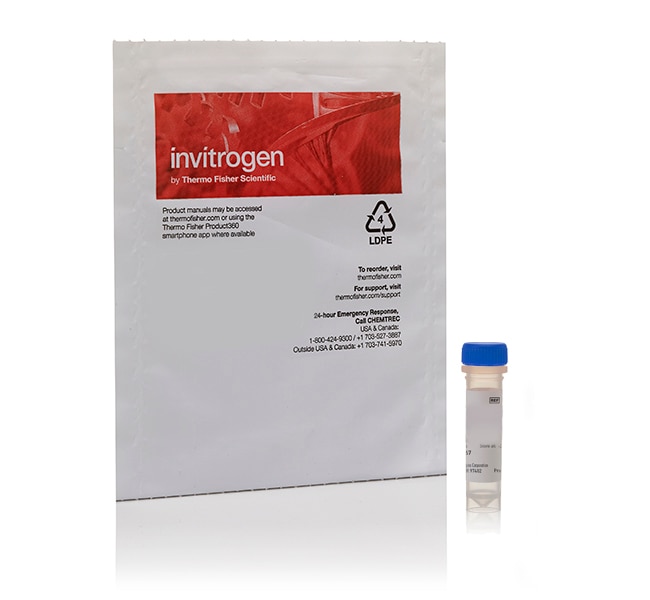
CellLight™ ER-GFP, BacMam 2.0
CellLight™ ER-GFP, BacMam 2.0, proporciona un método sencillo para etiquetar el retículo endoplásmico (ER) con proteína verde fluorescente (GFP) enMás información
| Número de catálogo | Cantidad |
|---|---|
| C10590 | 1 vial |
Número de catálogo C10590
Precio (MXN)
-
Cantidad:
1 vial
CellLight™ ER-GFP, BacMam 2.0, proporciona un método sencillo para etiquetar el retículo endoplásmico (ER) con proteína verde fluorescente (GFP) en células vivas. Solamente tiene que añadir reactivo a las células y dejarlas incubar toda la noche; por la mañana, las células estarán listas.
¿Desea etiquetar otras estructuras celulares? Más información sobre las herramientas de etiquetado de proteínas fluorescentes CellLight™
Esta construcción lista para usar se transfecta en las células utilizando la tecnología BacMam 2.0 y expresa GFP fusionada a la secuencia de señal ER de calreticulina y KDEL (señal de retención ER) con una interrupción celular mínima. Puede observar el comportamiento de ER-GFP en células vivas mediante imágenes fluorescentes y multiplexado con otras proteínas fluorescentes o colorantes orgánicos.
Las células que expresan construcciones CellLight™ también se pueden fijar con formaldehído para la adquisición de imágenes multiplexadas mediante técnicas inmunocitoquímicas.
La tecnología CellLight™ es:
• Rápida y cómoda: solamente tiene que añadir reactivo CellLight™ a las células, dejarlas incubar durante la noche y realizar la adquisición de imágenes, o bien almacenar las células congeladas listas para ensayos para utilizarlas posteriormente
• Muy eficaz: hasta un 90 % de transducción de una amplia variedad de líneas celulares de mamíferos, incluidas las células primarias, las células madre y las neuronas.
• Flexible: cotransduzca más de un reactivo BacMam para experimentos multiplex o estudios de colocalización; controle de cerca los niveles de expresión mediante simples variaciones de la dosis.
• Menos tóxica: Los reactivos CellLight™ no se replican en células de mamíferos y son adecuados para la manipulación de nivel de bioseguridad (BSL) 1
Tecnología BacMam
CellLight™ ER-GFP, BacMam 2.0, es una construcción fusionada de secuencia de señal de ER de calreticulina y KDEL (señal de retención de ER) y emGFP que se dirige de forma precisa y específica al ER celular-GFP. Esta construcción fusionada está envasada en el baculovirus del virus de insecto, que no se replica en las células humanas y está designado como seguro para su uso en la mayoría de laboratorios con nivel de bioseguridad (BSL) 1. La tecnología BacMam garantiza que la mayoría de los tipos de células de mamíferos se transduzcan o transfecten con alta eficacia y una toxicidad mínima. Esta transfección transitoria se puede detectar tras una incubación nocturna durante hasta cinco días, tiempo suficiente para llevar a cabo la mayoría de análisis celulares dinámicos. Como cualquier otra técnica de transfección o transducción, el método BacMam no transfecta o transduce todas las células con la misma eficacia, lo que hace que no sea adecuado para estudios de población celular o procesos de recuento o adquisición de imágenes automatizados. Los reactivos CellLight™ son perfectos para experimentos en los que se requiere la colocalización celular o subcelular o para estudios de la función celular que necesiten una resolución especial.
¿Desea etiquetar otras estructuras celulares? Más información sobre las herramientas de etiquetado de proteínas fluorescentes CellLight™
Esta construcción lista para usar se transfecta en las células utilizando la tecnología BacMam 2.0 y expresa GFP fusionada a la secuencia de señal ER de calreticulina y KDEL (señal de retención ER) con una interrupción celular mínima. Puede observar el comportamiento de ER-GFP en células vivas mediante imágenes fluorescentes y multiplexado con otras proteínas fluorescentes o colorantes orgánicos.
Las células que expresan construcciones CellLight™ también se pueden fijar con formaldehído para la adquisición de imágenes multiplexadas mediante técnicas inmunocitoquímicas.
La tecnología CellLight™ es:
• Rápida y cómoda: solamente tiene que añadir reactivo CellLight™ a las células, dejarlas incubar durante la noche y realizar la adquisición de imágenes, o bien almacenar las células congeladas listas para ensayos para utilizarlas posteriormente
• Muy eficaz: hasta un 90 % de transducción de una amplia variedad de líneas celulares de mamíferos, incluidas las células primarias, las células madre y las neuronas.
• Flexible: cotransduzca más de un reactivo BacMam para experimentos multiplex o estudios de colocalización; controle de cerca los niveles de expresión mediante simples variaciones de la dosis.
• Menos tóxica: Los reactivos CellLight™ no se replican en células de mamíferos y son adecuados para la manipulación de nivel de bioseguridad (BSL) 1
Tecnología BacMam
CellLight™ ER-GFP, BacMam 2.0, es una construcción fusionada de secuencia de señal de ER de calreticulina y KDEL (señal de retención de ER) y emGFP que se dirige de forma precisa y específica al ER celular-GFP. Esta construcción fusionada está envasada en el baculovirus del virus de insecto, que no se replica en las células humanas y está designado como seguro para su uso en la mayoría de laboratorios con nivel de bioseguridad (BSL) 1. La tecnología BacMam garantiza que la mayoría de los tipos de células de mamíferos se transduzcan o transfecten con alta eficacia y una toxicidad mínima. Esta transfección transitoria se puede detectar tras una incubación nocturna durante hasta cinco días, tiempo suficiente para llevar a cabo la mayoría de análisis celulares dinámicos. Como cualquier otra técnica de transfección o transducción, el método BacMam no transfecta o transduce todas las células con la misma eficacia, lo que hace que no sea adecuado para estudios de población celular o procesos de recuento o adquisición de imágenes automatizados. Los reactivos CellLight™ son perfectos para experimentos en los que se requiere la colocalización celular o subcelular o para estudios de la función celular que necesiten una resolución especial.
Para uso exclusivo en investigación. No apto para uso en procedimientos diagnósticos.
Especificaciones
ColorVerde
Método de detecciónFluorescente
Tipo de coloranteGFP (EmGFP)
EmisiónVisible
Intervalo de longitud de onda de excitación488⁄510
Para utilizar con (equipo)Microscopio confocal, microscopio de fluorescencia
FormularioLíquido
Línea de productosCellLight
Cantidad1 vial
Condiciones de envíoHielo húmedo
TécnicaIntensidad de fluorescencia
Tipo de etiquetaProteína fluorescente
Tipo de productoRetículo endoplásmico
Sub Cellular LocalizationRetículo endoplásmico
Unit SizeEach
Contenido y almacenamiento
Almacenar de 2 °C a 6 °C, protegido de la luz. No congelar.
Preguntas frecuentes
How can I increase the transduction efficiency with the BacMam 2.0 reagents such as the the CellLight and Premo products?
Is there any way to preserve the CellLights labeling beyond 5 days?
Are the CellLights products toxic to cells?
For how long will the CellLights products label my cells?
What cell types can the CellLights products be used with?
Citations & References (26)
Citations & References
Abstract
Mutations in ABCD4 cause a new inborn error of vitamin B12 metabolism.
Journal:Nat Genet
PubMed ID:22922874
Inherited disorders of vitamin B12 (cobalamin) have provided important clues to how this vitamin, which is essential for hematological and neurological function, is transported and metabolized. We describe a new disease that results in failure to release vitamin B12 from lysosomes, which mimics the cblF defect caused by LMBRD1 mutations.
Intracellular trafficking of Clostridium perfringens iota-toxin b.
Journal:Infect Immun
PubMed ID:22825447
'Clostridium perfringens iota-toxin is composed of an enzymatic component (Ia) and a binding component (Ib). Ib binds to a cell surface receptor, undergoes oligomerization in lipid rafts, and binds Ia. The resulting complex is then endocytosed. Here, we show the intracellular trafficking of iota-toxin. After the binding of the Ib
Single-cell redox imaging demonstrates a distinctive response of dopaminergic neurons to oxidative insults.
Journal:Antioxid Redox Signal
PubMed ID:21395478
'The study of the intracellular oxido-reductive (redox) state is of extreme relevance to the dopamine (DA) neurons of the substantia nigra pars compacta. These cells possess a distinct physiology intrinsically associated with elevated reactive oxygen species production, and they selectively degenerate in Parkinson''s disease under oxidative stress conditions. To test
Intracellular trafficking mechanism, from intracellular uptake to extracellular efflux, for phospholipid/cholesterol liposomes.
Journal:Biomaterials
PubMed ID:22858002
'Liposomes are widely used as drug delivery vehicles to transfer chemotherapeutic agents, proteins, and nucleic acids into target cells. To improve therapeutic effects and reduce unexpected toxic side-effects, it is necessary to understand the mechanism of liposomal uptake into cells, and the intracellular fate of internalized liposomes. The intracellular fate
Der p2 Internalization by Epithelium Synergistically Augments Toll-like Receptor-Mediated Proinflammatory Signaling.
Journal:
PubMed ID:25749775
'House-dust-mite (HDM) major allergen Der p2 shares homology and function with Toll-like receptor (TLR) signaling protein myeloid differentiation-2 (MD2) and may lead to airway inflammation. Should Der p2 be internalized by human airway epithelium, it has the theoretical propensity to potentiate epithelium activation. This study aimed to demonstrate the internalization