Search


Citas y referencias (4)
Invitrogen™
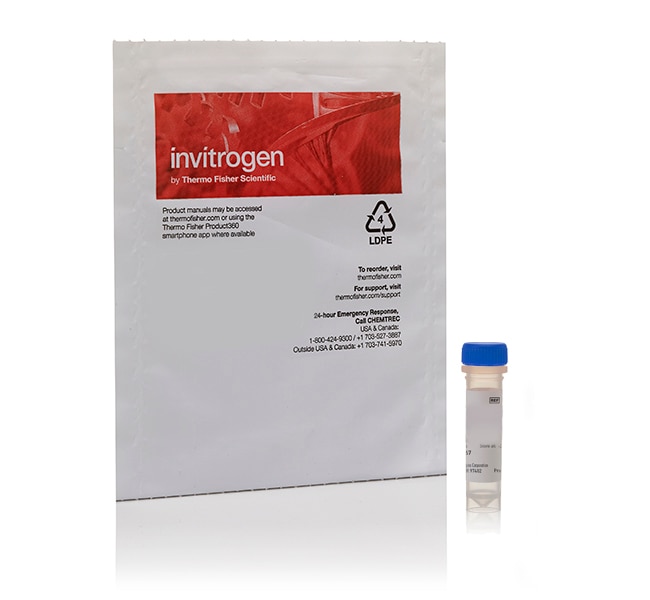
CellLight™ Null (control), BacMam 2.0
CellLight™ Null Control está diseñado para usarse como control de transducción negativo con nuestros reactivos de tinción de células vivasMás información
| Número de catálogo | Cantidad |
|---|---|
| C10615 | 1 vial |
Número de catálogo C10615
Precio (MXN)
-
Cantidad:
1 vial
CellLight™ Null Control está diseñado para usarse como control de transducción negativo con nuestros reactivos de tinción de células vivas de proteínas fluorescentes CellLight™. CellLight™ Null Control no contiene ningún promotor de mamífero ni ningún transgénico. Los reactivos CellLight™ combinan la utilidad y selectividad de las proteínas fluorescentes con la eficiencia de transducción de la tecnología BacMam, lo que permite la tinción inequívoca de orgánulos, estructuras celulares y procesos en células vivas de mamíferos. Se suministran en un formato listo para su uso: simplemente añada, incube y obtenga imágenes con una expresión muy eficaz en líneas celulares, células primarias, células madre y neuronas.
CellLight™ Null Control es:
• Altamente eficaz: > 90 % de la transducción de una amplia gama de líneas celulares de mamíferos, incluidas las células primarias, las células madre y las neuronas.
• Rápido y práctico: Simplemente añada el reactivo CellLight™ Null Control a las células, incube durante la noche y evalúe cómo las células toleran la transducción de BacMam.
• Seguro: Los reactivos CellLight™ no se replican en células de mamíferos, no tienen ningún efecto citopático de observable y son adecuados para manipulación de nivel de bioseguridad (BSL) 1.
Principio de los reactivos CellLight™
Otros reactivos CellLight™ son construcciones fusionadas de péptidos de señal o proteínas de estructura celular con emGFP, TagRFP o CFP Premiere que se dirigen de forma precisa y específica a estructuras y compartimentos subcelulares. Disponibilidad de una gran variedad de objetivos, incluyendo citoesqueleto, mitocondrias y compartimentos de secreción, para una práctica multiplexación, estudios de colocalización y adquisición de imágenes de los procesos celulares dinámicos donde se requiere una alta resolución espacial y temporal. Los reactivos CellLight™ toleran la fijación con formaldehído y, por tanto, son compatibles con el análisis de células fijas.
Tecnología BacMam
La tecnología BacMam está basada en un virus de insecto (baculovirus) para una transducción eficiente y una expresión transitoria en células de mamíferos. El baculovirus se ha modificado para incluir un casete de expresión que contiene la construcción fusionada CellLight™.
BacMam 2.0 incorpora elementos que mejoran en gran medida la eficiencia de la transducción y los niveles de expresión: una proteína de cápside pseudotipada para una entrada celular más eficiente, un promotor de CMV mejorado, y el elemento regulador postranscripcional de la hepatitis Woodchuck (WPRE).
Los baculovirus no se replican en las células de mamíferos, lo que les da un excelente perfil de seguridad y una falta de efectos citopáticos en las células de los mamíferos.
Comodidad del flujo de trabajo
A diferencia de los vectores de expresión, los reactivos BacMam habilitan la expresión titratable y reproducible de proteínas transitorias. No es necesario recurrir a métodos de transfección difíciles ni a la tediosa clonación. Para conseguir una expresión altamente eficiente incluso en células sensibles, como células madre, neuronas y células primarias, basta con añadir los reactivos CellLight™ a las células en un medio completo, incubar y obtener imágenes al día siguiente. O bien, mezcle el reactivo CellLight™ y las células en el momento de la siembra en placa.
Las eficiencias de cotransducción son elevadas, lo que permite utilizar fácilmente varios reactivos CellLight™ en el mismo experimento si es necesario etiquetar varias estructuras o vías. Los reactivos CellLight™ también toleran la fijación con formaldehído y, por tanto, son compatibles con el análisis de células fijas basado en anticuerpos.
Normalmente, las células transducidas transitoriamente expresan la proteína de fusión durante unos cinco días, aunque en células que se dividen lentamente, como algunos tipos de células primarias, la expresión se ha demostrado durante hasta dos semanas; en neuronas diferenciadas terminalmente hemos registrado imágenes más de tres semanas después de la transducción.
CellLight™ Null Control es:
• Altamente eficaz: > 90 % de la transducción de una amplia gama de líneas celulares de mamíferos, incluidas las células primarias, las células madre y las neuronas.
• Rápido y práctico: Simplemente añada el reactivo CellLight™ Null Control a las células, incube durante la noche y evalúe cómo las células toleran la transducción de BacMam.
• Seguro: Los reactivos CellLight™ no se replican en células de mamíferos, no tienen ningún efecto citopático de observable y son adecuados para manipulación de nivel de bioseguridad (BSL) 1.
Principio de los reactivos CellLight™
Otros reactivos CellLight™ son construcciones fusionadas de péptidos de señal o proteínas de estructura celular con emGFP, TagRFP o CFP Premiere que se dirigen de forma precisa y específica a estructuras y compartimentos subcelulares. Disponibilidad de una gran variedad de objetivos, incluyendo citoesqueleto, mitocondrias y compartimentos de secreción, para una práctica multiplexación, estudios de colocalización y adquisición de imágenes de los procesos celulares dinámicos donde se requiere una alta resolución espacial y temporal. Los reactivos CellLight™ toleran la fijación con formaldehído y, por tanto, son compatibles con el análisis de células fijas.
Tecnología BacMam
La tecnología BacMam está basada en un virus de insecto (baculovirus) para una transducción eficiente y una expresión transitoria en células de mamíferos. El baculovirus se ha modificado para incluir un casete de expresión que contiene la construcción fusionada CellLight™.
BacMam 2.0 incorpora elementos que mejoran en gran medida la eficiencia de la transducción y los niveles de expresión: una proteína de cápside pseudotipada para una entrada celular más eficiente, un promotor de CMV mejorado, y el elemento regulador postranscripcional de la hepatitis Woodchuck (WPRE).
Los baculovirus no se replican en las células de mamíferos, lo que les da un excelente perfil de seguridad y una falta de efectos citopáticos en las células de los mamíferos.
Comodidad del flujo de trabajo
A diferencia de los vectores de expresión, los reactivos BacMam habilitan la expresión titratable y reproducible de proteínas transitorias. No es necesario recurrir a métodos de transfección difíciles ni a la tediosa clonación. Para conseguir una expresión altamente eficiente incluso en células sensibles, como células madre, neuronas y células primarias, basta con añadir los reactivos CellLight™ a las células en un medio completo, incubar y obtener imágenes al día siguiente. O bien, mezcle el reactivo CellLight™ y las células en el momento de la siembra en placa.
Las eficiencias de cotransducción son elevadas, lo que permite utilizar fácilmente varios reactivos CellLight™ en el mismo experimento si es necesario etiquetar varias estructuras o vías. Los reactivos CellLight™ también toleran la fijación con formaldehído y, por tanto, son compatibles con el análisis de células fijas basado en anticuerpos.
Normalmente, las células transducidas transitoriamente expresan la proteína de fusión durante unos cinco días, aunque en células que se dividen lentamente, como algunos tipos de células primarias, la expresión se ha demostrado durante hasta dos semanas; en neuronas diferenciadas terminalmente hemos registrado imágenes más de tres semanas después de la transducción.
Para uso exclusivo en investigación. No apto para uso en procedimientos diagnósticos.
Especificaciones
ColorIncolora
Método de detecciónFluorescente
Tipo de coloranteno conjugado
EmisiónVisible
Para utilizar con (equipo)Microscopio confocal, microscopio de fluorescencia
FormularioLíquido
Línea de productosCellLight
Cantidad1 vial
Condiciones de envíoHielo húmedo
Tipo de etiquetaSin marcar
Tipo de productoControl nulo
Unit SizeEach
Contenido y almacenamiento
Almacenar de 2 °C a 6 °C, protegido de la luz. No congelar.
Preguntas frecuentes
How can I increase the transduction efficiency with the BacMam 2.0 reagents such as the the CellLight and Premo products?
Is there any way to preserve the CellLights labeling beyond 5 days?
Are the CellLights products toxic to cells?
For how long will the CellLights products label my cells?
What cell types can the CellLights products be used with?
Citations & References (4)
Citations & References
Abstract
Carbon nanotube rope with electrical stimulation promotes the differentiation and maturity of neural stem cells.
Journal:Small
PubMed ID:22753249
'In recent years, the utilization of nanomaterials such as carbon nanotubes (CNTs) in the field of neuroscience has forever changed the approach to nerve-related research. The array of novel properties CNTs possess allows them to interact with neurons at the nanodimensional scale. In this study, a CNT rope substrate is
Immunobiotic lactic acid bacteria beneficially regulate immune response triggered by poly(I:C) in porcine intestinal epithelial cells.
Journal:Vet Res
PubMed ID:22046952
ABSTRACT: This study analyzed the functional expression of TLR3 in various gastrointestinal tissues from adult swine and shows that TLR3 is expressed preferentially in intestinal epithelial cells (IEC), CD172a+CD11R1high and CD4+ cells from ileal Peyer's patches. We characterized the inflammatory immune response triggered by TLR3 activation in a clonal porcine
BacMam technology and its application to drug discovery.
Journal:Expert Opin Drug Discov
PubMed ID:23488908
The recombinant baculovirus/insect cell system was firmly established as a leading method for recombinant protein production when a new potential use for these viruses was revealed in 1995. It was reported that engineered recombinant baculoviruses could deliver functional expression cassettes to mammalian cell types; a system which has come to
Baculovirus-mediated gene transfer into mammalian cells.
Journal:Proc Natl Acad Sci U S A
PubMed ID:8637876
This paper describes the use of the baculovirus Autographa californica multiple nuclear polyhedrosis virus (AcMNPV) as a vector for gene delivery into mammalian cells. A modified AcMNPV virus was prepared that carried the Escherichia coli lacZ reporter gene under control of the Rous sarcoma virus promoter and mammalian RNA processing