Search


Citas y referencias (13)
Invitrogen™
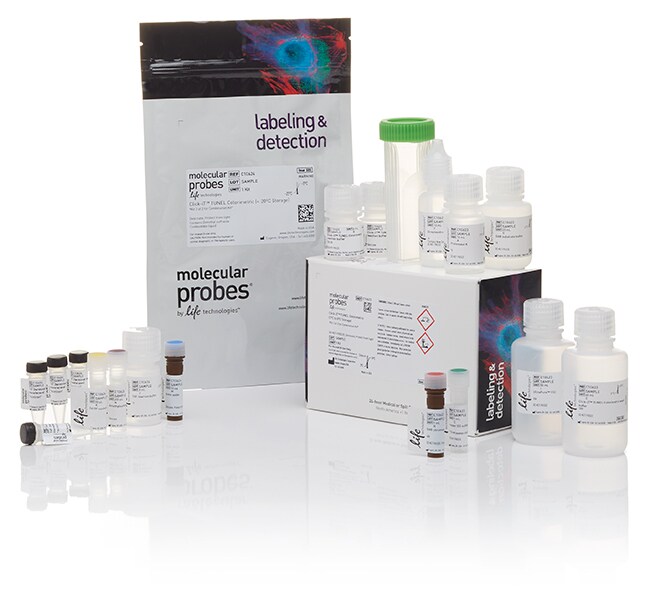
Click-iT™ TUNEL Colorimetric IHC Detection Kit
El kit Click-iT™ de detección de IHC mediante ensayos colorimétricos tipo TUNEL se utiliza para identificar células apoptóticas en muestrasMás información
| Número de catálogo | Cantidad |
|---|---|
| C10625 | 1 Kit |
Número de catálogo C10625
Precio (MXN)
-
Cantidad:
1 Kit
El kit Click-iT™ de detección de IHC mediante ensayos colorimétricos tipo TUNEL se utiliza para identificar células apoptóticas en muestras de tejidos y células cultivadas mediante el uso de una pequeña fracción de etiquetado muy específica y una conjugación de estreptavidina y peroxidasa. Tras la incorporación de la fracción de etiquetado en la fragmentación de ADN, la detección se logra mediante una reacción de clic catalizada que añade un grupo de biotina. Tras la adición del conjugado de estreptavidina y peroxidasa y un sustrato de peroxidasa, se genera una señal marrón oscuro que puede detectarse mediante microscopía óptica y almacenarse para futuros análisis.
Busque más herramientas para la detección basada en imágenes de células apoptóticas >
• Optimizado para la detección de células apoptóticas en muestras de tejido o de células.
• Ensayo colorimétrico de tipo TUNEL mejorado: mejor incorporación de las etiquetas gracias a una fracción de bajo nivel reactivo
• Aumento de la sensibilidad: la incorporación de etiquetas específicas da como resultado niveles de fondo más bajos y una señal más brillante.
• Resultados con una gran cantidad de contenido: la morfología de las células, el entorno celular y la señal apoptótica son claramente visibles.
• Flexibilidad: el ensayo puede configurarse para 50 pruebas de apoptosis de tipo TUNEL independientes
Las etapas posteriores de la apoptosis se caracterizan por la presencia de cambios en la morfología nuclear, condensación de cromatina, degradación de la envoltura nuclear y fragmentación del ADN. Los ensayos de tipo TUNEL (etiquetado de final de corte de dUTP de terminal deoxinucleotidil transferasa) se basan en la incorporación de dUTP modificados por la terminal deoxinucleotidil transferasa (TdT) en los extremos 3’-OH del ADN fragmentado. Los ensayos colorimétricos tipo TUNEL utilizan las dUTP conjugadas con una fracción de biotina, a las que se añade un conjugado de estreptavidina y peroxidasa y sustrato de peroxidasa, lo que genera una señal apoptótica marrón oscuro. Sin embargo, en los ensayos colorimétricos tipo TUNEL es habitual que el nivel de fondo sea alto, lo que reduce la sensibilidad y especificidad de la señal.
El kit de detección de IHC mediante ensayos colorimétricos tipo TUNEL se ha desarrollado para abordar estos problemas gracias a un dUTP modificado con un grupo de alquinos (un pequeño grupo funcional biortogonal) que permite que el TdT incorpore el nucleótido con mayor facilidad. Después de la incorporación, una reacción de clic muy específica forma un enlace covalente entre la azida de biotina y el grupo alquino. Se añade estreptavidina-peroxidasa (peroxidasa de rábano) seguida de sustrato de peroxidasa (DAB), lo que permite la detección colorimétrica de células apoptóticas. El alto grado de especificidad de etiquetado de la tecnología clic genera un nivel de fondo bajo y una mejor detección de las células apoptóticas.
El kit de detección de IHC mediante ensayos colorimétricos tipo TUNEL se ha optimizado y contiene todos los reactivos necesarios para la detección de células apoptóticas en muestras de tejido o células. Los reactivos que se incluyen en este kit se pueden usar para probar 50 muestras y se pueden configurar para probar desde 1 hasta 50 muestras a la vez.
Busque más herramientas para la detección basada en imágenes de células apoptóticas >
• Optimizado para la detección de células apoptóticas en muestras de tejido o de células.
• Ensayo colorimétrico de tipo TUNEL mejorado: mejor incorporación de las etiquetas gracias a una fracción de bajo nivel reactivo
• Aumento de la sensibilidad: la incorporación de etiquetas específicas da como resultado niveles de fondo más bajos y una señal más brillante.
• Resultados con una gran cantidad de contenido: la morfología de las células, el entorno celular y la señal apoptótica son claramente visibles.
• Flexibilidad: el ensayo puede configurarse para 50 pruebas de apoptosis de tipo TUNEL independientes
Las etapas posteriores de la apoptosis se caracterizan por la presencia de cambios en la morfología nuclear, condensación de cromatina, degradación de la envoltura nuclear y fragmentación del ADN. Los ensayos de tipo TUNEL (etiquetado de final de corte de dUTP de terminal deoxinucleotidil transferasa) se basan en la incorporación de dUTP modificados por la terminal deoxinucleotidil transferasa (TdT) en los extremos 3’-OH del ADN fragmentado. Los ensayos colorimétricos tipo TUNEL utilizan las dUTP conjugadas con una fracción de biotina, a las que se añade un conjugado de estreptavidina y peroxidasa y sustrato de peroxidasa, lo que genera una señal apoptótica marrón oscuro. Sin embargo, en los ensayos colorimétricos tipo TUNEL es habitual que el nivel de fondo sea alto, lo que reduce la sensibilidad y especificidad de la señal.
El kit de detección de IHC mediante ensayos colorimétricos tipo TUNEL se ha desarrollado para abordar estos problemas gracias a un dUTP modificado con un grupo de alquinos (un pequeño grupo funcional biortogonal) que permite que el TdT incorpore el nucleótido con mayor facilidad. Después de la incorporación, una reacción de clic muy específica forma un enlace covalente entre la azida de biotina y el grupo alquino. Se añade estreptavidina-peroxidasa (peroxidasa de rábano) seguida de sustrato de peroxidasa (DAB), lo que permite la detección colorimétrica de células apoptóticas. El alto grado de especificidad de etiquetado de la tecnología clic genera un nivel de fondo bajo y una mejor detección de las células apoptóticas.
El kit de detección de IHC mediante ensayos colorimétricos tipo TUNEL se ha optimizado y contiene todos los reactivos necesarios para la detección de células apoptóticas en muestras de tejido o células. Los reactivos que se incluyen en este kit se pueden usar para probar 50 muestras y se pueden configurar para probar desde 1 hasta 50 muestras a la vez.
Para uso exclusivo en investigación. No apto para uso en procedimientos diagnósticos.
Especificaciones
Para utilizar con (equipo)Sistema de adquisición de imágenes EVOS™ XL Core, sistema de adquisición de imágenes EVOS™ XL
Línea de productosClick-iT
Tipo de productoKit de detección de IHC colorimétrico TUNEL
Cantidad1 Kit
Condiciones de envíoHielo seco
Método de detecciónColorimétrico
FormatoPortaobjetos
Unit SizeEach
Contenido y almacenamiento
Condiciones de almacenamiento mixtas para los componentes del kit: De 2 a 8 °C y de -5 a -30 °C
Preguntas frecuentes
Can Metal Enhanced DAB Substrate Kit (Cat No. 34065) be used instead of the DAB provided in the Click-iT TUNEL Colorimetric IHC Detection Kit?
Can the Click-iT TUNEL Colorimetric IHC Detection Kit be used with other colorimetric dyes?
I ran out of the TdT enzyme used in the Click-iT TUNEL assay. Can I purchase it separately?
Can I perform Click-iT EdU TUNEL detection on cells growing in 3D culture?
For the Click-iT TUNEL for In Situ Apoptosis Detection Assay, how long should I digest my tissue samples in proteinase K?
Citations & References (13)
Citations & References
Abstract
Usp9X Regulates Cell Death in Malignant Peripheral Nerve Sheath Tumors.
Journal:Sci Rep
PubMed ID:30478285
'Malignant peripheral nerve sheath tumors (MPNSTs) are the leading cause of death in neurofibromatosis type 1 (NF1) patients. Current treatment modalities have been largely unsuccessful in improving MPNST patient survival, making the identification of new therapeutic targets urgent. In this study, we found that interference with Usp9X, a deubiquitinating enzyme
Inhibition of Hedgehog signaling reprograms the dysfunctional immune microenvironment in breast cancer.
Journal:Oncoimmunology
PubMed ID:30723576
'Host responses to tumor cells include tumor suppressing or promoting mechanisms. We sought to detail the effect of Hedgehog (Hh) pathway inhibition on the composition of the mammary tumor immune portfolio. We hypothesized that Hh signaling mediates a crosstalk between breast cancer cells and macrophages that dictates alternative polarization of
The structural atrophy of the aneurysm wall in secondary expanding aortic aneurysms with endoleak type II.
Journal:J Vasc Surg
PubMed ID:30792063
'Abdominal aortic aneurysm (AAA) has an age-dependent prevalence of 2% to 11% and is a leading cause of death in men aged >65 years if not treated surgically. Today, endovascular aneurysm repair (EVAR) is performed in up to 80% of elective cases and 60% of ruptured cases. Although EVAR improves perioperative,
Anti-tumor effect of cisplatin in human oral squamous cell carcinoma was enhanced by andrographolide via upregulation of phospho-p53 in vitro and in vivo.
Journal:Tumour Biol
PubMed ID:28513299
'Oral squamous cell carcinoma is one of the most common neoplasm in the world. Despite the improvements in diagnosis and treatment, the outcome is still poor now. Thus, the development of novel therapeuticapproaches is needed. The aim of this study is to assess the synergistic anti-tumor effect of andrographolide with
Synergistic anti-tumor efficacy of sorafenib and fluvastatin in hepatocellular carcinoma.
Journal:Oncotarget
PubMed ID:28423574
Drug resistance to sorafenib is common in patients with hepatocellular carcinoma(HCC). We examined the effects of a combination of sorafenib and fluvastatin on HCC using in vitro and in vivo models. The dual treatment induced apoptosis and reduced cellular viability in HCC more effectively than either drug alone. The combination