Search


Citas y referencias (7)
Invitrogen™
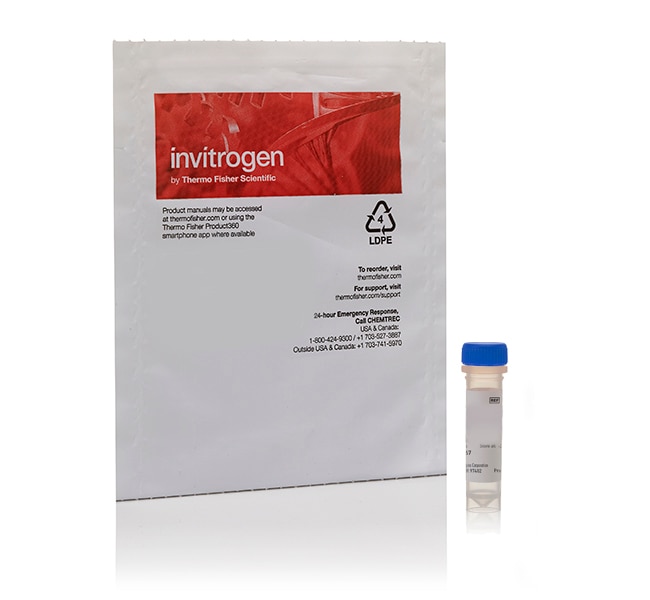
Click-IT™ ManNAz Metabolic Glycoprotein Labeling Reagent (tetraacetylated N-Azidoacetyl-D-Mannosamine)
El reactivo de etiquetado de glicoproteínas metabólicas de ManNAz Click-iT™ proporciona la primera parte de una técnica simple y sólidaMás información
| Número de catálogo | Cantidad |
|---|---|
| C33366 | 5,2 mg |
Número de catálogo C33366
Precio (MXN)
-
Cantidad:
5,2 mg
El reactivo de etiquetado de glicoproteínas metabólicas de ManNAz Click-iT™ proporciona la primera parte de una técnica simple y sólida de dos pasos para identificar y caracterizar las glicoproteínas que contienen ácido siálico de la superficie celular. En el primer paso, las células cultivadas se incuban con la manosamina modificada con azida (ManNAz). El azido-azúcar se incorpora metabólicamente en las glicoproteínas que contienen ácido siálico de la superficie celular a través de la naturaleza permisiva de la ruta de biosíntesis de oligosacáridos. En el segundo paso, a través de la ligadura quimioselectiva o la reacción de clic entre una azida y un alquino, las glicoproteínas etiquetadas con azido se pueden detectar con un kit de detección de glicoproteínas Click-iT™ para geles (alquino TAMRA o Dapoxyl™) o Western blots (alquino biotina). Estos productos Click-iT™ son compatibles con LC-MS⁄MS y tecnologías Multiplexed Proteomics™ para realizar análisis exhaustivos del glicoproteoma.
Para uso exclusivo en investigación. No apto para uso en procedimientos diagnósticos.
Especificaciones
Método de detecciónCon base de biotina, fluorescente
Línea de productosClick-iT
Tipo de productoReactivo de etiquetado
Cantidad5,2 mg
Condiciones de envíoTemperatura ambiente
Labeling TargetProteínas
Etiqueta o tinteAlexa Fluor 488, Alexa Fluor 555, Alexa Fluor 594, Alexa Fluor 647, biotina, Oregon Green 488, TMR (tetrametilrodamina)
Unit SizeEach
Contenido y almacenamiento
Almacenar en congelador entre -5 °C y -30 °C
Citations & References (7)
Citations & References
Abstract
Metabolic labeling of glycans with azido sugars for visualization and glycoproteomics.
Journal:Methods Enzymol
PubMed ID:17116478
'The staggering complexity of glycans renders their analysis extraordinarily difficult, particularly in living systems. A recently developed technology, termed metabolic oligosaccharide engineering, enables glycan labeling with probes for visualization in cells and living animals, and enrichment of specific glycoconjugate types for proteomic analysis. This technology involves metabolic labeling of glycans
Copper-free click chemistry for highly luminescent quantum dot conjugates: application to in vivo metabolic imaging.
Journal:Bioconjug Chem
PubMed ID:20222737
Quantum dots (QD) are inorganic nanocrystals with outstanding optical properties, specially suited for biological imaging applications. Their attachment to biomolecules in mild aqueous conditions for the design of bioconjugates is therefore highly desirable. 1,3-dipolar [3 + 2] cycloaddition between azides and terminal alkynes (
Dynamic monitoring of newly synthesized proteomes: up-regulation of myristoylated protein kinase A during butyric acid induced apoptosis.
Journal:Angew Chem Int Ed Engl
PubMed ID:21678537
Doubly charged: A double metabolic incorporation approach capable of proteome-wide profiling of post-translational modification dynamics on newly synthesized proteins has been developed (see scheme; blue box: methionine surrogate, orange diamond: PTM probe). This strategy reveals for the first time that up-regulation of myristoylated PKA protein is necessary for the occurrence
Sialic Acids Attached to O-Glycans Modulate Voltage-gated Potassium Channel Gating.
Journal:J Biol Chem
PubMed ID:21115483
Neuronal, cardiac, and skeletal muscle action potentials are produced and conducted through the highly regulated activity of several types of voltage-gated ion channels. Voltage-gated potassium (K(v)) channels are responsible for action potential repolarization. Glycans can be attached to glycoproteins through N- and O-linkages. Previous reports described the impact of N-glycans
A FRET-based fluorogenic phosphine for live-cell imaging with the Staudinger ligation.
Journal:Angew Chem Int Ed Engl
PubMed ID:18306205
Fluorescent phosphine probes have been used for direct imaging of various azide-bearing biomolecules with the Staudinger ligation in cell-free environments. Recently, we applied phosphine-based dyes to image azides on the surface of live cells. Notably, significant labeling above background could only be achieved using a highly negatively charged