Search


Citas y referencias (74)
Invitrogen™
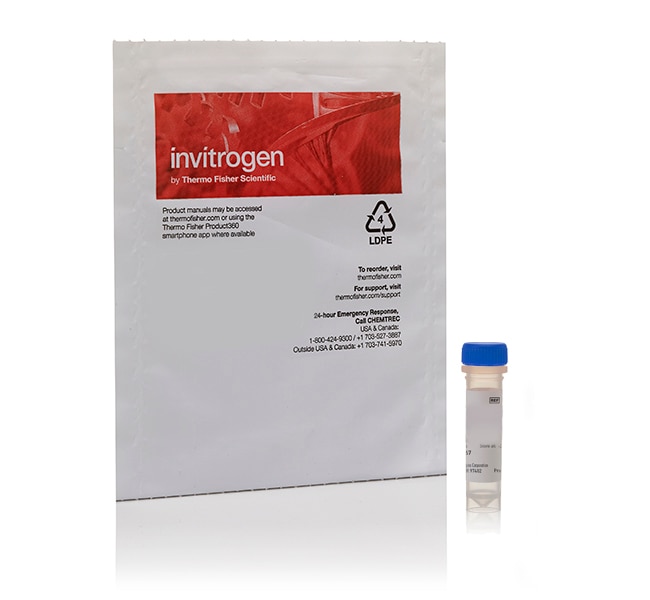
Cholera Toxin Subunit B (Recombinant), Alexa Fluor™ 488 Conjugate
Molecular Probes™ cholera toxin conjugates are made from a recombinant version of the B subunit only. This allows us toMás información
Have Questions?
Cambiar vista

| Número de catálogo | Cantidad |
|---|---|
| C34775 | 100 μg |
| C22841 | 500 μg |
Número de catálogo C34775
Precio (MXN)
-
Cantidad:
100 μg
Molecular Probes™ cholera toxin conjugates are made from a recombinant version of the B subunit only. This allows us to provide a very high-purity product that is completely free of the toxic A subunit. Cholera toxin B subunit (CT-B) attaches to cells by binding to ganglioside GM1, making it a powerful tool for retrograde labeling of neurons. This tracer has been used in a variety of applications, including tracing of rat forebrain afferents, projections of the parabrachial region, and neurons of the urinary bladder wall. When used in neuronal tracing applications, CT-B is typically introduced by pressure injection or by iontophoretic injection into neural tissue.
Cholera Toxin Subunit B Specifications:
• Label (Ex/Em): Alexa Fluor™ 488 (495/519 nm)
• At neutral pH, the 11.4 kDa B subunit exists as a 57 kDa pentamer
• Lyophilized product can be dissolved in buffer (e.g., PBS) for use
Cholera Toxin Subunit B for Studying Lipid Rafts
More recently, researchers have found that CT-B can be used as a marker for lipid rafts, which are membrane microdomains enriched in cholesterol and sphingolipids thought to be important in cell signaling. For lipid raft staining, cells are first incubated with fluorescent CT-B. Then, an anti–CT-B antibody is added to crosslink the CT-B in the lipid rafts into distinct patches on the plasma membrane. These patches are easily visualized by fluorescence microscopy. In addition to individual fluorescent CT-B conjugates, we also offer Vybrant™ Lipid Raft Labeling Kits that contain the Alexa Fluor™ 488, Alexa Fluor™ 555, or Alexa Fluor™ 594 dye conjugates of CT-B, an anti–CT-B antibody, and a detailed protocol for labeling and preparing cells for fluorescence microscopy.
Find More CT-B Conjugates
We offer various CT-B conjugates. Review Protein Conjugates—Section 14.7 in the Molecular Probes™ Handbook for more information on these tracers.
For Research Use Only. Not for human or animal therapeutic or diagnostic use.
Cholera Toxin Subunit B Specifications:
• Label (Ex/Em): Alexa Fluor™ 488 (495/519 nm)
• At neutral pH, the 11.4 kDa B subunit exists as a 57 kDa pentamer
• Lyophilized product can be dissolved in buffer (e.g., PBS) for use
Cholera Toxin Subunit B for Studying Lipid Rafts
More recently, researchers have found that CT-B can be used as a marker for lipid rafts, which are membrane microdomains enriched in cholesterol and sphingolipids thought to be important in cell signaling. For lipid raft staining, cells are first incubated with fluorescent CT-B. Then, an anti–CT-B antibody is added to crosslink the CT-B in the lipid rafts into distinct patches on the plasma membrane. These patches are easily visualized by fluorescence microscopy. In addition to individual fluorescent CT-B conjugates, we also offer Vybrant™ Lipid Raft Labeling Kits that contain the Alexa Fluor™ 488, Alexa Fluor™ 555, or Alexa Fluor™ 594 dye conjugates of CT-B, an anti–CT-B antibody, and a detailed protocol for labeling and preparing cells for fluorescence microscopy.
Find More CT-B Conjugates
We offer various CT-B conjugates. Review Protein Conjugates—Section 14.7 in the Molecular Probes™ Handbook for more information on these tracers.
For Research Use Only. Not for human or animal therapeutic or diagnostic use.
For Research Use Only. Not for use in diagnostic procedures.
Especificaciones
Tipo de etiquetaAlexa Fluor Dyes
Línea de productosAlexa Fluor
Forma de proteínaRecombinant
Subtipo de proteínaCholera Toxin
Cantidad100 μg
Condiciones de envíoRoom Temperature
ConjugadoAlexa Fluor 488
FormularioLyophilized
RecombinanteRecombinant
Unit SizeEach
Contenido y almacenamiento
Store in freezer (-5 to -30°C) and protect from light.
Preguntas frecuentes
I injected a fluorescent tracer, but cannot detect it after tissue is fixed and sectioned. What am I doing wrong?
Do you have a tracer that will only transport retrograde?
How do I know which tracer to choose for my experiment?
What products do you have for neuronal tracing?
Citations & References (74)
Citations & References
Abstract
Cocaine evokes projection-specific synaptic plasticity of lateral habenula neurons.
Journal:J Neurosci
PubMed ID:22956853
Addictive drugs share the ability to increase dopamine (DA) levels and trigger synaptic adaptations in the mesocorticolimbic system, two cellular processes engaged in the early stages of drug seeking. Neurons located in the lateral habenula (LHb) modulate the activity of DA neurons and DA release, and adaptively tune goal-directed behaviors.
Intracellular trafficking of Clostridium perfringens iota-toxin b.
Journal:Infect Immun
PubMed ID:22825447
'Clostridium perfringens iota-toxin is composed of an enzymatic component (Ia) and a binding component (Ib). Ib binds to a cell surface receptor, undergoes oligomerization in lipid rafts, and binds Ia. The resulting complex is then endocytosed. Here, we show the intracellular trafficking of iota-toxin. After the binding of the Ib
The B cell-specific major raft protein, Raftlin, is necessary for the integrity of lipid raft and BCR signal transduction.
Journal:EMBO J
PubMed ID:12805216
'Recent evidence indicates that membrane microdomains, termed lipid rafts, have a role in B-cell activation as platforms for B-cell antigen receptor (BCR) signal initiation. To gain an insight into the possible functioning of lipid rafts in B cells, we applied liquid chromatography electrospray ionization tandem mass spectrometry (LC-ESI-MS/MS) methodologies to
Lipid raft microdomains: a gateway for compartmentalized trafficking of Ebola and Marburg viruses.
Journal:J Exp Med
PubMed ID:11877482
'Spatiotemporal aspects of filovirus entry and release are poorly understood. Lipid rafts act as functional platforms for multiple cellular signaling and trafficking processes. Here, we report the compartmentalization of Ebola and Marburg viral proteins within lipid rafts during viral assembly and budding. Filoviruses released from infected cells incorporated raft-associated molecules,
Identification and characterization of small molecules that inhibit intracellular toxin transport.
Journal:Infect Immun
PubMed ID:17576758
'Shiga toxin (Stx), cholera toxin (Ctx), and the plant toxin ricin are among several toxins that reach their intracellular destinations via a complex route. Following endocytosis, these toxins travel in a retrograde direction through the endosomal system to the trans-Golgi network, Golgi apparatus, and endoplasmic reticulum (ER). There the toxins