Search

Invitrogen™
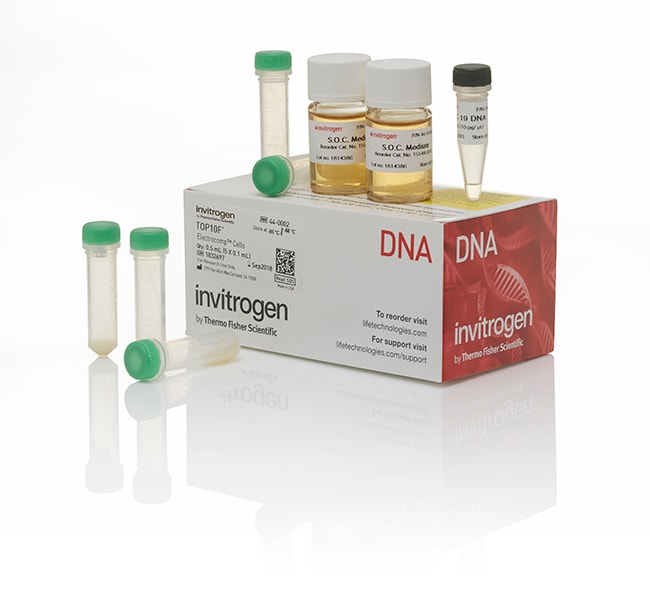
TOP10F' Electrocomp™ Kit
El genotipo de las células TOP10F’ es idéntico al de las células TOP10, con la adición de un episoma F'.Más información
| Número de catálogo | Cantidad |
|---|---|
| C66511 | 10 x 100 μl |
Número de catálogo C66511
Precio (MXN)
-
Cantidad:
10 x 100 μl
El genotipo de las células TOP10F’ es idéntico al de las células TOP10, con la adición de un episoma F'. El episoma F' contiene el gen de resistencia a la tetraciclina y permite aislar al ADN de una sola cadena de vectores que tengan un origen de replicación de f1. Además, el episoma F contiene el represor lacIq para la expresión inducible de los promotores trc, tac y lac con IPTG. Las células TOP10F requieren inducción IPTG para la detección del color azul/blanco.
El genotipo de las células TOP10F ofrece las siguientes características:
• hsdR para una transformación eficaz de ADN no metilado procedente de amplificaciones de PCR
• mcrA para una transformación eficaz de ADN metilado procedente de preparaciones genómicas
• lacZΔM15 para la detección del color azul/blanco de clones recombinantes
• endA1 para unas preparaciones de ADN más transparentes y mejores resultados en aplicaciones posteriores debido a la eliminación de la digestión inespecífica por parte de endonucleasa I
• recA1 para reducir los casos de recombinación inespecífica en ADN clonado
• Represor lacIq para la expresión inducible de los promotores trc, tac, and lac
Nota: Este kit contiene suficientes células electrocompetentes para 25 x 40 µl rxns o 50 x 20 µl rxns. Consulte el manual del producto para conocer las recomendaciones de escalas de reacción.
Genotipo:
F'{lacIqTn10(TetR)} mcrA Δ(mrr-hsdRMS-mcrBC) φ80lacZΔM15 ΔlacX74 recA1 araD139 Δ(ara-leu)7697 galU galK rpsL endA1 nupG
El genotipo de las células TOP10F ofrece las siguientes características:
• hsdR para una transformación eficaz de ADN no metilado procedente de amplificaciones de PCR
• mcrA para una transformación eficaz de ADN metilado procedente de preparaciones genómicas
• lacZΔM15 para la detección del color azul/blanco de clones recombinantes
• endA1 para unas preparaciones de ADN más transparentes y mejores resultados en aplicaciones posteriores debido a la eliminación de la digestión inespecífica por parte de endonucleasa I
• recA1 para reducir los casos de recombinación inespecífica en ADN clonado
• Represor lacIq para la expresión inducible de los promotores trc, tac, and lac
Nota: Este kit contiene suficientes células electrocompetentes para 25 x 40 µl rxns o 50 x 20 µl rxns. Consulte el manual del producto para conocer las recomendaciones de escalas de reacción.
Genotipo:
F'{lacIqTn10(TetR)} mcrA Δ(mrr-hsdRMS-mcrBC) φ80lacZΔM15 ΔlacX74 recA1 araD139 Δ(ara-leu)7697 galU galK rpsL endA1 nupG
Para uso exclusivo en investigación. No apto para uso en procedimientos diagnósticos.
Especificaciones
Tramado azul/blancoSí
Clonación de ADN metiladoSí
Clonación de ADN inestableNo es adecuado para clonar ADN inestable
Mejora la calidad de los plásmidosSí
PlásmidoSe puede utilizar para plasmidos > 20 kb
Preparación de ADN no metiladoNo es adecuado para preparar ADN no metilado
Línea de productosElectrocomp
Tipo de productoKit Electrocomp
Cantidad10 x 100 μl
Reduce la recombinaciónSí
Condiciones de envíoDry Ice
Nivel de eficiencia de transformaciónAlta eficiencia (> 10^9 cfu⁄μg)
FormatoTubo
EspecieE. coli
Unit SizeEach
Contenido y almacenamiento
Este kit contiene una cantidad suficiente de células eléctricamente competentes para reacciones de 40 x 20 μL o 40 x 20 μL Consulte el manual del producto para conocer las recomendaciones de escalas de reacción.