Search


Citas y referencias (6)
Invitrogen™
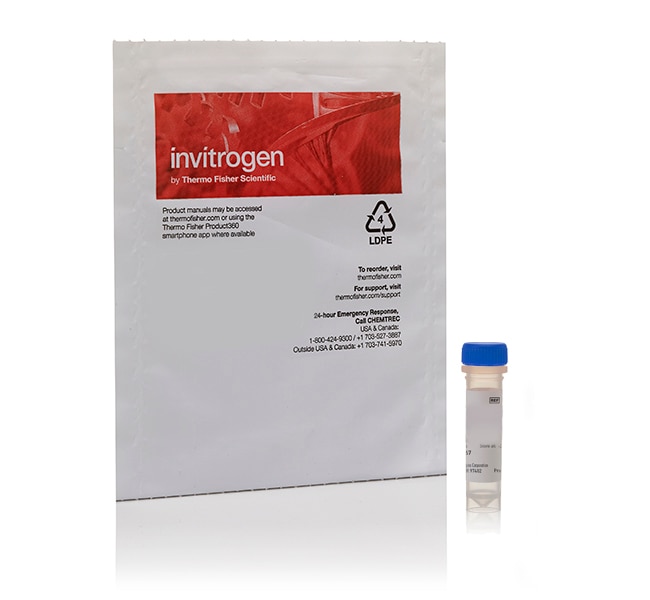
Escherichia coli (K-12 strain) BioParticles™, Alexa Fluor™ 488 conjugate
La línea de productos Molecular Probes™ BioParticles™ está formada por una serie de bacterias y levaduras marcadas con fluorescencia yMás información
| Número de catálogo | Cantidad |
|---|---|
| E13231 | 2 mg |
Número de catálogo E13231
Precio (MXN)
-
Cantidad:
2 mg
La línea de productos Molecular Probes™ BioParticles™ está formada por una serie de bacterias y levaduras marcadas con fluorescencia y matadas por calor o químicamente en una variedad de tamaños, formas y antigenicidades naturales. Estos productos fluorescentes de BioParticles™ se han empleado para estudiar la fagocitosis por microscopia de fluorescencia, la espectrofluorometría cuantitativa y la citometría de flujo.
Ofrecemos los conjugados BioParticles™ E. coli (cepa K-12), S. aureus (cepa Wood, sin proteína A) y zymosan (S. cerevisiae) con marcado covalente y distintos fluoróforos diferentes (se ha tenido especial cuidado para eliminar el colorante libre después de la conjugación). A diferencia de la fluorescencia de los conjugados BioParticles™ marcados con fluoresceína, que se encuentra parcialmente suprimida en ambientes ácidos, la fluorescencia de los conjugados de colorante Alexa Fluor™, BODIPY™ FL, tetrametilrodamina y Texas Red™ es uniformemente intensa en el rango de pH de 3 a 10.
Especificaciones de BioParticles:
• Etiqueta (Ex/Em): Alexa Fluor™ 488 (∼ 495/519 nm)
• Partícula: E. coli (cepa K-12)
• Reactivo de opsonización disponible
Uso de productos BioParticles
Los conjugados BioParticles™ se suministran en forma de polvos liofilizados. Hay aproximadamente 3 x 10⁸ partículas de E. coli o S. aureus por mg sólido y aproximadamente 2 x 10⁷ partículas de zimosano por mg sólido. Los conjugados BioParticles™ pueden reconstituirse en el tampón que prefiera para su uso en ensayos de fagocitosis. La fluorescencia de los conjugados BioParticles™ que están unidos a la superficie celular (pero no internalizados) puede suprimirse mediante bromuro de etidio, azul de tripano u otros supresores. Además de las aplicaciones celulares, los conjugados fluorescentes BioParticles™ pueden ser eficaces como referencias de calibración de citómetros de flujo al clasificar bacterias y mutantes de la levadura. Estas pequeñas partículas también pueden ser referencias útiles para estudios sobre la dispersión de la luz porque sus tamaños y formas difieren de manera característica.
Encuentre más productos BioParticles™
Ofrecemos una amplia gama de productos BioParticles™ E. coli (K-12 strain), S. aureus (cepa Wood, sin proteína A) y zymosan (S. Cerevisiae)) marcados con colorante y sin marcar. Para obtener más información sobre estos productos y sus aplicaciones, consulte Probes for Following Receptor Binding and Phagocytosis—Section 16.1 (Sondas para seguir la unión de receptores y la fagocitosis, sección 16.1) en el manual de Molecular Probes™.
Para ensayos de endocitosis sensibles al pH, consulte nuestros conjugados pHrodo™ BioParticles™.
Para uso exclusivo en investigación. No apto para uso diagnóstico o terapéutico en humanos ni en animales.
Ofrecemos los conjugados BioParticles™ E. coli (cepa K-12), S. aureus (cepa Wood, sin proteína A) y zymosan (S. cerevisiae) con marcado covalente y distintos fluoróforos diferentes (se ha tenido especial cuidado para eliminar el colorante libre después de la conjugación). A diferencia de la fluorescencia de los conjugados BioParticles™ marcados con fluoresceína, que se encuentra parcialmente suprimida en ambientes ácidos, la fluorescencia de los conjugados de colorante Alexa Fluor™, BODIPY™ FL, tetrametilrodamina y Texas Red™ es uniformemente intensa en el rango de pH de 3 a 10.
Especificaciones de BioParticles:
• Etiqueta (Ex/Em): Alexa Fluor™ 488 (∼ 495/519 nm)
• Partícula: E. coli (cepa K-12)
• Reactivo de opsonización disponible
Uso de productos BioParticles
Los conjugados BioParticles™ se suministran en forma de polvos liofilizados. Hay aproximadamente 3 x 10⁸ partículas de E. coli o S. aureus por mg sólido y aproximadamente 2 x 10⁷ partículas de zimosano por mg sólido. Los conjugados BioParticles™ pueden reconstituirse en el tampón que prefiera para su uso en ensayos de fagocitosis. La fluorescencia de los conjugados BioParticles™ que están unidos a la superficie celular (pero no internalizados) puede suprimirse mediante bromuro de etidio, azul de tripano u otros supresores. Además de las aplicaciones celulares, los conjugados fluorescentes BioParticles™ pueden ser eficaces como referencias de calibración de citómetros de flujo al clasificar bacterias y mutantes de la levadura. Estas pequeñas partículas también pueden ser referencias útiles para estudios sobre la dispersión de la luz porque sus tamaños y formas difieren de manera característica.
Encuentre más productos BioParticles™
Ofrecemos una amplia gama de productos BioParticles™ E. coli (K-12 strain), S. aureus (cepa Wood, sin proteína A) y zymosan (S. Cerevisiae)) marcados con colorante y sin marcar. Para obtener más información sobre estos productos y sus aplicaciones, consulte Probes for Following Receptor Binding and Phagocytosis—Section 16.1 (Sondas para seguir la unión de receptores y la fagocitosis, sección 16.1) en el manual de Molecular Probes™.
Para ensayos de endocitosis sensibles al pH, consulte nuestros conjugados pHrodo™ BioParticles™.
Para uso exclusivo en investigación. No apto para uso diagnóstico o terapéutico en humanos ni en animales.
Para uso exclusivo en investigación. No apto para uso en procedimientos diagnósticos.
Especificaciones
Tipo de célulaCélula de mamífero
Método de detecciónFluorescente
Tipo de coloranteAlexa Fluor™ 488
FormularioSólido
Cantidad2 mg
Condiciones de envíoHielo seco
EspecieE. coli
Para utilizar con (equipo)Microscopio de fluorescencia
Línea de productosAlexa Fluor, BioParticles
Tipo de productoConjugado E. coli
Unit SizeEach
Contenido y almacenamiento
Almacenar en el congelador (de – 5 a – 30 °C) y proteger de la luz.
Preguntas frecuentes
How are the Escherichia coli (K-12 strain) BioParticles, Alexa Fluor 488 conjugate supplied?
What is the particle size of Escherichia coli (K-12 strain) BioParticles, Alexa Fluor™ 488 conjugate (Cat. No. E13231)?
Are the Invitrogen BioParticles products sterile?
What is the type of bond that attaches the dyes to the BioParticles probes?
What cellular processes can be analyzed with a flow cytometer?
Citations & References (6)
Citations & References
Abstract
Extracellular Matrix Lumican Promotes Bacterial Phagocytosis, and Lum-/- Mice Show Increased Pseudomonas aeruginosa Lung Infection Severity.
Journal:J Biol Chem
PubMed ID:22865855
'Phagocytosis is central to bacterial clearance, but the exact mechanism is incompletely understood. Here, we show a novel and critical role for lumican, the connective tissue extracellular matrix small leucine-rich repeat proteoglycan, in CD14-mediated bacterial phagocytosis. In Psuedomonas aeruginosa lung infections, lumican-deficient (Lum(-/-)) mice failed to clear the bacterium from
Multipotent stem cells from trabecular meshwork become phagocytic TM cells.
Journal:Invest Ophthalmol Vis Sci
PubMed ID:22297497
'To isolate and characterize stem cells from human trabecular meshwork (TM) and to investigate the potential of these stem cells to differentiate into TM cells. Human trabecular meshwork stem cells (TMSCs) were isolated as side population cells by fluorescence-activated cell sorting or isolated by clonal cultures. Passaged TMSCs were compared
Antibody to Langerin/CD207 localizes large numbers of CD8alpha+ dendritic cells to the marginal zone of mouse spleen.
Journal:Proc Natl Acad Sci U S A
PubMed ID:19168629
Dendritic cells (DCs) are strategically positioned to take up antigens and initiate adaptive immunity. One DC subset expresses CD8alphaalpha in mice and is specialized to capture dying cells and process antigens for MHC class I
PLD$ is involved in phagocytosis of microglia: expression and localization changes of PLD4 are correlated with activation state of microglia.
Journal:PLoS One
PubMed ID:22102906
Phospholipase D4 (PLD4) is a recently identified protein that is mainly expressed in the ionized calcium binding adapter molecule 1 (Iba1)-positive microglia in the early postnatal mouse cerebellar white matter. Unlike PLD1 and PLD2, PLD4 exhibits no enzymatic activity for conversion of phosphatidylcholine into choline and phosphatidic acid, and its
Live cell imaging of zebrafish leukocytes.
Journal:Methods Mol Biol
PubMed ID:19378109
Zebrafish are ideally suited for the live imaging of early immune cell compartments. Macrophages that initially appear on the yolk surface prior to the onset of circulation are the first functional immune cells within the embryo, predating the emergence of the first granulocytic cells-the heterophilic neutrophils. Both cell types have