Search


Citas y referencias (6)
Invitrogen™
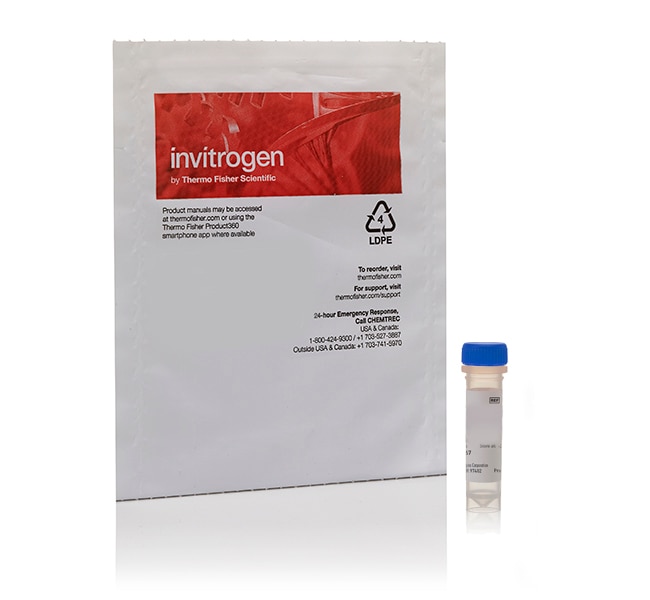
Image-IT™ DEAD Green™ Viability Stain
La tinción de viabilidad verde Image-iT® DEAD™ es un indicador de viabilidad rápido, sensible y fácil de usar que tambiénMás información
| Número de catálogo | Cantidad |
|---|---|
| I10291 | 1 vial |
Número de catálogo I10291
Precio (MXN)
-
Cantidad:
1 vial
La tinción de viabilidad verde Image-iT® DEAD™ es un indicador de viabilidad rápido, sensible y fácil de usar que también es susceptible de fijación y permeabilidad, lo que permite el multiplexing con otros biomarcadores de citotoxicidad. El colorante verde Image-iT® DEAD™ es impermeable a las células sanas y se vuelve permeable cuando la membrana plasmática de las células está en riesgo.
Para uso exclusivo en investigación. No apto para uso en procedimientos diagnósticos.
Especificaciones
Concentración1 mM
Método de detecciónFluorescente
Longitud de onda de emisiónVisible
FormularioLíquido
Cantidad1 vial
Condiciones de envíoHielo húmedo
Localización subcelularNucleus
ColorVerde
Para utilizar con (aplicación)Ensayo de viabilidad
Para utilizar con (equipo)Microscopio de fluorescencia
Línea de productosImage-iT, Molecular Probes
Tipo de productoTinción de viabilidad
Unit SizeEach
Contenido y almacenamiento
La tinción incluye material suficiente para realizar 10 placas en formato de placa de 96 pocillos y 50 μl de volumen de pocillos.Almacenar a ≤ −20 °C, desecar y proteger de la luz.
Preguntas frecuentes
Do you offer a cell viability stain compatible with fixation?
Which cell viability kits are compatible with fixation?
Citations & References (6)
Citations & References
Abstract
Global metabolic profiling of infection by an oncogenic virus: KSHV induces and requires lipogenesis for survival of latent infection.
Journal:PLoS Pathog
PubMed ID:22916018
Like cancer cells, virally infected cells have dramatically altered metabolic requirements. We analyzed global metabolic changes induced by latent infection with an oncogenic virus, Kaposi's Sarcoma-associated herpesvirus (KSHV). KSHV is the etiologic agent of Kaposi's Sarcoma (KS), the most common tumor of AIDS patients. Approximately one-third of the nearly 200
Antibody-targeted nanovectors for the treatment of brain cancers.
Journal:ACS Nano
PubMed ID:22390360
Introduced here is the hydrophilic carbon clusters (HCCs) antibody drug enhancement system (HADES), a methodology for cell-specific drug delivery. Antigen-targeted, drug-delivering nanovectors are manufactured by combining specific antibodies with drug-loaded poly(ethylene glycol)-HCCs (PEG-HCCs). We show that HADES is highly modular, as both the drug and antibody component can be varied
Analysis of cell cycle and replication of mouse macrophages after in vivo and in vitro Cryptococcus neoformans infection using laser scanning cytometry.
Journal:Infect Immun
PubMed ID:22252872
We investigated the outcome of the interaction of Cryptococcus neoformans with murine macrophages using laser scanning cytometry (LSC). Previous results in our lab had shown that phagocytosis of C. neoformans promoted cell cycle progression. LSC allowed us to simultaneously measure the phagocytic index, macrophage DNA content, and 5-ethynyl-2'-deoxyuridine (EdU) incorporation
Induction of the Warburg effect by Kaposi's sarcoma herpesvirus is required for the maintenance of latently infected endothelial cells.
Journal:Proc Natl Acad Sci U S A
PubMed ID:20498071
Kaposi's sarcoma (KS) is the most commonly reported tumor in parts of Africa and is the most common tumor of AIDS patients world-wide. KS-associated herpesvirus (KSHV) is the etiologic agent of KS. Although KS tumors contain many cell types, the predominant cell is the spindle cell, a cell of endothelial
Miniaturized modular-array fluorescence microscopy.
Journal:Biomed Opt Express
PubMed ID:33408992