Search


Citas y referencias (1)
Invitrogen™
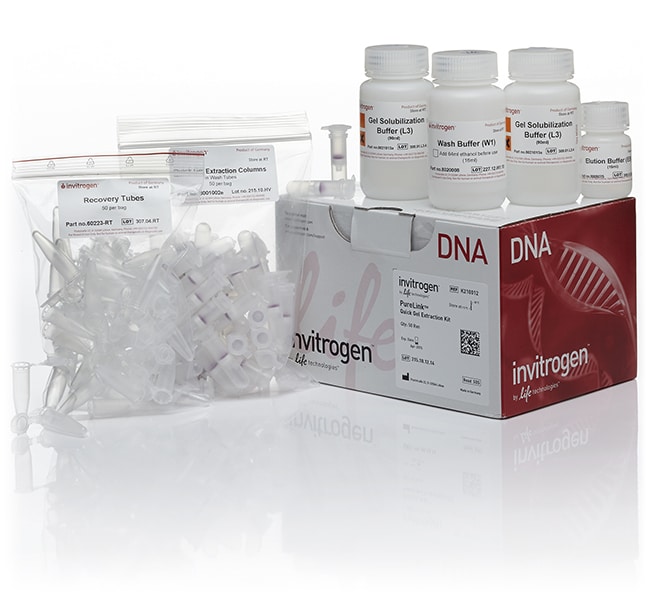
Kit de extracción de gel rápida PureLink™
El kit de extracción rápida de gel PureLink™ le permite purificar de manera rápida y eficaz fragmentos de ADN aMás información
Have Questions?
Cambiar vista

| Número de catálogo | Cantidad |
|---|---|
| K210012 | 50 preparaciones |
| K210025 | 250 preparaciones |
Número de catálogo K210012
Precio (MXN)
3,523.90
Each
Cantidad:
50 preparaciones
Precio (MXN)
3,523.90
Each
El kit de extracción rápida de gel PureLink™ le permite purificar de manera rápida y eficaz fragmentos de ADN a partir de geles de agarosa TAE o TBE con diversos porcentajes. El ADN se puede extraer y purificar a partir de geles de agarosa con diferentes puntos de fusión en ∼30 minutos mediante columnas de extracción rápida de gel PureLink™ basadas en membranas de sílice. Para su comodidad, se ofrecen protocolos de purificación para centrifugación y vacío.
Ventajas de utilizar el kit de extracción rápida de gel PureLink™:
• Purificación sencilla de fragmentos de ADN de geles de agarosa TAE y TBE con varios porcentajes y puntos de fusión
• Realización del procedimiento en ∼30 minutos
• Purificación sencilla de fragmentos de ADN de 40 bp a 10 kb a partir de los geles
• Obtención de una alta recuperación de fragmentos de ADN
• Unión y purificación de hasta 15 µg de ADN con una columna
• Purificación de fragmentos de ADN que son de alta calidad y presentación de un rendimiento fiable en PCR, digestión de enzimas de restricción, clonación y etiquetado
Nota: el kit de extracción rápida de gel PureLink™ no está diseñado para purificar ADN plasmídico superhelicoidal ni ADN genómico a partir de geles de agarosa. Si se utiliza este kit, solo se podrán purificar fragmentos de ADN lineal a partir de los geles.
Ventajas de utilizar el kit de extracción rápida de gel PureLink™:
• Purificación sencilla de fragmentos de ADN de geles de agarosa TAE y TBE con varios porcentajes y puntos de fusión
• Realización del procedimiento en ∼30 minutos
• Purificación sencilla de fragmentos de ADN de 40 bp a 10 kb a partir de los geles
• Obtención de una alta recuperación de fragmentos de ADN
• Unión y purificación de hasta 15 µg de ADN con una columna
• Purificación de fragmentos de ADN que son de alta calidad y presentación de un rendimiento fiable en PCR, digestión de enzimas de restricción, clonación y etiquetado
Nota: el kit de extracción rápida de gel PureLink™ no está diseñado para purificar ADN plasmídico superhelicoidal ni ADN genómico a partir de geles de agarosa. Si se utiliza este kit, solo se podrán purificar fragmentos de ADN lineal a partir de los geles.
Para uso exclusivo en investigación. No apto para uso en procedimientos diagnósticos.
Especificaciones
Volumen de elución50 μL
Tipo de producto finalADN
Para utilizar con (aplicación)Secuenciación de última generación, clonación, secuenciación, etiquetado de ácidos nucleicos, PCR, transcripción in vitro
Compatibilidad de alto rendimientoNo compatible con alto rendimiento (manual)
Etiqueta o tinteBromuro de etidio, SYBR Safe
Cantidad50 preparaciones
Tipo de muestraFragmentos de ADN en cortes de gel de agarosa, Muestras de gel
Condiciones de envíoTemperatura ambiente
Cantidad de material de partida≤400 mg
Tiempo de prueba30 min
Producción15 μg (Binding capacity)
Isolation TechnologyColumna de centrifugación o vacío, columna de centrifugación de sílice
Unit SizeEach
Contenido y almacenamiento
PureLink Elution Tubes
For better long-term performance, it is recommended to store the purification columns at 2°C to 8°C.
For better long-term performance, it is recommended to store the purification columns at 2°C to 8°C.
Preguntas frecuentes
My downstream enzymatic reactions are not working after purifying my DNA with your PureLink Quick Gel Extraction Kit. What should I do?
What types and concentrations of agarose are compatible with the PureLink Quick Gel Extraction Kit (Cat. No. K210012)?
Can I use water to elute my sample using the PureLink Quick Gel Extraction Kit?
I'm running an agarose gel with TAE or TBE. Can I use your gel extraction kits?
Why did I get multiple bands on post-extraction gel analysis after using the PureLink Quick Gel Extraction Kit (Cat. No. K210012)?
Citations & References (1)
Citations & References
Abstract
A naturally occurring splice variant of CXCL12/stromal cell-derived factor 1 is a potent human immunodeficiency virus type 1 inhibitor with weak chemotaxis and cell survival activities.
Journal:J Virol
PubMed ID:17507482
CXCL12/stromal cell-derived factor 1 is a member of the CXC family of chemokines that plays an important role in hematopoiesis and signals through CXCR4 and CXCR7. Two splice variants of human CXCL12 (CXCL12alpha and CXCL12beta) induce chemotaxis of CXCR4(+) cells and inhibit X4 infection. Recent studies described four other novel