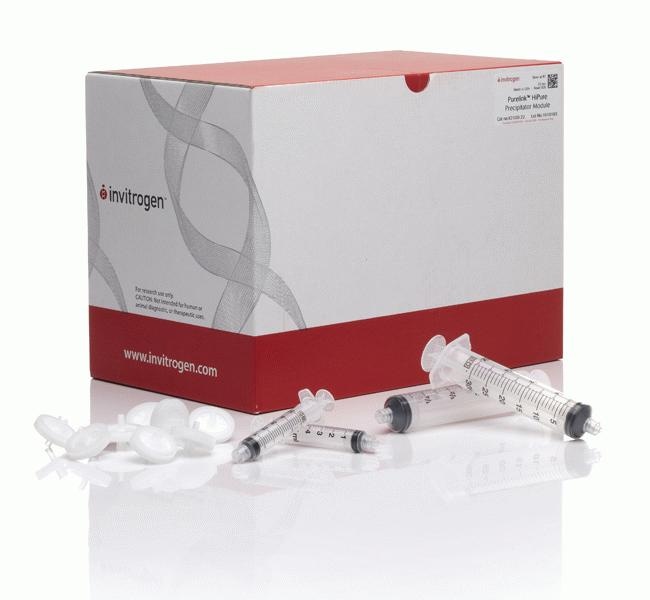
El precipitador PureLink™ HiPure permite la desalación rápida, sencilla y eficaz y la concentración de ADN plasmídico aislado mediante cromatografíaMás información
Have Questions?
Cambiar vista
Número de catálogo
Cantidad
K210021
10 preparaciones
K210022
25 preparaciones
2 opciones
Número de catálogo K210021
Precio (MXN)
-
Cantidad:
10 preparaciones
El precipitador PureLink™ HiPure permite la desalación rápida, sencilla y eficaz y la concentración de ADN plasmídico aislado mediante cromatografía de intercambio aniónico. El método tradicional de precipitación de ADN de intercambio aniónico de ADN plasmídico aislado implica la precipitación del isopropanol seguida de la centrifugación y el secado del ADN, una tarea laboriosa que requiere mucho tiempo. El uso del precipitador PureLink™ HiPure permite la concentración de ADN plasmídico en 5 minutos, elimina la necesidad de centrifugación y reduce el riesgo de perder el sedimento de ADN durante la extracción del sobrenadante. La recuperación es del >80 % y el ADN plasmídico resultante está listo para su uso en las aplicaciones más exigentes, como la transfección.
Para uso exclusivo en investigación. No apto para uso en procedimientos diagnósticos.
Especificaciones
Tipo de producto finalADN plasmídico
Para utilizar con (aplicación)Secuenciación de última generación, transfección, clonación, secuenciación, transformación, etiquetado de ácidos nucleicos, PCR, transcripción in vitro
Compatibilidad de alto rendimientoNo compatible con alto rendimiento (manual)
Escala preparativa> 200 µg de ADN plasmídico (en pequeña escala)
Línea de productosPureLink
Tipo de productoMódulo precipitador
Cantidad10 preparaciones
Tipo de muestraCultivo bacteriano
Condiciones de envíoTemperatura ambiente
ObjetivoADN plasmídico
Tiempo de prueba5 min
FormatoJeringa
Isolation TechnologyResina de intercambio de aniones
Unit SizeEach
Contenido y almacenamiento
El módulo del precipitador PureLink™ HiPure incluye precipitadores HiPure y jeringas de 5 y 30 ml. Almacenar todos los componentes a temperatura ambiente.
Preguntas frecuentes
My plasmid yield was lower than expected. What could be the cause?
There are several reasons lower yields can occur:
-Make sure the binding of the plasmid is being done at RT. Temperature affects the pH of the binding solution.
-Make sure all other solutions are also warmed to RT for optimal yield.
-Verify that the centrifugation immediately following the neutralization step was not done at 4 degrees C. If it was, the supernatant MUST be warmed to RT before loading onto the column.
-The 1:1:1 ratio of buffers (Resuspension/Lysis/Precipitation) has not been kept precisely. A surplus of solution E3 will exceed the optimal salt concentration for DNA binding, thus leading to decreased DNA yield.
-Low-copy number plasmids give lower yields.
-If all of the medium was not removed at the cell harvesting step, the pH of the subsequent step can be affected and reduce yield.
-The cell pellet was not thoroughly resuspended before lysis.
-The purified DNA pellet was overdried after isopropanol precipitation and ethanol wash making it difficult to resuspend the pellet. Air dry only.
-Pellets can be easily lost during the alcohol precipitation and wash steps. It is best to pipette off the alcohol solutions rather than pouring them off, as the pellets tend to be slippery.
-After lysis and neutralization, the lysate is not homogeneous. After addition of solutions (Resuspension/Lysis/Precipitation buffers), cells must be mixed thoroughly by inverting the tubes until a homogeneous phase is obtained. Otherwise, cells will not be lysed completely and the plasmid DNA will stick to bacterial debris. In the case of bigger bacterial cell pellets, more vigorous shaking may be required to achieve homogeneity. However, do NOT vortex, as vortexing will release chromosomal DNA.
I did not recover any DNA after using one of your PureLink HiPure plasmid purification kits. Why?
The DNA pellet from precipitation with isopropanol is easily dislodged when washing with 70% ethanol. It is best to remove the isopropanol supernatant and the ethanol wash by pipetting. Be careful not to shoot the washing buffer directly onto the pellet. Instead, allow the washing buffer to run over the pellet. Regardless of which manufacturer's miniprep kit you use, washing the pellet can be challenging because it is so small.
What is the binding capacity of the PureLink HiPure Precipitator?
The binding capacity of the PureLink HiPure Precipitator is 2 mg.
Can I use the PureLink HiPure Precipitator with other anion exchange kits?
For best results, we recommend the use of the PureLink HiPure Precipitators with our PureLink HiPure Plasmid Filter Maxiprep/Midiprep Kit or PureLink HiPure Plasmid Maxiprep/Midiprep kit. However, PureLink HiPure Precipitator can be used with an equivalent anion exchange plasmid purification kit. We do offer the PureLink HiPure Precipitator as a stand-alone product (Cat. Nos. K210021 and K210022).
Can the PureLink HiPure Precipitator be re-used?
It is not recommended. We cannot guarantee the yield or the quality of the DNA from a re-used Precipitator.