Search


Citas y referencias (8)
Invitrogen™
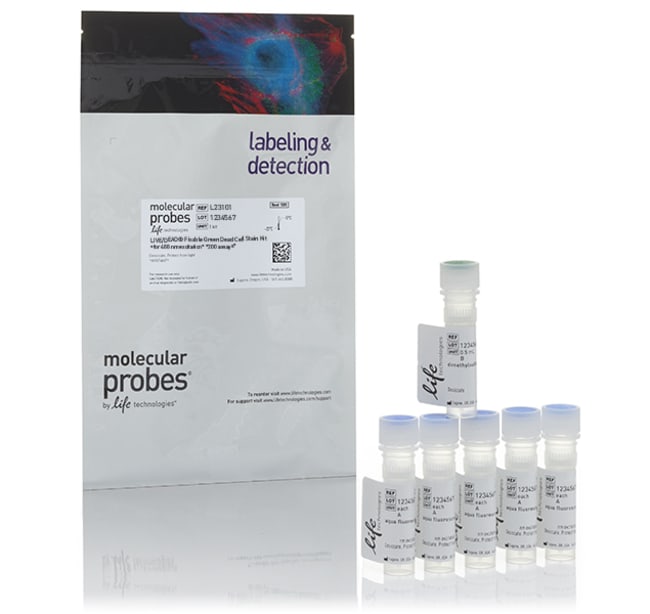
LIVE/DEAD™ Fixable Green Dead Cell Stain Kit, for 488 nm excitation
El kit de tinción de células muertas de fijación LIVE/DEAD™ Green se utiliza para determinar la viabilidad de las célulasMás información
Have Questions?
Cambiar vista

| Número de catálogo | Cantidad |
|---|---|
| L23101 | 200 ensayos |
| L34970 | 400 ensayos |
| L34969 | 80 ensayos |
Número de catálogo L23101
Precio (MXN)
-
Cantidad:
200 ensayos
El kit de tinción de células muertas de fijación LIVE/DEAD™ Green se utiliza para determinar la viabilidad de las células antes de la fijación y la permeabilización necesarias para la tinción de anticuerpos intracelulares o antes de la eliminación de materiales biopeligrosos mediante fijación en formaldehído. Este kit se ha optimizado y validado para su uso con un citómetro de flujo de láser azul.
• Estable: los colorantes se han liofilizado en viales separados para mantener la estabilidad
• Sólido: el patrón de tinción es el mismo antes y después de la fijación
• Señal brillante: permite una fácil distinción entre células vivas/muertas en un solo canal
Consulte una guía de selección para todos los colorantes de viabilidad con fijación para citometría de flujo.
Estable
A diferencia de los productos que se venden en forma de solución, la tinción LIVE/DEAD™ Fixable Green se ha envasado cómodamente en viales de 40 ensayos para ayudar a garantizar la estabilidad y el rendimiento del colorante a largo plazo. Al introducirse en la solución, los colorantes de reactivos de amina perderán su eficacia tras un corto periodo de tiempo; por lo tanto, se recomienda utilizar el total del vial una vez que se haya rehidratado. Si esto no es posible, divida los viales en pequeños volúmenes y almacénelos a -80 °C; evite someterlos a ciclos de congelación y descongelación.
Sólido
Los tintes del discriminador de células muertas pueden ver reducida su sensibilidad tras un tratamiento con fijadores, como los métodos de fijación basados en formaldehído o etanol que resultan necesarios para llevar a cabo estudios de fosforilación intracelular. La tinción LIVE/DEAD™ Fixable Green es un tinte de reactivos de amina que se une de forma covalente a las aminas intra y extracelulares. El patrón de tinción se mantiene después de la fijación con formaldehído.
Brillo óptimo
La tinción LIVE/DEAD™ Fixable Green se ha seleccionado basándose en sus propiedades fluorescentes para proporcionar una señal brillante cuando se excita mediante un láser azul de 488 nm. El tinte reactivo fluorescente verde tiene un máximo de excitación de ∼495 nm, por lo que es ideal para su uso con un láser azul y una emisión de ∼520 nm, lo que permite la recopilación en el canal FITC Puesto que se pueden distinguir células vivas y muertas con un solo tinte y un solo canal de un citómetro de flujo, es la opción ideal para experimentos de varios colores.
Funcionamiento
En células con membranas comprometidas, el colorante reacciona con aminas libres tanto en el interior de la célula como en su superficie, lo que provoca una intensa tinción fluorescente. En células viables, la reactividad del colorante está limitada a las aminas de la superficie celular, lo que se traduce en una fluorescencia menos intensa. La diferencia de intensidad suele ser 50 veces mayor entre células vivas y muertas, lo que facilita la discriminación.
Colores disponibles
Los tintes de células muertas con fijación LIVE/DEAD™ están disponibles en una amplia variedad de colores para satisfacer sus necesidades de paneles de varios colores.
• Estable: los colorantes se han liofilizado en viales separados para mantener la estabilidad
• Sólido: el patrón de tinción es el mismo antes y después de la fijación
• Señal brillante: permite una fácil distinción entre células vivas/muertas en un solo canal
Consulte una guía de selección para todos los colorantes de viabilidad con fijación para citometría de flujo.
Estable
A diferencia de los productos que se venden en forma de solución, la tinción LIVE/DEAD™ Fixable Green se ha envasado cómodamente en viales de 40 ensayos para ayudar a garantizar la estabilidad y el rendimiento del colorante a largo plazo. Al introducirse en la solución, los colorantes de reactivos de amina perderán su eficacia tras un corto periodo de tiempo; por lo tanto, se recomienda utilizar el total del vial una vez que se haya rehidratado. Si esto no es posible, divida los viales en pequeños volúmenes y almacénelos a -80 °C; evite someterlos a ciclos de congelación y descongelación.
Sólido
Los tintes del discriminador de células muertas pueden ver reducida su sensibilidad tras un tratamiento con fijadores, como los métodos de fijación basados en formaldehído o etanol que resultan necesarios para llevar a cabo estudios de fosforilación intracelular. La tinción LIVE/DEAD™ Fixable Green es un tinte de reactivos de amina que se une de forma covalente a las aminas intra y extracelulares. El patrón de tinción se mantiene después de la fijación con formaldehído.
Brillo óptimo
La tinción LIVE/DEAD™ Fixable Green se ha seleccionado basándose en sus propiedades fluorescentes para proporcionar una señal brillante cuando se excita mediante un láser azul de 488 nm. El tinte reactivo fluorescente verde tiene un máximo de excitación de ∼495 nm, por lo que es ideal para su uso con un láser azul y una emisión de ∼520 nm, lo que permite la recopilación en el canal FITC Puesto que se pueden distinguir células vivas y muertas con un solo tinte y un solo canal de un citómetro de flujo, es la opción ideal para experimentos de varios colores.
Funcionamiento
En células con membranas comprometidas, el colorante reacciona con aminas libres tanto en el interior de la célula como en su superficie, lo que provoca una intensa tinción fluorescente. En células viables, la reactividad del colorante está limitada a las aminas de la superficie celular, lo que se traduce en una fluorescencia menos intensa. La diferencia de intensidad suele ser 50 veces mayor entre células vivas y muertas, lo que facilita la discriminación.
Colores disponibles
Los tintes de células muertas con fijación LIVE/DEAD™ están disponibles en una amplia variedad de colores para satisfacer sus necesidades de paneles de varios colores.
Para uso exclusivo en investigación. No apto para uso en procedimientos diagnósticos.
Especificaciones
Permeabilidad celularImpermeable
Tipo de célulaCélulas eucariotas
DescripciónKit de tinción de células muertas LIVE/DEAD™ Fixable Green, para 488 nm de excitación
Método de detecciónFluorescente
Tipo de coloranteOtras etiquetas o colorantes
Longitud de onda de emisión520 nm
Longitud de onda de excitación495 nm
FormularioSólido
FormatoTubo(s)
Cantidad200 ensayos
Condiciones de envíoTemperatura ambiente
SolubilidadDMSO (dimetilsulfóxido)
ColorVerde
Para utilizar con (aplicación)Ensayo de viabilidad
Para utilizar con (equipo)Citómetro de flujo
Línea de productosLIVE/DEAD
Tipo de productoTinción
Unit SizeEach
Contenido y almacenamiento
Contiene 5 viales de tinción de células muertas con fijación LIVE/DEAD™ y 500 μl de DMSO.
Almacenar a -20 °C.
Almacenar a -20 °C.
Preguntas frecuentes
I need to use a dead cell control for my viability assay. Do you have a protocol for killing cells for this?
Regarding the LIVE/DEAD Fixable Dead Cell Stain Kits, which can discriminate between live and dead cells using flow cytometry with one emission wavelength. Can these kits be used with microscopy?
How do I prepare dead cell controls for LIVE/DEAD cell viability assays?
Which cell viability kits are compatible with fixation?
Why do I need to include a viability stain in my assays?
Citations & References (8)
Citations & References
Abstract
Techniques to improve the direct ex vivo detection of low frequency antigen-specific CD8+ T cells with peptide-major histocompatibility complex class I tetramers.
Journal:Cytometry A
PubMed ID:18836993
'The ability to quantify and characterize antigen-specific CD8+ T cells irrespective of functional readouts using fluorochrome-conjugated peptide-major histocompatibility complex class I (pMHCI) tetramers in conjunction with flow cytometry has transformed our understanding of cellular immune responses over the past decade. In the case of prevalent CD8+ T cell populations that
Amine reactive dyes: an effective tool to discriminate live and dead cells in polychromatic flow cytometry.
Journal:J Immunol Methods
PubMed ID:16756987
'Membrane-damaged cells caused by either mechanical trauma or through normal biological processes can produce artifacts in immunophenotyping analysis by flow cytometry. Dead cells can nonspecifically bind monoclonal antibody conjugates, potentially leading to erroneous conclusions, particularly when cell frequencies are low. To date, DNA intercalating dyes (Ethidium monoazaide (EMA), Propidium Iodide,
Phenotypic Screening with Human iPS Cell-Derived Cardiomyocytes: HTS-Compatible Assays for Interrogating Cardiac Hypertrophy.
Journal:
PubMed ID:24071917
'A major hurdle for cardiovascular disease researchers has been the lack of robust and physiologically relevant cell-based assays for drug discovery. Derivation of cardiomyocytes from human-induced pluripotent stem (iPS) cells at high purity, quality, and quantity enables the development of relevant models of human cardiac disease with source material that
Anakinra treatment in patients with refractory inflammatory myopathies and possible predictive response biomarkers: a mechanistic study with 12 months follow-up.
Journal:Ann Rheum Dis
PubMed ID:23625983
'OBJECTIVE: To perform a mechanistic study on the effect of interleukin (IL)-1 blockade by anakinra in patients with refractory myositis and to explore possible predictive biomarkers. METHODS: Fifteen patients with refractory myositis were treated with anakinra for 12 months. Clinical response was assessed by the six-item core set measures of
Blocking angiotensin-converting enzyme induces potent regulatory T cells and modulates TH1- and TH17-mediated autoimmunity.
Journal:Proc Natl Acad Sci U S A
PubMed ID:19706421
The renin-angiotensin-aldosterone system (RAAS) is a major regulator of blood pressure. The octapeptide angiotensin II (AII) is proteolytically processed from the decapeptide AI by angiotensin-converting enzyme (ACE), and then acts via angiotensin type 1 and type 2 receptors (AT1R and AT2R). Inhibitors of ACE and antagonists of the AT1R are