Search

Invitrogen™
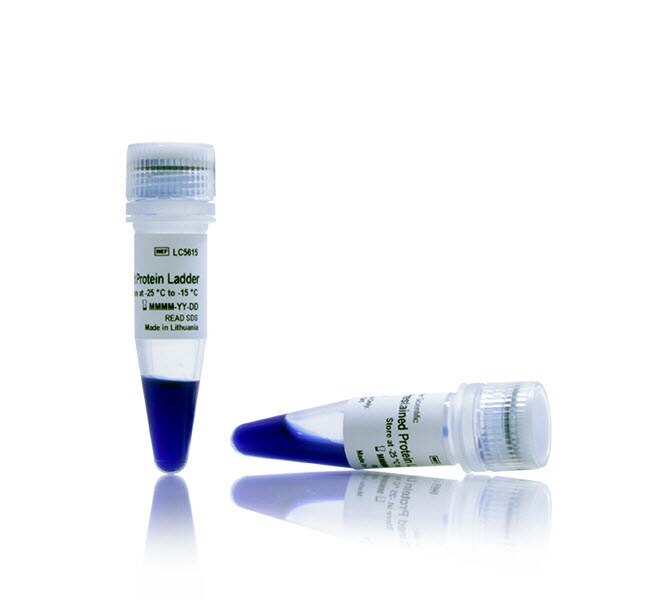
iBright™ Prestained Protein Ladder
La escalera de proteínas preteñida iBright contiene doce proteínas recombinantes, diez (de 11 a 250 kDa) teñidas de azul yMás información
| Número de catálogo | Cantidad |
|---|---|
| LC5615 | 2 x 250 μl |
Número de catálogo LC5615
Precio (MXN)
-
Cantidad:
2 x 250 μl
La escalera de proteínas preteñida iBright contiene doce proteínas recombinantes, diez (de 11 a 250 kDa) teñidas de azul y etiquetadas con flúor para una visualización fluorescente directa y cercana a IR y dimensionamiento de proteínas, y dos proteínas (30 kDa y 80 kDa) que no están teñidas y contienen sitios de unión de IgG para unir los anticuerpos primarios y secundarios utilizados para la detección quimioluminiscente y fluorescente de la proteína diana. La escalera de proteínas se suministra en un formato listo para su uso para la carga directa en geles; sin necesidad de calentar, reducir ni añadir un tampón de muestras antes de usarlo.
Compare y visualice todos los demás estándares y escaleras de proteínas›
Características del producto
• Visualización fluorescente: detecte las diez proteínas teñidas utilizando el láser rojo de 670 nm o el canal de 700 nm de un generador de imágenes de fluorescencia
• Confirmación de Western blot: detecte las dos proteínas no teñidas (30 kDa y 80 kDa) utilizando el sistema de detección para la proteína diana
Aplicaciones
• Western blotting: detección de las dos bandas sin teñir con el método de detección utilizado para la proteína diana. Compatible con sustratos quimioluminiscentes y anticuerpos secundarios fluorescentes.
• Dimensionamiento de proteínas en geles de poliacrilamida-SDS, visualización de proteínas durante la electroforesis y transferencia y visualización de proteínas durante la adquisición de imágenes por fluorescencia (diez bandas teñidas de azul)
• Estimación del tamaño de las proteínas: dimensionamiento de las proteínas en geles de poliacrilamida-SDS y en western blot mediante generadores de imágenes de fluorescencia de infrarrojo cercano (NIR)
Compare y visualice todos los demás estándares y escaleras de proteínas›
Características del producto
• Visualización fluorescente: detecte las diez proteínas teñidas utilizando el láser rojo de 670 nm o el canal de 700 nm de un generador de imágenes de fluorescencia
• Confirmación de Western blot: detecte las dos proteínas no teñidas (30 kDa y 80 kDa) utilizando el sistema de detección para la proteína diana
Aplicaciones
• Western blotting: detección de las dos bandas sin teñir con el método de detección utilizado para la proteína diana. Compatible con sustratos quimioluminiscentes y anticuerpos secundarios fluorescentes.
• Dimensionamiento de proteínas en geles de poliacrilamida-SDS, visualización de proteínas durante la electroforesis y transferencia y visualización de proteínas durante la adquisición de imágenes por fluorescencia (diez bandas teñidas de azul)
• Estimación del tamaño de las proteínas: dimensionamiento de las proteínas en geles de poliacrilamida-SDS y en western blot mediante generadores de imágenes de fluorescencia de infrarrojo cercano (NIR)
Para uso exclusivo en investigación. No apto para uso en procedimientos diagnósticos.
Especificaciones
Método de detecciónColorimétrico, fluorescencia NIR y sistema de detección definido por el usuario (dos bandas)
Compatibilidad del gelGeles medios Novex™, minigeles Novex™, geles de Tris-glicina Novex ™, geles NuPAGE™ Bis-Tris, geles NuPAGE™, geles NuPAGE™ MES, geles NuPAGE™ MOPS, geles de Tris-acetato NuPAGE™, geles de Tris-glicina Precise™, geles SDS-PAGE, geles de Tris-HEPES Precise™
Peso molecular250, 130, 95, 80, 70, 55, 43, 34, 30, 26, 15, 11 kDa
Cantidad2 x 250 μl
Listo para cargarSí
Condiciones de envíoHielo seco
ColorBlue
Number of Markers12
Línea de productosiBright
Tipo de productoMarcadores moleculares de proteínas
Intervalo de tamañosDe 11 a 250 kDa
System TypeWestern Blotting, SDS-PAGE
Unit SizeEach
Contenido y almacenamiento
Tampón de almacenamiento: 62,5 mM Tris-H3PO4 (pH 7,5 a 25° C), 1 mM EDTA, 2% (peso/volumen) SDS, 10 mM DTT, 1 mM NaN3 y 33 % de glicerol
Tras su recepción, almacenar a –20° C. El productos se envía en hielo.
Tras su recepción, almacenar a –20° C. El productos se envía en hielo.