Search


Citas y referencias (1)
Invitrogen™
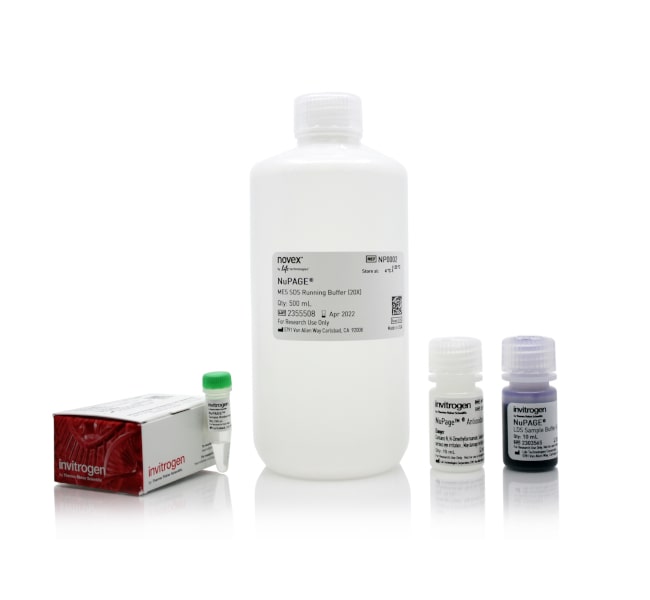
NuPAGE™ MES SDS Buffer Kit (for Bis-Tris Gels)
El kit de tampones de SDS MES NuPAGE se ha diseñado para la separación de proteínas de tamaño pequeño aMás información
| Número de catálogo | Cantidad |
|---|---|
| NP0060 | 1 kit |
Número de catálogo NP0060
Precio (MXN)
-
Cantidad:
1 kit
El kit de tampones de SDS MES NuPAGE se ha diseñado para la separación de proteínas de tamaño pequeño a mediano en geles Bis-Tris NuPAGE e incluye los siguientes tampones:
• Tampón de desplazamiento de SDS NuPAGE MES (20X, 500 ml, n.º de cat. cat. NP0002)
• Agente reductor de muestras NuPAGE (10X, 250 µl, n.º de cat. NP0004)
• Antioxidante NuPAGE (n.º de cat. NP0005)
• Tampón de muestra de LDS NuPAGE (4X, 10 ml, n.º de cat. NP0007)
Compare los patrones de migración de proteínas mediante MES y MOP en geles de Bis-Tris NuPAGE
Descubra todos los tampones y reactivos disponibles para SDS-PAGE
• Tampón de desplazamiento de SDS NuPAGE MES (20X, 500 ml, n.º de cat. cat. NP0002)
• Agente reductor de muestras NuPAGE (10X, 250 µl, n.º de cat. NP0004)
• Antioxidante NuPAGE (n.º de cat. NP0005)
• Tampón de muestra de LDS NuPAGE (4X, 10 ml, n.º de cat. NP0007)
Compare los patrones de migración de proteínas mediante MES y MOP en geles de Bis-Tris NuPAGE
Descubra todos los tampones y reactivos disponibles para SDS-PAGE
Para uso exclusivo en investigación. No apto para uso en procedimientos diagnósticos.
Especificaciones
Tipo de gelGel SDS PAGE
Cantidad1 kit
Gel CompatibilityGel de tricina Novex™
Línea de productosNuPAGE
Tipo de productoKit del tampón
Unit SizeEach
Contenido y almacenamiento
Contiene
• Tampón de desplazamiento de SDS MES NuPAGE™ (20X, 500 ml)
• Agente reductor de muestras NuPAGE™ (10X, 250 µl), que contiene 500 mM de ditiotreitol
• Antioxidante NuPAGE™ (15 ml)
• Tampón de muestras de LDS NuPAGE™ (10 ml)
Almacenar cada uno a 4 °C. Caliente el tampón de muestra de LDS NuPAGE™ a 25 °C antes de usarlo.
• Tampón de desplazamiento de SDS MES NuPAGE™ (20X, 500 ml)
• Agente reductor de muestras NuPAGE™ (10X, 250 µl), que contiene 500 mM de ditiotreitol
• Antioxidante NuPAGE™ (15 ml)
• Tampón de muestras de LDS NuPAGE™ (10 ml)
Almacenar cada uno a 4 °C. Caliente el tampón de muestra de LDS NuPAGE™ a 25 °C antes de usarlo.
Preguntas frecuentes
Can I prepare my protein sample with the reducing agent and store it for future use?
My LDS or SDS sample buffer precipitates when stored at 4 degrees C. Can I warm it up? Can I store it at room temperature?
How are Bolt gels different than NuPAGE gels?
What is the advantage of NuPAGE Gels over regular Tris-Glycine gels?
Can beta-mercaptoethanol (BME) be used rather than DTT as the reducing agent in the NuPAGE LDS Sample Buffer?
Citations & References (1)
Citations & References
Abstract
Spermidine but not spermine is essential for hypusine biosynthesis and growth in Saccharomyces cerevisiae: Spermine is converted to spermidine in vivo by the FMS1-amine oxidase.
Journal:Proc Natl Acad Sci U S A
PubMed ID:14617780
In our earlier work we showed that either spermidine or spermine could support the growth of spe2Delta or spe3Delta polyamine-requiring mutants, but it was unclear whether the cells had a specific requirement for either of these amines. In the current work, we demonstrate that spermidine is specifically required for the