Search


Citas y referencias (17)
Invitrogen™
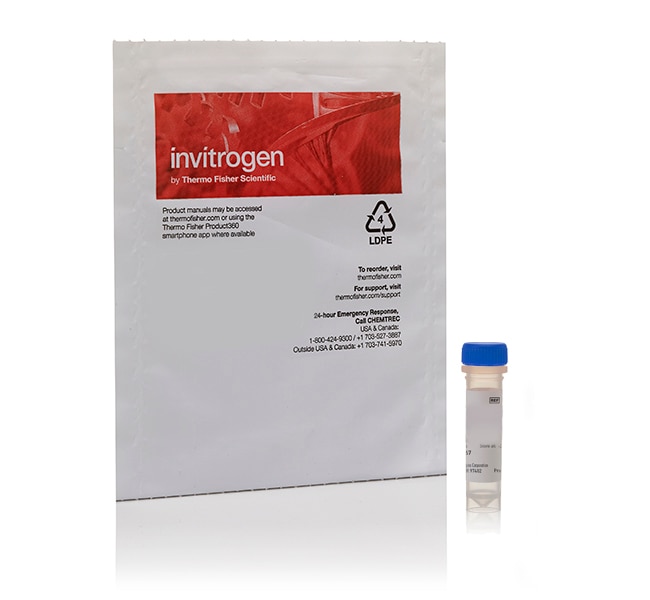
Qtracker™ 705 Vascular Labels
Los puntos cuánticos no dirigidos Qtracker™ están diseñados para ser inyectados en la vena de la cola de ratones paraMás información
| Número de catálogo | Cantidad |
|---|---|
| Q21061MP | 200 μl |
Número de catálogo Q21061MP
Precio (MXN)
-
Cantidad:
200 μl
Los puntos cuánticos no dirigidos Qtracker™ están diseñados para ser inyectados en la vena de la cola de ratones para el estudio de la estructura vascular usando técnicas de obtención de imágenes de animales pequeños in vivo (SAIVI). Estos nanocristales muestran una intensa fluorescencia con emisión de desplazamiento rojo para aumentar la penetración de los tejidos, y tienen un revestimiento de superficie de PEG especialmente desarrollado para minimizar las interacciones inespecíficas y reducir la respuesta inmune del tejido. Debido a que el revestimiento de la superficie de PEG no contiene grupos funcionales reactivos, los puntos cuánticos no dirigidos Qtracker™ se conservan en circulación durante más tiempo y se pueden exponer durante hasta 3 horas con una sola inyección o durante periodos de tiempo más largos con inyecciones adicionales.
¿Necesita otro espectro de emisión o un seguimiento más prolongado? Consulte nuestros otros productos de seguimiento de células de mamífero.
Atributos principales:
• La etiqueta Qtracker™ 705 tiene Ex/Em (405-665/655) nm
• Diseñados para la adquisición de imágenes in vivo de animales pequeños
• Se introducen mediante inyección en la vena de la cola, se puede adquirir imágenes hasta 3 horas después de la inyección
• Disponibles en cuatro colores: emisión de 705 nm, 655 nm, 705 nm u 800 nm
Obtenga más información sobre SAIVI y sobre las aplicaciones de los nanocristales Qdot™.
Para uso exclusivo en investigación. No diseñado para uso terapéutico o de diagnóstico en animales o humanos.
¿Necesita otro espectro de emisión o un seguimiento más prolongado? Consulte nuestros otros productos de seguimiento de células de mamífero.
Atributos principales:
• La etiqueta Qtracker™ 705 tiene Ex/Em (405-665/655) nm
• Diseñados para la adquisición de imágenes in vivo de animales pequeños
• Se introducen mediante inyección en la vena de la cola, se puede adquirir imágenes hasta 3 horas después de la inyección
• Disponibles en cuatro colores: emisión de 705 nm, 655 nm, 705 nm u 800 nm
Obtenga más información sobre SAIVI y sobre las aplicaciones de los nanocristales Qdot™.
Para uso exclusivo en investigación. No diseñado para uso terapéutico o de diagnóstico en animales o humanos.
Para uso exclusivo en investigación. No apto para uso en procedimientos diagnósticos.
Especificaciones
Concentración2 μM
Tipo de coloranteNanocristales Qdot
Línea de productosQTRACKER, Qdot
Cantidad200 μl
Tipo de reactivoReactivos para imágenes vasculares
Condiciones de envíoTemperatura ambiente
TécnicaObtención de imágenes in vivo
Tipo de productoEtiqueta
Unit SizeEach
Contenido y almacenamiento
Contiene 200 μl de puntos cuánticos no dirigidos Qtracker™ (solución de 2 μM en 50 mM de tampón de borato, pH de 8,3). Almacenar de 2–6 °C. No la congele. Estable durante al menos 6 meses.
Preguntas frecuentes
When I label with Qtracker cell labeling reagents, I get a punctate label pattern. How do I make it more uniform?
How long after injection should I start imaging my mouse?
What happens to unconjugated dye in the mouse after small animal in vivo imaging?
What amount of Qtracker non-targeted reagent should I inject to image vasculature?
I want to track my cells with a nucleic acid stain, like DAPI or Hoechst dye. Do you recommend this?
Citations & References (17)
Citations & References
Abstract
Noninvasive imaging of quantum dots in mice.
Journal:Bioconjug Chem
PubMed ID:14733586
'Quantum dots having four different surface coatings were tested for use in in vivo imaging. Localization was successfully monitored by fluorescence imaging of living animals, by necropsy, by frozen tissue sections for optical microscopy, and by electron microscopy, on scales ranging from centimeters to nanometers, using only quantum dots for
In vivo imaging of quantum dots.
Journal:Methods Mol Biol
PubMed ID:19488714
'Noninvasive whole-body near-infrared fluorescence imaging is now acknowledged as a powerful method for the molecular mapping of biological events in live small animals such as mouse models. With outstanding optical properties such as high fluorescence quantum yields and low photobleaching rates, quantum dots (QDs) are labels of choice in the
Imaging takes a quantum leap.
Journal:Physiology (Bethesda)
PubMed ID:15546848
Semiconducting nanocrystals, or quantum dots (QDs), have emerged as a new tool in physiological imaging, combining high brilliance, photostability, broad excitation but very narrow emission spectra, and surface chemistry compatible with biomolecular conjugation. In this review, we demonstrate the power of QDs in diverse applications, including long-term in vivo fluorescence
In vivo excitation of nanoparticles using luminescent bacteria.
Journal:Proc Natl Acad Sci U S A
PubMed ID:22615349
The lux operon derived from Photorhabdus luminescens incorporated into bacterial genomes, elicits the production of biological chemiluminescence typically centered on 490 nm. The light-producing bacteria are widely used for in vivo bioluminescence imaging. However, in living samples, a common difficulty is the presence of blue-green absorbers such as hemoglobin. Here we
Lymph node B lymphocyte trafficking is constrained by anatomy and highly dependent upon chemoattractant desensitization.
Journal:Blood
PubMed ID:22039261
B lymphocyte recirculation through lymph nodes (LNs) requires crossing endothelial barriers and chemoattractant-triggered cell migration. Here we show how LN anatomy and chemoattractant receptor signaling organize B lymphocyte LN trafficking. Blood-borne B cells predominately used CCR7 signaling to adhere to high endothelial venules (HEVs). New B cell emigrants slowly transited