Search


Citas y referencias (7)
Invitrogen™
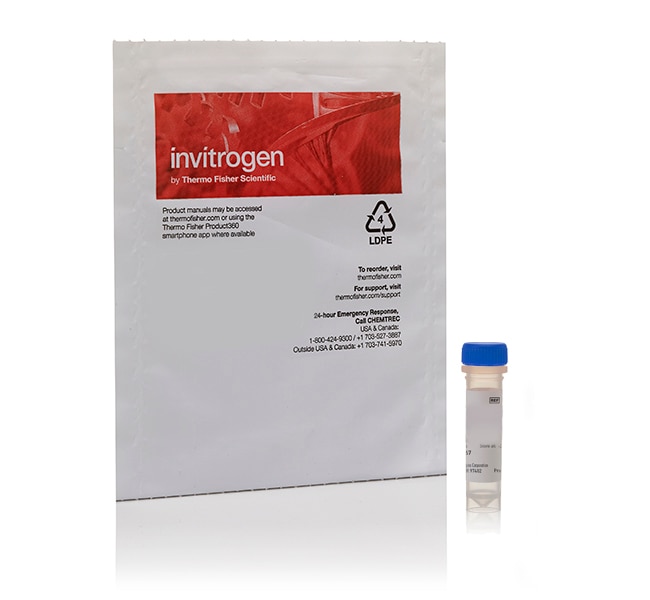
Qtracker™ 800 Vascular Labels
Los puntos cuánticos no dirigidos Qtracker™ están diseñados para ser inyectados en la vena de la cola de ratones paraMás información
| Número de catálogo | Cantidad |
|---|---|
| Q21071MP | 200 μl |
Número de catálogo Q21071MP
Precio (MXN)
-
Cantidad:
200 μl
Los puntos cuánticos no dirigidos Qtracker™ están diseñados para ser inyectados en la vena de la cola de ratones para el estudio de la estructura vascular usando técnicas de obtención de imágenes de animales pequeños in vivo (SAIVI). Estos nanocristales muestran una intensa fluorescencia con emisión de desplazamiento rojo para aumentar la penetración de los tejidos, y tienen un revestimiento de superficie de PEG especialmente desarrollado para minimizar las interacciones inespecíficas y reducir la respuesta inmune del tejido. Debido a que el revestimiento de la superficie de PEG no contiene grupos funcionales reactivos, los puntos cuánticos no dirigidos Qtracker™ se conservan en circulación durante más tiempo y se pueden exponer durante hasta 3 horas con una sola inyección o durante periodos de tiempo más largos con inyecciones adicionales.
¿Necesita otro espectro de emisión o un seguimiento más prolongado? Consulte nuestros otros productos de seguimiento de células de mamífero.
Atributos principales:
• La etiqueta Qtracker™ 800 tiene Ex/Em (405-760/800) nm
• Diseñados para la adquisición de imágenes in vivo de animales pequeños
• Se introducen mediante inyección en la vena de la cola, se puede adquirir imágenes hasta 3 horas después de la inyección
• Disponibles en cuatro colores: emisión de 565 nm, 655 nm, 705 nm u 800 nm
Obtenga más información sobre SAIVI y sobre las aplicaciones de los nanocristales Qdot™.
Para uso exclusivo en investigación. No diseñado para uso terapéutico o de diagnóstico en animales o humanos.
¿Necesita otro espectro de emisión o un seguimiento más prolongado? Consulte nuestros otros productos de seguimiento de células de mamífero.
Atributos principales:
• La etiqueta Qtracker™ 800 tiene Ex/Em (405-760/800) nm
• Diseñados para la adquisición de imágenes in vivo de animales pequeños
• Se introducen mediante inyección en la vena de la cola, se puede adquirir imágenes hasta 3 horas después de la inyección
• Disponibles en cuatro colores: emisión de 565 nm, 655 nm, 705 nm u 800 nm
Obtenga más información sobre SAIVI y sobre las aplicaciones de los nanocristales Qdot™.
Para uso exclusivo en investigación. No diseñado para uso terapéutico o de diagnóstico en animales o humanos.
Para uso exclusivo en investigación. No apto para uso en procedimientos diagnósticos.
Especificaciones
Concentración2 μM
Tipo de coloranteNanocristales Qdot
Línea de productosQTRACKER, Qdot
Cantidad200 μl
Tipo de reactivoReactivos para imágenes vasculares
Condiciones de envíoTemperatura ambiente
TécnicaObtención de imágenes in vivo
Tipo de productoEtiqueta
Unit SizeEach
Contenido y almacenamiento
Contiene 200 μl de puntos cuánticos no dirigidos Qtracker™ (solución de 2 μM en 50 mM de tampón de borato, pH de 8,3). Almacenar de 2–6 °C. No la congele. Estable durante al menos 6 meses.
Preguntas frecuentes
When I label with Qtracker cell labeling reagents, I get a punctate label pattern. How do I make it more uniform?
How long after injection should I start imaging my mouse?
What happens to unconjugated dye in the mouse after small animal in vivo imaging?
What amount of Qtracker non-targeted reagent should I inject to image vasculature?
I want to track my cells with a nucleic acid stain, like DAPI or Hoechst dye. Do you recommend this?
Citations & References (7)
Citations & References
Abstract
Noninvasive vascular imaging in fluorescent tumors using multispectral unmixing.
Journal:Biotechniques
PubMed ID:18855773
Noninvasive imaging of tumor vascularization in animal models provides an important tool for studying the biology of tumor angiogenesis as well as monitoring the effects of antiangiogenic therapies. Through the use of in vivo multispectral fluorescent imaging, we have discovered a distinct spectral signature associated with blood vessels present in
The chemokine receptors ACKR2 and CCR2 reciprocally regulate lymphatic vessel density.
Journal:EMBO J
PubMed ID:25271254
Skeletal myofiber VEGF regulates contraction-induced perfusion and exercise capacity but not muscle capillarity in adult mice.
Journal:Am J Physiol Regul Integr Comp Physiol
PubMed ID:27225953
Intravital fluorescence imaging of mouse brain using implantable semiconductor devices and epi-illumination of biological tissue.
Journal:Biomed Opt Express
PubMed ID:26137364
Indocyanine green nanoparticles undergo selective lymphatic uptake, distribution and retention and enable detailed mapping of lymph vessels, nodes and abnormalities.
Journal:J Drug Target
PubMed ID:29388438