Search


Citas y referencias (18)
Invitrogen™
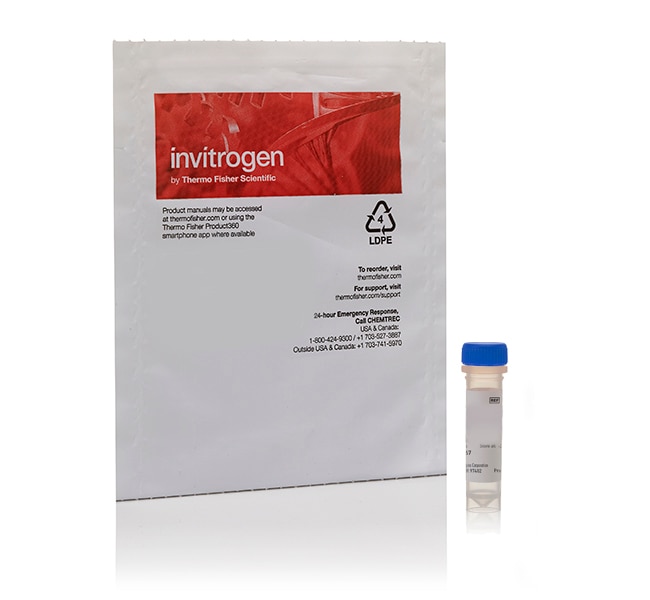
Qdot™ 655 ITK™ Carboxyl Quantum Dots
Los puntos cuánticos de carboxilo Qdot™ 655 ITK™ son el material de partida ideal para preparar conjugados personalizados que requierenMás información
| Número de catálogo | Cantidad |
|---|---|
| Q21321MP | 250 µl |
Número de catálogo Q21321MP
Precio (MXN)
-
Cantidad:
250 µl
Los puntos cuánticos de carboxilo Qdot™ 655 ITK™ son el material de partida ideal para preparar conjugados personalizados que requieren una alta carga de biomoléculas. Estos materiales son un grupo funcional de carboxilato y pueden ser acoplados a grupos aminos de proteínas y oligonucleótidos modificados usando condensación mediada por EDC. Los revestimientos de estas sondas proporcionan más sitios de unión que nuestros puntos cuánticos de amina Qdot™ ITK™, pero carecen de los enlaces de PEG que ayudan a evitar las interacciones no específicas. Estos materiales se pueden conjugar con los enlazadores bifuncionales X-PEG-amina para una reactividad personalizada y una mayor especificidad. Nuestros puntos cuánticos de carboxilo Qdot™ ITK™ se proporcionan como soluciones de 8 μM y están disponibles en los nueve colores de la sonda de Qdot™.
Características importantes de los puntos cuánticos de carboxilo Qdot™ ITK™:
• El punto cuántico de carboxilo Qdot™ 655 ITK™ tiene un máximo de emisión de ∼ 655 nm
• Fluorescencia muy fotoestable y brillante
• Se excitan de forma eficaz con fuentes de excitación de una sola línea
• Emisión estrecha, gran corrimiento de Stokes
• Disponible en varios colores
• Ideal para aplicaciones de etiquetado y seguimiento
Propiedades de los nanocristales Qdot™
Las sondas Qdot™ son ideales para aplicaciones de imagen y etiquetado que requieren señales fluorescentes brillantes o seguimiento en tiempo real. Los nueve colores disponibles de las sondas Qdot™, únicos entre los reactivos fluorescentes, pueden excitarse simultáneamente con una única fuente de luz (UV a azul-verde). Esta propiedad hace que estos reactivos sean excelentes para aplicaciones de multiplexado económicas y fáciles de usar. Las etiquetas Qdot™ se basan en nanotecnología de semiconductores y son similares en escala a las proteínas de tamaño moderado.
Acerca del kit de herramientas de innovador de reactivos Qdot™ ITK™
Estas sondas Qdot™ ITK™ son ideales para investigadores que desean preparar conjugados específicos (no almacenados) para sus aplicaciones y necesitan una funcionalidad de conjugación personalizable.
Hay disponibles otras formas de nanocristales Qdot™
Además de la forma derivada de carboxilo, ofrecemos puntos cuánticos Qdot™ ITK™ con modificaciones de hidrocarburos amino y alifáticos. También hemos desarrollado una amplia gama de conjugados y kits de marcado de nanocristales Qdot™. Consulte las características de los nanocristales Qdot™ o ™ la sección 6.6 sobre nanocristales Qdot—del manual de Molecular Probes™ para obtener más información.
Para uso exclusivo en investigación. No diseñado para uso terapéutico o de diagnóstico en animales o humanos.
Características importantes de los puntos cuánticos de carboxilo Qdot™ ITK™:
• El punto cuántico de carboxilo Qdot™ 655 ITK™ tiene un máximo de emisión de ∼ 655 nm
• Fluorescencia muy fotoestable y brillante
• Se excitan de forma eficaz con fuentes de excitación de una sola línea
• Emisión estrecha, gran corrimiento de Stokes
• Disponible en varios colores
• Ideal para aplicaciones de etiquetado y seguimiento
Propiedades de los nanocristales Qdot™
Las sondas Qdot™ son ideales para aplicaciones de imagen y etiquetado que requieren señales fluorescentes brillantes o seguimiento en tiempo real. Los nueve colores disponibles de las sondas Qdot™, únicos entre los reactivos fluorescentes, pueden excitarse simultáneamente con una única fuente de luz (UV a azul-verde). Esta propiedad hace que estos reactivos sean excelentes para aplicaciones de multiplexado económicas y fáciles de usar. Las etiquetas Qdot™ se basan en nanotecnología de semiconductores y son similares en escala a las proteínas de tamaño moderado.
Acerca del kit de herramientas de innovador de reactivos Qdot™ ITK™
Estas sondas Qdot™ ITK™ son ideales para investigadores que desean preparar conjugados específicos (no almacenados) para sus aplicaciones y necesitan una funcionalidad de conjugación personalizable.
Hay disponibles otras formas de nanocristales Qdot™
Además de la forma derivada de carboxilo, ofrecemos puntos cuánticos Qdot™ ITK™ con modificaciones de hidrocarburos amino y alifáticos. También hemos desarrollado una amplia gama de conjugados y kits de marcado de nanocristales Qdot™. Consulte las características de los nanocristales Qdot™ o ™ la sección 6.6 sobre nanocristales Qdot—del manual de Molecular Probes™ para obtener más información.
Para uso exclusivo en investigación. No diseñado para uso terapéutico o de diagnóstico en animales o humanos.
Para uso exclusivo en investigación. No apto para uso en procedimientos diagnósticos.
Especificaciones
Reactividad químicaAmina
Concentración8 μM
Emisión655
Etiqueta o tinteQdot™ 655
Tipo de productoPunto cuántico
Cantidad250 µl
Fracción reactivaÁcido carboxílico
Condiciones de envíoTemperatura ambiente
Tipo de etiquetaNanocristales Qdot
Línea de productosITK, Qdot
Unit SizeEach
Contenido y almacenamiento
Almacenar en el refrigerador (2–8° C).
Preguntas frecuentes
How large are the Qdot nanocrystals?
What is the best way to remove white precipitate from my ITK Qdot nanocrystals?
I see a white precipitate in my ITK Qdot nanocrystals; should I be concerned?
Why do my Qdot nanocrystals appear to be blinking?
My Qdot nanocrystals were brightly fluorescent before I mounted my samples; now I'm seeing a loss of fluorescence. Why is this happening?
Citations & References (18)
Citations & References
Abstract
Transgenic mice expressing a cameleon fluorescent Ca2+ indicator in astrocytes and Schwann cells allow study of glial cell Ca2+ signals in situ and in vivo.
Journal:J Neurosci Methods
PubMed ID:19454294
'Glial cell Ca2+ signals play a key role in glial-neuronal and glial-glial network communication. Numerous studies have thus far utilized cell-permeant and injected Ca2+ indicator dyes to investigate glial Ca2+ signals in vitro and in situ. Genetically encoded fluorescent Ca2+ indicators have emerged as novel probes for investigating cellular Ca2+
Optimizing a waveguide-based sandwich immunoassay for tumor biomarkers: evaluating fluorescent labels and functional surfaces.
Journal:Bioconjug Chem
PubMed ID:19173652
'The sensor team at the Los Alamos National Laboratory has developed a waveguide-based optical biosensor for the detection of biomarkers associated with disease. We have previously demonstrated the application of this technology to the sensitive detection of carcinoembryonic antigen in serum and nipple aspirate fluid from breast cancer patients. In
Targeted cellular delivery of quantum dots loaded on and in biotinylated liposomes.
Journal:Bioconjug Chem
PubMed ID:20715851
'We describe the preparation, biophysical characterization, and receptor-mediated cellular internalization of biotinylated lipid particles (BLPs) loaded on the surface and internally with two distinct (colors) of quantum dot (QD) probes. BLPs were formulated with 1.4 and 2.7 mol % PEG-lipids containing either a fusogenic or pH-sensitive lipid to promote bilayer
Quantum dot photon statistics measured by three-dimensional particle tracking.
Journal:Nano Lett
PubMed ID:17949048
'We present an instrument for performing correlation spectroscopy on single fluorescent particles while tracking their Brownian motion in three dimensions using real-time feedback. By tracking CdSe/ZnS quantum dots in water (diffusion coefficient approximately 20 mum2/s), we make the first measurements of photon antibunching (at approximately 10 ns) on single fluorophores
Bioconjugation of the estrogen receptor hER(a) to a quantum dot dye for a controlled immobilization on a SiO(2) surface.
Journal:J Colloid Interface Sci
PubMed ID:21216405
'We investigated the immobilization of the estrogen receptor hER(a) on silanized SiO(2) surfaces for biosensor applications. The conjugation of the estrogen receptor hER(a) to the quantum dot dye QD655 was achieved. In order to obtain an optimal immobilization of the estrogen receptor hER(a) on the functionalized SiO(2) surface, the bioconjugate