Search


Citas y referencias (1)
Invitrogen™
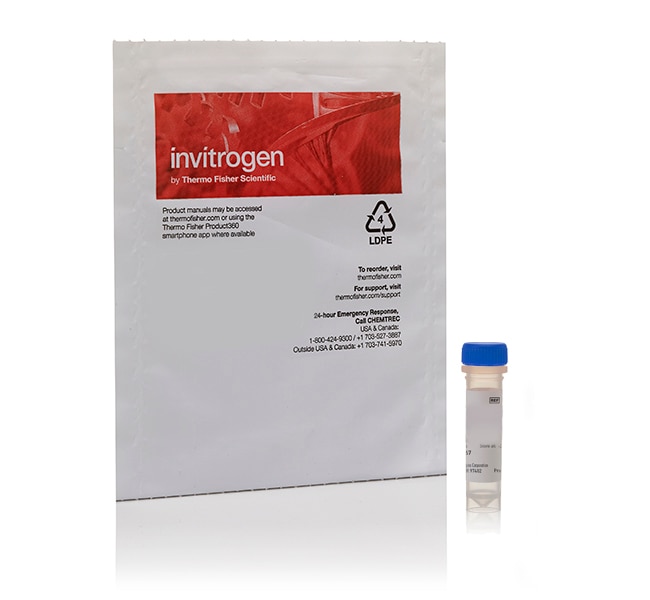
SYTO™ 84 Orange Fluorescent Nucleic Acid Stain - 5 mM Solution in DMSO
Para su uso con microscopio de fluorescencia y citometría de flujo
| Número de catálogo | Cantidad |
|---|---|
| S11365 | 250 μL |
Número de catálogo S11365
Precio (MXN)
-
Cantidad:
250 μL
La tinción de ácido nucleico naranja fluorescente permeable en células SYTO 84 exhibe fluorescencia naranja brillante al enlazarse con los ácidos nucleicos. Debido a que el patrón de tinción de SYTO en las células vivas puede variar entre los diferentes tipos de células, ofrecemos el kit de muestreo para tinción de ácido nucleico naranja fluorescente SYTO (S-11360) para permitir a los investigadores encontrar el tinte naranja fluorescente más adecuado para su sistema.
Para uso exclusivo en investigación. No apto para uso en procedimientos diagnósticos.
Especificaciones
ColorNaranja
DescripciónTinción de ácido nucleico SYTO™ 84 Orange Fluorescent - Solución de 5 mm en DMSO
Método de detecciónFluorescente
Tipo de colorantePermeabilidad celular
Emisión582 nm
Intervalo de longitud de onda de excitación567 nm
Para utilizar con (equipo)Microscopio de fluorescencia
Línea de productosSYTO
Cantidad250 μL
Condiciones de envíoTemperatura ambiente
Volumen (métrico)250 μl
Tipo de etiquetaFluorescente
Tipo de productoTinción de ácidos nucleicos
Sub Cellular LocalizationÁcidos nucleicos
Unit SizeEach
Contenido y almacenamiento
Almacenar en el congelador de -5 °C a -30 °C y proteger de la luz.
Preguntas frecuentes
How do SYTO dyes bind to DNA?
Citations & References (1)
Citations & References
Abstract
Multiparameter assessments to determine the effects of sugars and antimicrobials on a polymicrobial oral biofilm.
Journal:Appl Environ Microbiol
PubMed ID:17021225
Clinical studies indicate relationships between dental plaque, a naturally formed biofilm, and oral diseases. The crucial role of nonmicrobial biofilm constituents in maintaining biofilm structure and biofilm-specific attributes, such as resistance to shear and viscoelasticity, is increasingly recognized. Concurrent analyses of the diverse nonmicrobial biofilm components for multiparameter assessments formed