Search


Citas y referencias (5)
Invitrogen™
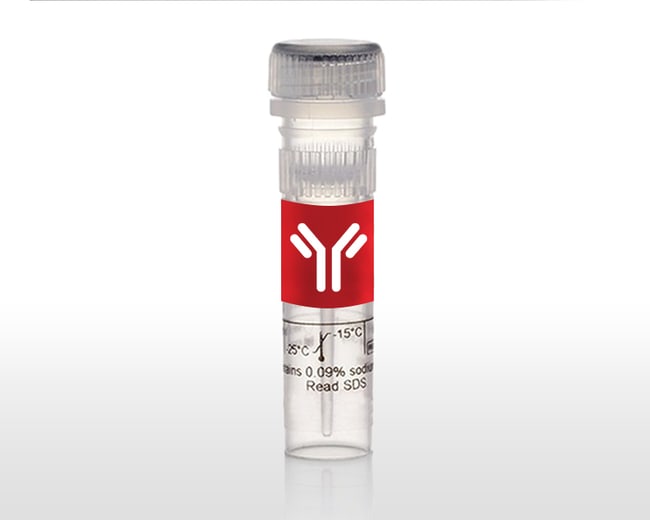
SAIVI™ Rapid Antibody Labeling Kit, Alexa Fluor™ 680
Kit de etiquetado rápido de anticuerpos SAIVI™, Alexa Fluor™ 680
| Número de catálogo | Cantidad |
|---|---|
| S30045 | 1 kit |
Número de catálogo S30045
Precio (MXN)
-
Cantidad:
1 kit
The Alexa Fluor™ 680 SAIVI™ Antibody Labeling Kit provides a convenient means to label antibodies with an optimal degree of labeling for in vivo imaging applications (DOL; ∼2) over a 6-fold antibody concentration range with no adjustments in reaction volume, dye concentration, or antibody concentration necessary. Using this procedure, optimally labeled antibodies are ready for applications that require azide-free reagents, such as live-cell imaging or direct injection into animals.
El kit de etiquetado de anticuerpos Alexa Fluor™ 680 SAIVI™ proporciona un medio práctico para marcar anticuerpos con un grado óptimo de marcación para aplicaciones de adquisición de imágenes in vivo (DOL; ∼2) en un rango de concentración de anticuerpos multiplicado por seis sin necesidad de ajustes en el volumen de reacción, la concentración de colorante o la concentración de anticuerpos. Mediante este procedimiento, los anticuerpos etiquetados de forma óptima están listos para las aplicaciones que requieren reactivos sin azida, como las imágenes de células vivas o la inyección directa en animales.
Para uso exclusivo en investigación. No apto para uso en procedimientos diagnósticos.
Especificaciones
Colorinfrarrojo
Método de detecciónFluorescencia
Excitación/emisión679/702
Tipo de etiquetaColorantes Alexa Fluor
Escala de etiquetadoDe 0,5 a 3 mg
Línea de productosAlexa Fluor, SAIVI
Tipo de productoKit de etiquetado de anticuerpos
Cantidad1 kit
Condiciones de envíoTemperatura ambiente
Labeling TargetAnticuerpos
Etiqueta o tinteAlexa Fluor 680
Unit SizeEach
Contenido y almacenamiento
Almacenar en el refrigerador (de 2 °C a 8 °C) y proteger de la luz.
Preguntas frecuentes
What amount of conjugated antibody should I inject to image tumors?
What size needle should I use for small animal in vivo imaging?
What are the optimal and maximal volumes of reagent that can be injected into a mouse?
What type of mice are the best for in vivo imaging?
Citations & References (5)
Citations & References
Abstract
Affibody Molecules for In vivo Characterization of HER2-Positive Tumors by Near-Infrared Imaging.
Journal:Clin Cancer Res
PubMed ID:18559604
'PURPOSE: HER2 overexpression has been associated with a poor prognosis and resistance to therapy in breast cancer patients. We are developing molecular probes for in vivo quantitative imaging of HER2 receptors using near-infrared (NIR) optical imaging. The goal is to provide probes that will minimally interfere with the studied system,
Noninvasive positron emission tomography and fluorescence imaging of CD133+ tumor stem cells.
Journal:
PubMed ID:24469819
'A technology that visualizes tumor stem cells with clinically relevant tracers could have a broad impact on cancer diagnosis and treatment. The AC133 epitope of CD133 currently is one of the best-characterized tumor stem cell markers for many intra- and extracranial tumor entities. Here we demonstrate the successful noninvasive detection
Minimally invasive quantification of lymph flow in mice and rats by imaging depot clearance of near-infrared albumin.
Journal:Am J Physiol Heart Circ Physiol
PubMed ID:22101523
'There is a lack of available methods to noninvasively quantify lymphatic function in small experimental animals, a necessity for studies on lymphatic system pathophysiology. We present a new method to quantify lymph flow in mice and rats, based on optically monitoring the depot clearance of near-infrared fluorescently labeled albumin and
Multiplexed mAbs: a new strategy in preclinical time-domain imaging of acute myeloid leukemia.
Journal:Blood
PubMed ID:23243270
Antibodies play a fundamental role in diagnostic immunophenotyping of leukemias and in cell-targeting therapy. However, this versatility is not reflected in imaging diagnostics. In the present study, we labeled anti–human mAbs monochromatically against selected human myeloid markers expressed on acute myeloid leukemia (AML) cells, all with the same near-infrared fluorochrome.
Influenza virus aerosol exposure and analytical system for ferrets.
Journal:Proc Natl Acad Sci U S A
PubMed ID:21536880
Understanding the transmission ability of newly emerging influenza viruses is central to the development of public health preparedness and prevention strategies. Animals are used to model influenza virus infection and transmission, but the routinely used intranasal inoculation of a liquid virus suspension does not reflect natural infection. We report the