Search


Citas y referencias (2)
Invitrogen™
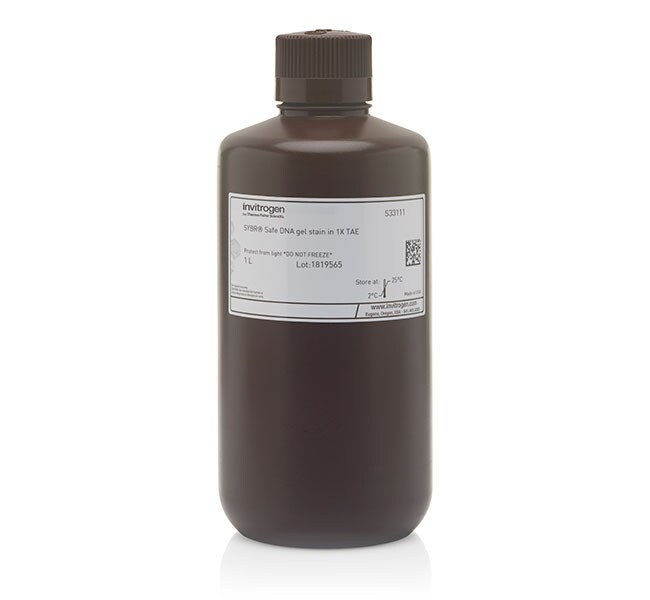
SYBR™ Safe DNA Gel Stain in 1X TAE
La tinción de gel de ADN SYBR Safe™ se creó específicamente para reducir la mutagenicidad: ser más segura que elMás información
Have Questions?
Cambiar vista

| Número de catálogo | Cantidad |
|---|---|
| S33112 | 4 l |
| S33111 | 1 l |
Número de catálogo S33112
Precio (MXN)
-
Cantidad:
4 l
La tinción de gel de ADN SYBR Safe™ se creó específicamente para reducir la mutagenicidad: ser más segura que el bromuro de etidio al teñir ADN en geles de agarosa o acrilamida. La tinción SYBR Safe™ no solo es menos mutagénica que el bromuro de etidio, sino que su sensibilidad de detección también es mejor. La tinción SYBR Safe™ se presenta como una solución premezclada que puede usarse como una solución de bromuro de etidio, ya sea en el gel durante el proceso de electroforesis o como tinción posterior al proceso. Cuando se une a los ácidos nucleicos, la tinción SYBR Safe™ verde fluorescente tiene una excitación de fluorescencia máxima a ∼ 280 y ∼ 502 nm, y una emisión máxima a ∼ 530 nm.
Para uso exclusivo en investigación. No apto para uso en procedimientos diagnósticos.
Especificaciones
Ubicación de detecciónDetección en gel
Método de detecciónFluorescencia
Cantidad4 l
Duración de almacenamiento6 meses
Condiciones de envíoTemperatura ambiente
Molécula dianaADN
Etiqueta o tinteSYBR Safe
Tipo de productoTinción para geles de ADN
Unit SizeEach
Contenido y almacenamiento
• Se suministra como una solución lista para su uso en 1X TAE
Almacenar a temperatura ambiente en el recipiente original.
Almacenar a temperatura ambiente en el recipiente original.
Preguntas frecuentes
Why do I sometimes see speckles in my gel when using SYBR Safe DNA Gel Stain?
What is the pH range of SYBR dyes?
Which direction does the SYBR Safe dye run during electrophoresis?
Does ethanol precipitation remove the SYBR Safe dye?
Can I reuse SYBR Safe DNA Gel Stain for a second gel?
Citations & References (2)
Citations & References
Abstract
Development of a SYBR safe technique for the sensitive detection of DNA in cesium chloride density gradients for stable isotope probing assays.
Journal:J Microbiol Methods
PubMed ID:18329741
SYBR safe, a fluorescent nucleic acid stain, was evaluated as a replacement for ethidium bromide (EtBr) in cesium chloride (CsCl) density gradients for DNA stable isotope probing (DNA-SIP) assays. The separation of 12C- and 13C-labelled DNA using SYBR safe gave similar results to those obtained using EtBr with pure cultures
Mechanisms of palatal epithelial seam disintegration by transforming growth factor (TGF) beta3.
Journal:Dev Biol
PubMed ID:17698055
TGFbeta3 signaling initiates and completes sequential phases of cellular differentiation that is required for complete disintegration of the palatal medial edge seam, that progresses between 14 and 17 embryonic days in the murine system, which is necessary in establishing confluence of the palatal stroma. Understanding the cellular mechanism of palatal