Search

Thermo Scientific™
Piko PCR Plate, 96-well, clear
Las placas de PCR Thermo Scientific Piko de 96 pocillos, transparentes, pertenecen a una familia de placas de PCR queMás información
Have Questions?
Cambiar vista

| Número de catálogo | Cantidad |
|---|---|
| SPL0960 | 200 placas |
| SPL096050 | 50 placas |
Número de catálogo SPL0960
Precio (MXN)
-
Cantidad:
200 placas
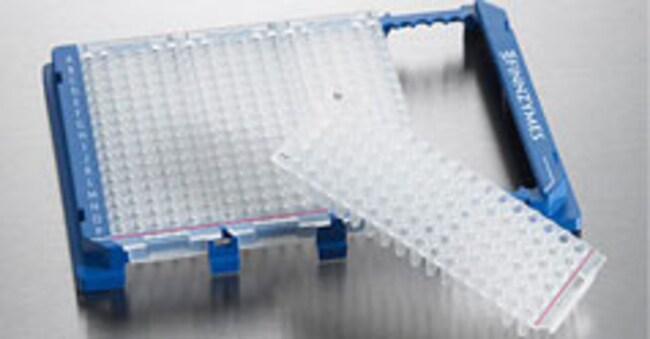
Las placas de PCR Thermo Scientific Piko de 96 pocillos, transparentes, pertenecen a una familia de placas de PCR que ocupan lo mismo que un portaobjetos de microscopio. Además de reducir el tamaño de la placa, hemos reducido considerablemente el grosor de las paredes del pocillo utilizando nuestra tecnología patentada de pared ultrafina (UTW).
Se pueden encajar cuatro placas en un solo marco, lo que equivale a una microplaca estándar de 384 pocillos.
Características
• Pared ultrafina (UTW) para aplicaciones de PCR rápida/qPCR
• Perfil bajo
• Diseñadas para su uso con los termocicladores de 96 pocillos Piko y PikoReal
• Las placas se pueden encajar en el marco de la placa para crear una placa estándar de 384 pocillos
• Compatible con pipetas multicanal estándar y plataformas de manipulación de líquidos
• Espaciado de pocillos y tamaño conformes con las dimensiones industriales (ANSI)
Aplicaciones
• PCR
• qPCR/PCR en tiempo real
Productos relacionados
Placa de PCR Piko, 96 pocillos, transparente
Placa de PCR Piko, 96 pocillos, blanca
Marco para placas de PCR Piko de 96 pocillos, blanco
Se pueden encajar cuatro placas en un solo marco, lo que equivale a una microplaca estándar de 384 pocillos.
Características
• Pared ultrafina (UTW) para aplicaciones de PCR rápida/qPCR
• Perfil bajo
• Diseñadas para su uso con los termocicladores de 96 pocillos Piko y PikoReal
• Las placas se pueden encajar en el marco de la placa para crear una placa estándar de 384 pocillos
• Compatible con pipetas multicanal estándar y plataformas de manipulación de líquidos
• Espaciado de pocillos y tamaño conformes con las dimensiones industriales (ANSI)
Aplicaciones
• PCR
• qPCR/PCR en tiempo real
Productos relacionados
Placa de PCR Piko, 96 pocillos, transparente
Placa de PCR Piko, 96 pocillos, blanca
Marco para placas de PCR Piko de 96 pocillos, blanco
Especificaciones
Certificaciones/conformidadCertificación como material libre de ARNasa y ADNasa
Para utilizar con (equipo)Termociclador Piko, sistema de PCR en tiempo real PikoReal
Tipo de productoMicroplaca de PCR
Cantidad200 placas
Velocidad de reacciónEstándar
Código de barrasSin código de barras
ColorTransparente
MaterialPolipropileno
N.° de pocillos96
Línea de productosPiko
Unit Size200 plates