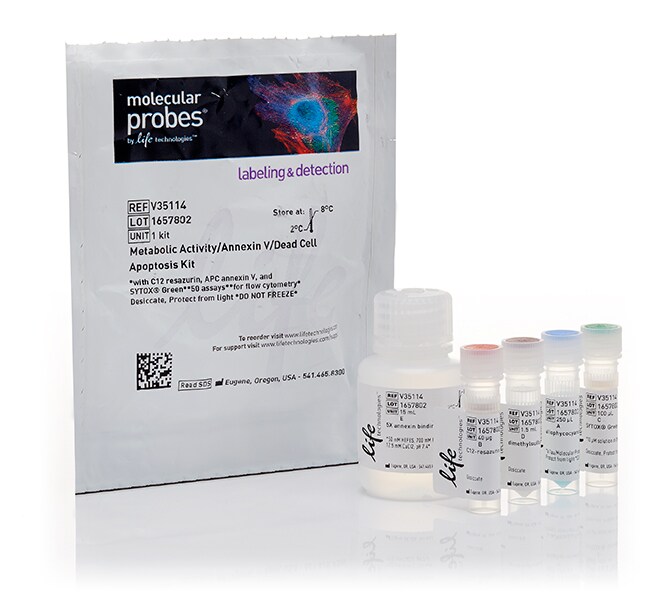
Metabolic Activity Dead Cell Apoptosis Kit with C12 Resazurin, Annexin V APC, and SYTOX™ Green, for flow cytometry
Invitrogen™

Metabolic Activity Dead Cell Apoptosis Kit with C12 Resazurin, Annexin V APC, and SYTOX™ Green, for flow cytometry

Este producto de citometría de flujo proporciona un ensayo de fluorescencia de tres colores que distingue las células vivas deMás información
Have Questions?
Número de catálogoCantidad
V351141 Kit
Número de catálogo V35114
Precio (MXN)
-
Cantidad:
1 Kit
Este producto de citometría de flujo proporciona un ensayo de fluorescencia de tres colores que distingue las células vivas de las apoptóticas y de las apoptóticas tardías. Estas poblaciones pueden distinguirse fácilmente mediante un citómetro de flujo con fuentes de excitación de 488 nm y 633 nm (un láser de iones de argón y uno HeNe) y los siguientes reactivos: anexina V para detectar fosfatidilserina, resazurina C12 para el metabolismo celular, y colorante de ácido nucleico SYTOX™ Green para membranas afectadas.

Consulte la guía de selección para todos los ensayos de apoptosis para citometría de flujo.
Para uso exclusivo en investigación. No apto para uso en procedimientos diagnósticos.
Especificaciones
Excitación/emisiónC12-resazurina: 571⁄585, SYTOX™ Green: 503⁄524, APC: 650⁄660
Líneas láser del citómetro de flujo633/635, 488
Para utilizar con (aplicación)Citometría de flujo
Para utilizar con (equipo)Microscopio de fluorescencia, citómetro de flujo
N.º de reacciones50 reactions
Línea de productosSYTOX
Tipo de productoKit de apoptosis de células muertas
Cantidad1 Kit
Condiciones de envíoHielo húmedo
ConjugadoAPC, SYTOX™ Green, C12-resazurina
FormatoTubo, portaobjetos
Unit Size1 kit
Contenido y almacenamiento
Contiene 1 vial de conjugado de anexina V, APC (250 µl), 1 vial de tinción SYTOX™ Green (100 µl), 1 vial de C12-resazurina (40 µg) y 1 vial de DMSO (1,5 ml).

Almacenar en el refrigerador (2–8 °C) y proteger de la luz.

Preguntas frecuentes

How do SYTO dyes bind to DNA?

The binding mode of SYTO nucleic acid stains is unknown. However, the behavior of these and related nucleic acid dyes suggests the following binding properties:

1.They appear to contact the solvent (suggested by sensitivity to salt, divalent cations, and in particular, SDS) and thus are likely to have contacts in the grooves.
2.All SYTO dyes appear to show some base selectivity and are thus likely to have minor groove contacts.
3.They can be removed from nucleic acid via ethanol precipitation; this characteristic is not shared by ethidium bromide and other intercalators. Likewise, the dyes are not removed from nucleic acid via butanol or chloroform extraction. These extraction methods do remove ethidium bromide from nucleic acid. 4. SYTO binding is not affected by nonionic detergents.
5. SYTO dyes are not quenched by BrdU, so they do not bind nucleic acids in precisely the same way as Hoechst 33342 and DAPI ((4′,6-diamidino-2-phenylindole).

SYBR Green I has shown little mutagenicity on frameshift indicator strains, indicating that it isn't likely to strongly intercalate.

Find additional tips, troubleshooting help, and resources within our Cell Analysis Support Center.

I trypsinized my adherent cells and labeled with annexin V, and now my flow data is showing a high percentage of apoptotic cells even for control, untreated cells. What is the problem?

Trypsinization or mechanical scraping of cells temporarily disrupts the plasma membrane, allowing annexin V to bind phosphatidylserine on the cytoplasmic surface of the cell membrane and thus leading to false positive staining. Allow the cells to recover for about 30 minutes in optimal cell culture conditions and medium after trypsinizing/scraping so that they can recover their membrane integrity before staining. For lightly adherent cell lines, such as HeLa and NIH 3T3, another option is to use non-enzyme treatments like Gibco Cell Dissociation Buffer (Cat. No. 13151014).

Find additional tips, troubleshooting help, and resources within our Cell Analysis Support Center.

Can I detect annexin V staining in an imaging assay?

Annexin V staining is not typically used in imaging experiments; it is a better reagent for flow cytometry analysis. All cells will stain to some extent, so it can be difficult to distinguish a relatively bright annexin V-stained cell from a dimmer non-apoptotic cell. Caspase activation, detected using our CellEvent Caspase 3/7 or Image-iT LIVE Caspase detection kits, is a better method for detecting apoptosis in an imaging assay.

Find additional tips, troubleshooting help, and resources within our Cell Analysis Support Center.

When should I stain adherent cells with annexin V for flow cytometric analysis? Before or after I trypsinize them?

Trypsinize first and then allow the cells to recover about 30 minutes in optimal cell culture conditions and medium before staining with annexin V conjugates. Trypsinization or mechanical scraping of cells temporarily disrupts the plasma membrane, allowing for annexin V to bind phosphatidylserine on the cytoplasmic surface of the cell membrane and thus leading to false positive staining. For lightly adherent cell lines such as HeLa and NIH 3T3, you could use a less harsh (non-enzymatic) dissociation product like Gibco Cell Dissociation Buffer (Cat. No. 13151014).

Find additional tips, troubleshooting help, and resources within our Cell Analysis Support Center.

Can I fix my cells after annexin V staining?

Yes, this is possible. We have established protocols for annexin V staining combined with intracellular staining of lymphocytes that can be found here. The most important step is to leave some binding buffer in the suspension when fixation is started. Compared to staining of live cells, the intensity of the annexin V signal may be somewhat reduced.

Citations & References (2)

Citations & References
Abstract
Bruton's tyrosine kinase is at the crossroads of metabolic adaptation in primary malignant human lymphocytes.
Authors:Sharif-Askari B, Doyon D, Paliouras M, Aloyz R
Journal:Sci Rep
PubMed ID:31363127
'In this work we explored metabolic aspects of human primary leukemic lymphocytes that hold a potential impact on the treatment of Bruton tyrosine kinase (BTK)-driven diseases. Our results suggest that there is crosstalk between Bruton tyrosine kinase (BTK) signaling and bioenergetic stress responses. In primary chronic lymphocytic leukemia (CLL) lymphocytes, ... More
Ibrutinib Resistance Is Reduced by an Inhibitor of Fatty Acid Oxidation in Primary CLL Lymphocytes.
Authors:Galicia-Vázquez G, Aloyz R
Journal:Front Oncol
PubMed ID:30319974
Chronic Lymphocytic Leukemia (CLL) is an incurable disease, characterized by the accumulation of malignant B-lymphocytes in the blood stream (quiescent state) and homing tissues (where they can proliferate). In CLL, the targeting of B-cell receptor signaling through a Burton's tyrosine kinase inhibitor (ibrutinib) has rendered outstanding clinical results. However, complete ... More