Search


Citations & References (32)
Invitrogen™
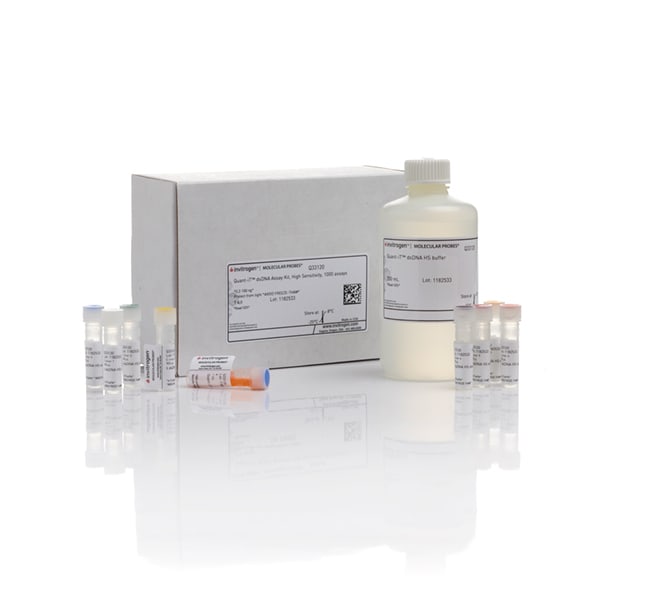
Quant-iT™ dsDNA Assay Kits, high sensitivity (HS) and broad range (BR)
For highly selective quantitation of double-stranded DNA over RNA, the Quant-iT dsDNA Assay Kits, high sensitivity and broad range, produce fluorescence signals that are linear in the ranges of 0.2-100 ng and 2-1000 ng of DNA, respectively.
Have Questions?
Change view

| Catalog Number | Assay | Quantitation Range |
|---|---|---|
| Q33120 | dsDNA Quantitation, HS | 0.2 to 100 ng |
| Q33130 | dsDNA Quantitation, BR | 4 to 1000 ng |
Catalog number Q33120
Price (USD)
602.65
Online exclusive
670.00Save 67.35
Each
Assay:
dsDNA Quantitation, HS
Quantitation Range:
0.2 to 100 ng
Price (USD)
602.65
Online exclusive
670.00Save 67.35
Each
Perform dsDNA quantification easily and quickly with Quant-iT dsDNA assay kits. Both the Quant-iT High-Sensitivity dsDNA Assay Kit and the Quant-iT Broad-Range dsDNA Assay Kit provide concentrated assay reagent, dilution buffer, and pre-diluted DNA standards. These DNA assay kits are highly selective for double-stranded DNA over RNA, and, in the ranges of 0.2–100 ng DNA (for the HS dsDNA Assay Kit) and 4–1000 ng DNA (for the BR dsDNA Assay Kit), the fluorescence signal is linear.
The Quant-iT dsDNA High-Sensitivity Assay Kit and the Quant-iT dsDNA Broad-Range Assay Kit make DNA quantification easy and accurate. The kits provide concentrated assay reagent, dilution buffer, and prediluted DNA standards. Simply dilute the reagent 1:200, load 200 μL into the wells of a microplate, add 1–20 μL sample, mix, then read the fluorescence.
The assays are highly selective for double-stranded DNA over RNA, and, in the range of 0.2–100 ng for the HS assay or 4–1000 ng for the BR assay, the fluorescence signal is linear with DNA. The assays are performed at room temperature, and the signal is stable for three hours. Common contaminants such as salts, solvents, detergents, and protein are well tolerated in these assays.
For Research Use Only. Not for use in diagnostic procedures.
Specifications
AssaydsDNA Quantitation, HS
For Use With (Equipment)Microplate Reader
No. of Reactions1000 Assays (200 μL assay volume)
Product LineQuant-iT
Quantitation Range0.2 to 100 ng
Quantity1 kit
Shipping ConditionRoom Temperature
Detection MethodFluorescence
Unit SizeEach
Frequently asked questions (FAQs)
Why am I getting negative fluorescence values with my Qubit Assays?
I have a Quant-iT DNA Kit and want to use it for the Qubit Fluorometer. Can I?
What is the useful pH range for Quant-iT DNA kits?
I'm trying to quantify some DNA labeled with a fluorophore. Will this work?
Does DNA length have an effect on the dsDNA assays?
Citations & References (32)
Citations & References
Abstract
Natural transformation of Myxococcus xanthus.
Journal:J Bacteriol
PubMed ID:21378184
'Myxococcus xanthus belongs to the delta class of the proteobacteria and is notable for its complex life-style with social behaviors and relatively large genome. Although previous observations have suggested the existence of horizontal gene transfer in M. xanthus, its ability to take up exogenous DNA via natural transformation has not
Gastroenteritis outbreak caused by waterborne norovirus at a New Zealand ski resort.
Journal:Appl Environ Microbiol
PubMed ID:17965205
'In July 2006, public health services investigated an outbreak of acute gastroenteritis among staff and visitors of a popular ski resort in southern New Zealand. The source of the outbreak was a drinking water supply contaminated by human sewage. The virological component of the investigation played a major role in
Expression/localization patterns of sirtuins (SIRT1, SIRT2, and SIRT7) during progression of cervical cancer and effects of sirtuin inhibitors on growth of cervical cancer cells.
Journal:
PubMed ID:25794641
'Sirtuins belong to the family of class III histone deacetylases; its role in neoplasia is controversial as both tumor-suppressive and promoting functions have been reported. There are very few reports available, where expressions of sirtuin isoforms are comprehensively analyzed during neoplasia. Therefore, in the present study, the expression of SIRT1,
The altered landscape of the human skin microbiome in patients with primary immunodeficiencies.
Journal:
PubMed ID:24170601
'While landmark studies have shown that microbiota activate and educate host immunity, how immune systems shape microbiomes and contribute to disease is incompletely characterized. Primary immunodeficiency (PID) patients suffer recurrent microbial infections, providing a unique opportunity to address this issue. To investigate the potential influence of host immunity on the
Effect of the metabolic environment at key stages of follicle development in cattle: focus on steroid biosynthesis.
Journal:Physiol Genomics
PubMed ID:22414914
'Cellular mechanisms that contribute to low estradiol concentrations produced by the preovulatory ovarian follicle in cattle with a compromised metabolic status are largely unknown. To gain insight into the main metabolic mechanisms affecting preovulatory follicle function, two different animal models were used. Experiment 1 compared Holstein-Friesian nonlactating heifers (n =