Search


Citations & References (1)
Invitrogen™
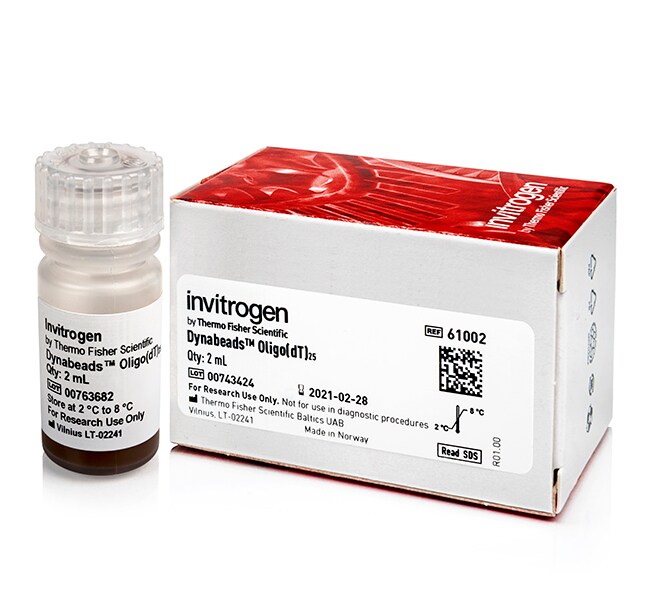
Dynabeads™ Oligo(dT)25
Dynabeads™ Oligo(dT)25 mRNA isolation beads specifically target and capture mRNA molecules from virtually any crude sample and eliminate the need to purify total RNA when the desired information-bearing nucleic acid is mRNA.
Have Questions?
Change view

| Catalog Number | Quantity |
|---|---|
| 61002 | 2 mL |
| 61005 | 5 mL |
Catalog number 61002
Price (TWD)
24,075.00
온라인 행사
Ends: 30-Sep-2026
32,100.00Save 8,025.00 (25%)
Each
Quantity:
2 mL
Price (TWD)
24,075.00
온라인 행사
Ends: 30-Sep-2026
32,100.00Save 8,025.00 (25%)
Each
Dynabeads™ Oligo(dT)25 mRNA isolation beads specifically target and capture mRNA molecules from virtually any crude sample and eliminate the need to purify total RNA when the desired information-bearing nucleic acid is mRNA. Since mRNA comprises only about 1–5% ot total cellular RNA, the isolation of total RNA is not the most efficient way to isolate mRNA. Other technologies designed to purify total RNA yield ∼80% ribosomal RNA and force mRNA to compete with ribosomal RNA, transfer RNA, micro RNA, small nucleolar RNA, and small cytoplasmic RNA for membrane binding. Advantages of Dynabeads™ Oligo(dT)25 beads:
• Fast and gentle procedure yields pure intact mRNA
• Extremely pure mRNA isolation, best choice upstream of cDNA synthesis
• Exquisitely sensitive mRNA isolation enables cDNA synthesis and cDNA library construction from ultra-small starting samples (enables cDNA library construction from a single cell)
How the beads work
The oligo(dT)25-coated Dynabeads™ specifically target and capture the mRNA transcriptome from an extremely wide variety of crude starting samples. Ribosomal RNA, DNA, proteins, and small RNA molecules (such as transfer RNA, micro RNA, and small nucleolar RNA) do not bind to the beads and are discarded. Only polyadenylated RNA species (mRNA) are captured. Isolated mRNA is pure, eliminating the need for ribosomal RNA subtraction or a post-extraction DNase treatment. This column-free system ensures the highest transcriptome recovery:
• Physical mRNA capture on mobile magnetic beads
• Rapid and gentle magnetic handling procedures
• No mRNA lost during high g-force spins
• No mRNA trapped in column membranes during elution
Applications
mRNA is suitable for all downstream molecular applications, including gene cloning, cDNA synthesis, cDNA library construction, RT-PCR, quantitative RT-PCR, RPA (Ribonuclease Protection Assay), subtractive hybridization, primer extension, SAGE, RACE, and others. The Dynabeads™ Oligo(dT)25 mRNA isolation beads are the ideal mRNA purification method prior to cDNA library construction. Use of these beads ensures the highest recovery and enrichment of the transcriptome. These beads capture more of the transcriptome than is possible with methods that integrate a total RNA isolation step upstream of mRNA isolation.
Verastile elution options
Elution can be performed in any volume down to 5 μL. mRNA elution is optional because enzymatic reactions in downstream procedures are not inhibited by presence of Dynabeads™. Additionally, one can perform cDNA synthesis directly on the beads to create a reusable solid-phase cDNA library.
For Research Use Only. Not for use in diagnostic procedures.
Specifications
For Use With (Application)RNA Extraction
FormBeads in Suspension
High-throughput CompatibilityHigh-throughput Compatible
Ligand TypeOligo-dT
Product LineDYNAL, Dynabeads
Product TypemRNA Isolation Bead
Quantity2 mL
Shelf Life36 months from date of manufacture
Shipping ConditionRoom Temperature
Unit SizeEach
Contents & Storage
Store 2°C to 8°C
2 mL Beads
2 mL Beads
Frequently asked questions (FAQs)
I am getting DNA contamination after mRNA isolation using Dynabeads magnetic beads. Why is this?
I am getting rRNA contamination after mRNA isolation using Dynabeads magnetic beads. What should I do?
How long can I leave the isolated mRNA on Dynabeads Oligo(dT)25 magnetic beads?
My Dynabeads magnetic beads are not pelleting well with the magnet. Do you have any suggestions for me?
Can I use Dynabeads Oligo(dT)25 magnetic beads in real-time PCR?
Citations & References (1)
Citations & References
Abstract
20 beta-hydroxysteroid dehydrogenase and CYP19A1 are differentially expressed during maturation in Atlantic cod (Gadus morhua).
Journal:J Mol Endocrinol
PubMed ID:17909270
In order to better quantify the molecular mechanisms regulating final oocyte maturation and spawning, complete coding sequences with partially or fully untranslated regions for the steroidogenic enzymes, cytochrome P450 aromatase and 20 beta-hydroxysteroid dehydrogenase, were cloned from ovaries of Atlantic cod (Gadus morhua). The nucleotide and amino acid sequences showed