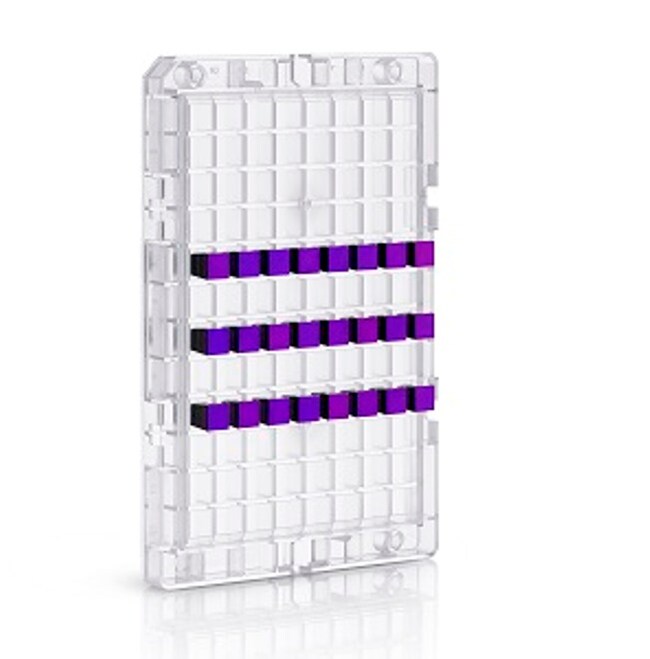
GeneChip™ HT HG-U133+PM Array Plate
Actual product may vary

GeneChip™ HT HG-U133+PM Array Plate

Have Questions?
Catalog number 901261
Price (TWD)
-
Description: Proven performance from the industry standard
The GeneChip™ HT HG-U133+ PM 24-Array Plate enables high-throughput expression profiling of multiple samples at a time using the same content as the industry-standard GeneChip Human Genome U133 Plus 2.0 Array*.

The HT HG-U133+ PM Array Plate enables you to:
• Measure gene expression of more than 47,000 transcripts and variants, including more than 33,000 well-characterized genes and UniGene clusters per sample
• Get accurate and reproducible data by using multiple independent measurements for each transcript

Scatter plots represent median MAQC B - MAQC A signals for each array type. The high correlation coefficients indicate similar biology is being observed (Fig. 1 and Fig. 2).

Key Benefits:
• Enables increased productivity and efficiency through parallel processing
   - Process 16, 24, or 96 samples on a single array plate
• Same industry-leading performance and content as the Human Genome U133 Plus 2.0 Array in cartridge format
   - Strong signal and fold change correlation to previous plate and cartridge designs
• Multiple independent measurements per transcript for increased confidence in your results
   - Interrogates more sequence than a single probe measurement
• Conveniently packaged
   - Individual 16-, 24-, and 96-array plates available
   - All processing trays included

Content Profile:
Sequences used in the design of the arrays were selected from GenBank™, dbEST and RefSeq. The majority of sequence clusters were created from the UniGene database (Build 133, April 20, 2001) and refined by analysis and comparison with a number of other publicly available databases, including the Washington University EST trace repository and the University of California, Santa Cruz Golden-Path human genome database (April 2001 release).

An additional set of sequence clusters were created from Build 159 of UniGene (January 25, 2003) and refined by analysis and comparison with a number of other publicly available databases, including the Washington University EST trace repository and the NCBI human genome assembly (Build 31). Sequences were further analyzed for correct orientation, false priming, false clustering, alternative splicing and alternative polyadenylation.

*Two design changes were introduced with the GeneChip HT HG-U133+ PM Array Plate:
• Only perfect match (PM) probes from the cartridge design were retained while mismatch (MM) probes were removed.
• Empirical data was used to select the best-performing probes resulting in reducing the number of PM probes
   - 42,461 probe sets were reduced from 11 to nine probes
   - Six probe sets were reduced from 11 to 10
For Research Use Only. Not for use in diagnostic procedures.
Specifications
Unit Size1 kit

Frequently asked questions (FAQs)

Is the hybridization mix for cartridges the same as the hybridization mix for PEG arrays (array plates)?

The hybridization mix for PEG arrays is different from the hybridization mix for cartridges. The concentrations of the hybridization mix are different and in addition, DMSO is not added into the hybridization mix for PEG arrays because it can affect the glue that holds the PEG to the plate.

What does the "_x_at" extension represent in the HG-U133 probe set name?

Occasionally, it is not possible to select either a unique probe set or a probe set with all probes common among multiple transcripts ("_s_at" ). In such cases, similarity criteria are suspended, and the resulting probe set name is appended with the "_x_at" extension. These probe sets contain some probes that are identical, or highly similar, to unrelated sequences. These probes may cross-hybridize in an unpredictable manner with sequences other than the main target. Data generated from these probe sets should be interpreted with caution, due to the likelihood that some of the signal is from transcripts other than the one being intentionally measured.

Find additional tips, troubleshooting help, and resources within our Microarray Analysis Support Center.

What does the "_s_at" extension represent in the HG-U133 probe set name?

The primary goal in probe set selection is to select a probe set unique to a single transcript or common among a small set of similar transcript variants. A probe set name is appended with the "_s_at" extension when all the probes exactly match multiple transcripts. The probe set selection process generally favors probe sets measuring fewer transcripts. Probe sets with common probes among multiple transcripts (the "_s_at" probe sets), are frequent and are to be expected, due to alternative polyadenylation and alternative splicing. In most cases, "_s_at" probe sets represent transcripts from the same gene, but the same probe set can sometimes also represent transcripts from homologous genes. One transcript may be represented by both a unique and an "_s_at" probe set when the transcript variation is sufficient.

Find additional tips, troubleshooting help, and resources within our Microarray Analysis Support Center.

How long does it take to scan the plate?

96 arrays = 4-4.6 hours
24 arrays = 1.5-2 hours

Find additional tips, troubleshooting help, and resources within our Microarray Analysis Support Center.

If I have cartridges, can I move to PM only arrays in the middle of my project?

No, continue to finish products using the same procedures and products. New projects can be moved to PM only arrays.

Find additional tips, troubleshooting help, and resources within our Microarray Analysis Support Center.