Search


Citations & References (12)
Invitrogen™
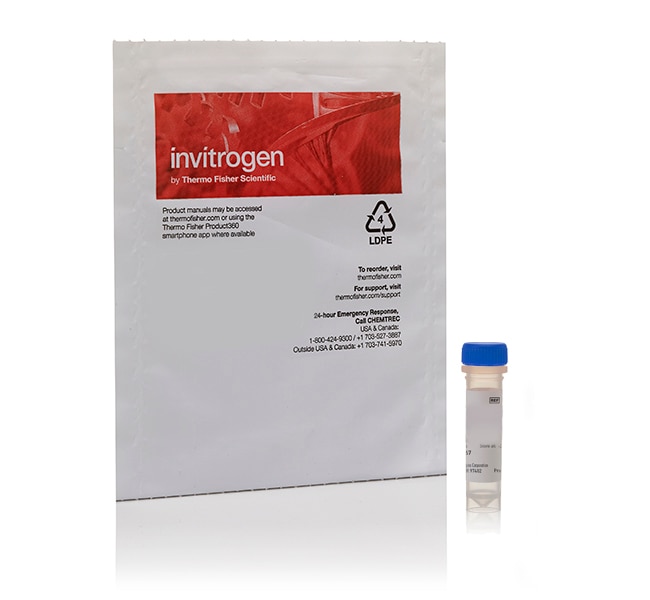
CellLight™ Tubulin-RFP, BacMam 2.0
CellLight Tubulin-RFP, BacMam 2.0, provides an easy way to label tubulin with red fluorescent protein (RFP) in live cells. SimplyRead more
| Catalog Number | Quantity | Color | Target |
|---|---|---|---|
| C10614 | 1 mL | Red | Cytoskeleton, Tubulin |
Catalog number C10614
Price (TWD)
19,740.00
Online offer
Ends: 30-Sep-2026
28,200.00Save 8,460.00 (30%)
Each
Quantity:
1 mL
Color:
Red
Target:
Cytoskeleton, Tubulin
Price (TWD)
19,740.00
Online offer
Ends: 30-Sep-2026
28,200.00Save 8,460.00 (30%)
Each
CellLight Tubulin-RFP, BacMam 2.0, provides an easy way to label tubulin with red fluorescent protein (RFP) in live cells. Simply add the reagent to your cells, incubate overnight, and the cells are ready to image in the morning.
Want to label other cell structures? Learn more about CellLight fluorescent protein labeling tools
This ready-to-use construct is transfected into cells using BacMam 2.0 technology, where it expresses RFP fused to human tubulin. You can observe tubulin-RFP behavior in live cells with almost no cytotoxicity and label with multiple tracking or tracing dyes to image dynamic cellular processes.
Cells expressing CellLight constructs can also be fixed with formaldehyde for multiplexed imaging using immunocytochemical techniques.
CellLight Technology is:
• Fast and convenient: simply add CellLight reagent to your cells, incubate overnight, and image—or store frozen, assay-ready cells for later use
• Highly efficient: up to 90% transduction of a wide range of mammalian cell lines, including primary cells, stem cells, and neurons
• Flexible: co-transduce more than one BacMam reagent for multiplex experiments or co-localization studies; tightly control expression levels by simply varying the dose
• Less toxic: CellLight reagents are non-replicating in mammalian cells and are suitable for biosafety level (BSL) 1 handling
BacMam Technology
CellLight Tubulin-RFP, BacMam 2.0, is a fusion construct of human tubulin and TagRFP, providing accurate and specific targeting to cellular tubulin-RFP. This fusion construct is packaged in the insect virus baculovirus, which does not replicate in human cells and is designated as safe to use with biosafety level (BSL) 1 in most laboratories. BacMam technology ensures that most mammalian cell types are transduced/transfected with high efficiency and minimal toxicity. This transient transfection can be detected after overnight incubation for up to five days—enough time to carry out most dynamic cellular analyses. Like any transfection/transduction technique, the BacMam method does not transfect/transduce all of the cells with equal efficiency, making it poorly suited to cellular population studies or automated imaging/counting. CellLight reagents are ideal for experiments where cellular or subcellular co-locatization is required, or for cellular function studies that need special resolution.
Visualize staining your cell without wasting your reagents, antibodies, or time with our new Stain-iT Cell Staining Simulator.
Want to label other cell structures? Learn more about CellLight fluorescent protein labeling tools
This ready-to-use construct is transfected into cells using BacMam 2.0 technology, where it expresses RFP fused to human tubulin. You can observe tubulin-RFP behavior in live cells with almost no cytotoxicity and label with multiple tracking or tracing dyes to image dynamic cellular processes.
Cells expressing CellLight constructs can also be fixed with formaldehyde for multiplexed imaging using immunocytochemical techniques.
CellLight Technology is:
• Fast and convenient: simply add CellLight reagent to your cells, incubate overnight, and image—or store frozen, assay-ready cells for later use
• Highly efficient: up to 90% transduction of a wide range of mammalian cell lines, including primary cells, stem cells, and neurons
• Flexible: co-transduce more than one BacMam reagent for multiplex experiments or co-localization studies; tightly control expression levels by simply varying the dose
• Less toxic: CellLight reagents are non-replicating in mammalian cells and are suitable for biosafety level (BSL) 1 handling
BacMam Technology
CellLight Tubulin-RFP, BacMam 2.0, is a fusion construct of human tubulin and TagRFP, providing accurate and specific targeting to cellular tubulin-RFP. This fusion construct is packaged in the insect virus baculovirus, which does not replicate in human cells and is designated as safe to use with biosafety level (BSL) 1 in most laboratories. BacMam technology ensures that most mammalian cell types are transduced/transfected with high efficiency and minimal toxicity. This transient transfection can be detected after overnight incubation for up to five days—enough time to carry out most dynamic cellular analyses. Like any transfection/transduction technique, the BacMam method does not transfect/transduce all of the cells with equal efficiency, making it poorly suited to cellular population studies or automated imaging/counting. CellLight reagents are ideal for experiments where cellular or subcellular co-locatization is required, or for cellular function studies that need special resolution.
Visualize staining your cell without wasting your reagents, antibodies, or time with our new Stain-iT Cell Staining Simulator.
For Research Use Only. Not for use in diagnostic procedures.
Specifications
ColorRed
Detection MethodFluorescence
Dye TypeRFP (TagRFP)
EmissionVisible
Excitation Wavelength Range555⁄584
For Use With (Equipment)Confocal Microscope, Fluorescence Microscope
FormLiquid
Product LineCellLight
Quantity1 mL
Shipping ConditionWet Ice
TargetCytoskeleton, Tubulin
TechniqueFluorescence Intensity
Label TypeFluorescent Dye
Product TypeTubulin
Sub Cellular LocalizationCytoskeleton, Tubulin
Unit SizeEach
Contents & Storage
Store at 2°C to 6°C, protected from light. Do Not Freeze.
Frequently asked questions (FAQs)
How can I increase the transduction efficiency with the BacMam 2.0 reagents such as the the CellLight and Premo products?
Is there any way to preserve the CellLights labeling beyond 5 days?
Are the CellLights products toxic to cells?
For how long will the CellLights products label my cells?
What cell types can the CellLights products be used with?
Citations & References (12)
Citations & References
Abstract
Sperm-associated antigen 4, a novel hypoxia-inducible factor 1 target, regulates cytokinesis, and its expression correlates with the prognosis of renal cell carcinoma.
Journal:Am J Pathol
PubMed ID:23602831
'Hypoxia plays a crucial role in many pathophysiological conditions, including cancer biology, and hypoxia-inducible factor (HIF) regulates transcriptional responses under hypoxia. To elucidate the cellular responses to hypoxia, we performed chromatin immunoprecipitation with deep sequencing in combination with microarray analysis and identified HIF-1 targets. We focused on one of the
Optimization of gene delivery methods in Xenopus laevis kidney (A6) and Chinese hamster ovary (CHO) cell lines for heterologous expression of Xenopus inner ear genes.
Journal:In Vitro Cell Dev Biol Anim
PubMed ID:21959846
'The Xenopus inner ear provides a useful model for studies of hearing and balance because it shares features with the mammalian inner ear, and because amphibians are capable of regenerating damaged mechanosensory hair cells. The structure and function of many proteins necessary for inner ear function have yet to be
Dynamic Imaging of the Hepatitis C Virus NS5A Protein during a Productive Infection.
Journal:
PubMed ID:24429364
Hepatitis C virus (HCV) NS5A is essential for viral genome replication within cytoplasmic replication complexes and virus assembly at the lipid droplet (LD) surface, although its definitive functions are poorly understood. We developed approaches to investigate NS5A dynamics during a productive infection. We report here that NS5A motility and efficient
MicroRNA and protein profiling of brain metastasis competent cell-derived exosomes.
Journal:
PubMed ID:24066071
Exosomes are small membrane vesicles released by most cell types including tumor cells. The intercellular exchange of proteins and genetic material via exosomes is a potentially effective approach for cell-to-cell communication and it may perform multiple functions aiding to tumor survival and metastasis. We investigated microRNA and protein profiles of
Nucleocytoplasmic coagulation: an injury-induced aggregation event that disulfide crosslinks proteins and facilitates their removal by plasmin.
Journal:Cell Rep
PubMed ID:23041318
Cellular injury causes a myriad of processes that affect proteostasis. We describe nucleocytoplasmic coagulation (NCC), an intracellular disulfide-dependent protein crosslinking event occurring upon late-stage cell death that orchestrates the proteolytic removal of misfolded proteins. In vitro and in vivo models of neuronal injury show that NCC involves conversion of soluble intracellular proteins,