Search


引用資料與參考文獻 (1)
Gibco™
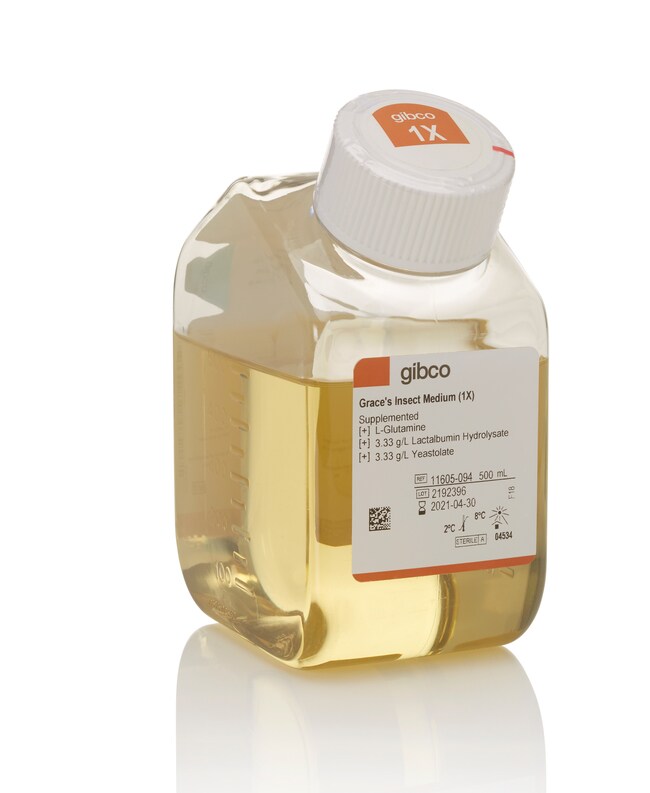
Grace's Insect Medium, supplemented
Grace's Insect Medium, Supplemented, was originally designed for the growth of cells from the Australian Emperor Gum Moth, Antherea eucalypti.深入閱讀
Have Questions?
變更視圖

| 產品號碼 | Quantity |
|---|---|
| 11605102 | 10 x 500 mL |
| 11605094 | 500 mL |
產品號碼 11605102
價格 (TWD)
18,750.00
Online offer
Ends: 30-Jun-2026
25,000.00您節省 6,250.00 (25%)
Each
Quantity:
10 x 500 mL
價格 (TWD)
18,750.00
Online offer
Ends: 30-Jun-2026
25,000.00您節省 6,250.00 (25%)
Each
Grace's Insect Medium, Supplemented, was originally designed for the growth of cells from the Australian Emperor Gum Moth, Antherea eucalypti. Grace's Supplemented Insect Medium is now widely used for the growth of Spodeptera frugiperda cells, Sf9 and Sf21.
Sf9 and Sf21 cells are routinely used to express recombinant protein using the Baculovirus Expression Vector System (BEVS). We offer a variety of Gibco™ media options for a range of insect cell culture applications.
Formulation
This Grace's Insect Medium contains lactalbumin hydrolysate, yeastolate, L-glutamine, and sodium bicarbonate. The complete formulation is available. Grace's Supplemented Insect Medium contains lactalbumin hydrolysate and yeastolate not commonly found in the unsupplemented version.
Dual site cGMP manufacturing and quality system
Gibco™ Grace's Supplemented Insect Medium is manufactured at a cGMP-compliant facility located in Grand Island, New York. The facility is registered with the FDA as a medical device manufacturer and is certified to ISO 13485 standards. For supply chain continuity, we offer an identical product made in our Scotland facility (11605-045). This facility is registered with the FDA as a medical device manufacturer and is certified to the ISO 13485 standard.
Grace's Supplemented Insect Medium contains lactalbumin hydrolysate and yeastolate, and is commonly supplemented with 10% Fetal Bovine Serum (FBS) before use. Grace's Supplemented Insect Medium requires ambient CO2 in order to maintain physiological pH.
Sf9 and Sf21 cells are routinely used to express recombinant protein using the Baculovirus Expression Vector System (BEVS). We offer a variety of Gibco™ media options for a range of insect cell culture applications.
Formulation
This Grace's Insect Medium contains lactalbumin hydrolysate, yeastolate, L-glutamine, and sodium bicarbonate. The complete formulation is available. Grace's Supplemented Insect Medium contains lactalbumin hydrolysate and yeastolate not commonly found in the unsupplemented version.
Dual site cGMP manufacturing and quality system
Gibco™ Grace's Supplemented Insect Medium is manufactured at a cGMP-compliant facility located in Grand Island, New York. The facility is registered with the FDA as a medical device manufacturer and is certified to ISO 13485 standards. For supply chain continuity, we offer an identical product made in our Scotland facility (11605-045). This facility is registered with the FDA as a medical device manufacturer and is certified to the ISO 13485 standard.
Grace's Supplemented Insect Medium contains lactalbumin hydrolysate and yeastolate, and is commonly supplemented with 10% Fetal Bovine Serum (FBS) before use. Grace's Supplemented Insect Medium requires ambient CO2 in order to maintain physiological pH.
For Research Use Only. Not for use in diagnostic procedures.
規格
Cell LineSf21, Sf9
Cell TypeInsect Cell
Inorganic SaltsCalcium, Magnesium
Product LineGibco
Product TypeGrace's Insect Medium
Quantity10 x 500 mL
Shipping ConditionRoom Temperature
FormLiquid
With AdditivesGlutamine, Yeastolate, Lactalbumin Hydrolysate
Without AdditivesNo Insect Hemolymph
Unit SizeEach
內容物與存放
Storage conditions: 2°C to 8°C. Protect from light
Shipping conditions: Ambient
Shelf life: 12 months from date of manufacture
Shipping conditions: Ambient
Shelf life: 12 months from date of manufacture
常見問答集 (常見問題)
For how long can I store Grace's Insect Medium, unsupplemented at room temperature?
What additional supplements are required in Grace's Insect Cell Culture Medium, Unsupplemented to make a "complete" formulation that will support insect cell growth?
引用資料與參考文獻 (1)
引用資料與參考文獻
Abstract
Structures of the human rad17-replication factor C and checkpoint rad 9-1-1 complexes visualized by glycerol spray/low voltage microscopy.
Journal:J Biol Chem
PubMed ID:11907025
Human checkpoint Rad proteins are thought to function as damage sensors in the DNA damage checkpoint response pathway. The checkpoint proteins hRad9, hHus1, and hRad1 have limited homology to the replication processivity factor proliferating cell nuclear antigen (PCNA), and hRad17 has homology to replication factor C (RFC). Such observations have