Search


引用資料與參考文獻 (10)
Gibco™
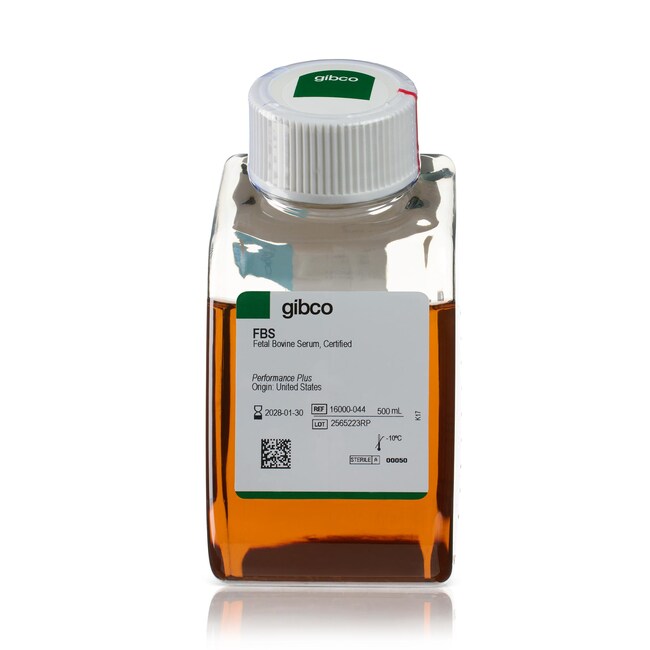
Fetal Bovine Serum, certified, United States
Important Update: We've recently introduced Premium Plus Fetal Bovine Serum (FBS) specification-based products. These improved products are alternatives to our Certified US origin, New Zealand origin, and Qualified Australia origin SKUs. Product stability, performance, manufacturing, storage, and transport processes are unchanged.
| 產品號碼 | Quantity | Format |
|---|---|---|
| 16000044 | 500 mL | Bottle |
我們全新升級的 Premium Plus 胎牛血清(FBS)在產品規格上有所提升,同時保有原有的穩定性、生產流程、儲存及運輸方式,讓您使用更安心。
產品號碼 16000044
價格 (TWD)
30,700.00
Each
Gibco™ fetal bovine sera offer excellent value for basic cell culture, specialty research, and specific assays, earning the trust of researchers with consistent quality and award-winning support that helps meet your research needs and budget requirements
Gibco™ Sera: Trusted Quality for Consistent Performance
Sera Category: Premium (Performance Plus)
- Use for a broad range of cell types, especially sensitive cell lines
- Our most characterized sera with the lowest endotoxin and hemoglobin levels
- Endotoxin level: ≤5 EU/mL
- Hemoglobin level: ≤15 mg/dL
- Origin: United States
Gibco™ Serum Delivers
- ISO 13485 certified, processed in FDA registered facilities
- Triple filtered at 0.1 μm
- Gibco™ bottle is easier to use in the hood, reduces the risk of contamination and helps you perform cell culture more consistently
- Peel-off sticker on label provides handy reference for lot number and expiration date recording in lab notebook
For research use or further manufacturing use only. Serum and blood proteins are not for direct administration into humans or animals.
規格
Endotoxin Concentration≤5 EU/mL
Hemoglobin Concentration≤15 mg/dL
Purity or Quality GradeCertified
Shipping ConditionFrozen
SpeciesCattle/Bovine
AgeFetal
Country of OriginUnited States
FormLiquid
FormatBottle
Product TypeFetal Bovine Serum
Quantity500 mL
Serum TreatmentStandard (Sterile-filtered)
SterilitySterile
Sterilization MethodTriple-filtered, 0.1 μm
Unit SizeEach
內容物與存放
Storage conditions: ≤-10°C
Shipping conditions: Frozen
Shipping conditions: Frozen
常見問答集 (常見問題)
What are the benefits and disadvantages of using heat-inactivated FBS in cell culture?
How much of the total protein measured in Fetal Bovine Serum (heat inactivated or otherwise) is attributed to albumin?
How much Fetal Bovine Serum (FBS) do I need to add to my medium?
How long can I store Gibco Fetal Bovine Serum at 4 degrees C?
How should I thaw Gibco Fetal Bovine Serum?
引用資料與參考文獻 (10)
引用資料與參考文獻
Abstract
Fibroblast growth factor receptor-1 signaling induces osteopontin expression and vascular smooth muscle cell-dependent adventitial fibroblast migration in vitro.
Journal:Circulation
PubMed ID:12176960
'BACKGROUND: Increased expression of osteopontin (OPN), fibroblast growth factors (FGFs), and their type-1 receptor (FGFR-1) is associated with neointima formation and atherosclerosis. This study tested the hypothesis that ligand activation of FGFR-1 stimulates OPN expression in rat aortic smooth muscle cells (RASMCs), explored the signaling pathway involved, and assessed the
Ultraviolet-induced junD activation and apoptosis in myeloblastic leukemia ML-1 cells.
Journal:J Biol Chem
PubMed ID:12082101
'The exposure of mammalian cells to UV irradiation induces the expression of immediate early genes such as c-jun and c-fos and activates the transcription factors AP-1 and NF-kappaB. JunD is one of the three members of the Jun family and shares some functional characteristics with c-Jun. In the present study,
Dystrophin deficiency markedly increases enterovirus-induced cardiomyopathy: a genetic predisposition to viral heart disease.
Journal:Nat Med
PubMed ID:12118246
Both enteroviral infection of the heart and mutations in the dystrophin gene can cause cardiomyopathy. Little is known, however, about the interaction between genetic and acquired forms of cardiomyopathy. We previously demonstrated that the enteroviral protease 2A cleaves dystrophin; therefore, we hypothesized that dystrophin deficiency would predispose to enterovirus-induced cardiomyopathy.
Ascorbic-acid transporter Slc23a1 is essential for vitamin C transport into the brain and for perinatal survival.
Journal:Nat Med
PubMed ID:11984580
The only proven requirement for ascorbic acid (vitamin C) is in preventing scurvy, presumably because it is a cofactor for hydroxylases required for post-translational modifications that stabilize collagen. We have created mice deficient in the mouse ortholog (solute carrier family 23 member 1 or Slc23a1) of a rat ascorbic-acid transporter,
Cell docking and on-chip monitoring of cellular reactions with a controlled concentration gradient on a microfluidic device.
Journal:Anal Chem
PubMed ID:12199565
We have developed a microfluidic device for on-chip monitoring of cellular reactions. The device consists of two primary analytical functions: control of cell transport and immobilization, and dilution of an analyte solution to generate a concentration gradient. In this device, a dam structure in parallel to the fluid flow was