Search


引用資料與參考文獻 (4)
Gibco™
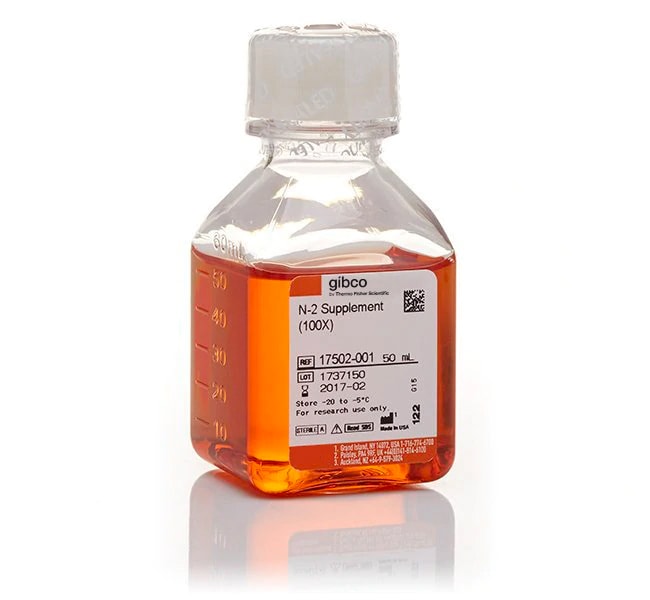
N-2 Supplement (100X)
N-2 Supplement is a versatile serum-free cell culture supplement that supports the growth and viability of various cell types.
Have Questions?
變更視圖

| 產品號碼 | Quantity |
|---|---|
| 17502001 | 50 mL |
| 17502048 | 5 mL |
產品號碼 17502001
價格 (TWD)
***
Quantity:
50 mL
價格 (TWD)
***
Gibco N-2 Supplement is a chemically defined, serum-free supplement based on Bottenstein's N-1 formulation, containing optimized concentrations of insulin, iron-rich holo-transferrin, progesterone, putrescine, and selenite. N-2 Supplement is recommended for growth and expression of neuroblastomas and neural cells in primary cultures from both the peripheral nervous system (PNS) and the central nervous system (CNS).
N-2 Supplement has been demonstrated in wide-ranging applications, such as the culture of neural stem cells, the culture of the SH-SY5Y cell line (subline of the neuroblastoma cell line SK-N-SH), and culture of the HT22 mouse hippocampal neuronal cell line. Additionally, N-2 Supplement adds support to cell culture media used to differentiate pluripotent stem cells (PSCs) to a variety of cell types, including neural and pancreatic-like cell types.
N-2 Supplement may be used with Neurobasal media supplemented with growth factors such as bFGF and EGF. When combined with Dulbecco's Modified Eagle Medium (D-MEM) and fetal bovine serum (FBS), N-2 Supplement also provides suitable supplementation for the culture of human and rodent astrocytes.
- Each lot is cGMP manufactured
- Each lot is tested for sterility, endotoxin, and performance
- Contains insulin, iron-rich holo-transferrin, progesterone, putrescine, and selenite
- Can be used as a substitute for Bottenstein's N-1 formulation
- Provided as a 100X concentrate
Choose Gibco N-2 Supplement for a reliable, high-quality product trusted by researchers worldwide.
For Research Use Only. Not for use in diagnostic procedures.
規格
Cell TypeNeural Cells
Concentration100 X
Culture TypeMammalian Cell Culture
Quantity50 mL
Serum LevelSerum-Free
Shelf Life18 Months
Shipping ConditionDry Ice
SourceSerum-Free
Tested ForEndotoxin, Performance, Sterility
ClassificationSerum-free
FormLiquid
Product TypeCell Culture Supplement
SterilitySterile
pH6 to 8
Unit SizeEach
內容物與存放
Store in freezer (-5 to -20°C) and protect from light.
常見問答集 (常見問題)
What supplements should I use with Neurobasal or Neurobasal-A medium?
Is there a difference between the Gibco N-2 Supplement formulation from Thermo Fisher and the N-2 Supplement formulation from Global Stem?
Can I filter the N-2 Supplement?
What is the recommended storage condition and shelf life for N-2 Supplement (100X) (Cat. No. 17502001 or 17502048)?
Which supplement can I add to Neurobasal Medium to culture my neural cells?
引用資料與參考文獻 (4)
引用資料與參考文獻
Abstract
In vitro generation of human pluripotent stem cell derived lung organoids.
Journal:
PubMed ID:25803487
'Recent breakthroughs in 3-dimensional (3D) organoid cultures for many organ systems have led to new physiologically complex in vitro models to study human development and disease. Here, we report the step-wise differentiation of human pluripotent stem cells (hPSCs) (embryonic and induced) into lung organoids. By manipulating developmental signaling pathways hPSCs
Directed differentiation of human pluripotent stem cells into intestinal tissue in vitro.
Journal:Nature
PubMed ID:21151107
Studies in embryonic development have guided successful efforts to direct the differentiation of human embryonic and induced pluripotent stem cells (PSCs) into specific organ cell types in vitro. For example, human PSCs have been differentiated into monolayer cultures of liver hepatocytes and pancreatic endocrine cells that have therapeutic efficacy in
Recapitulation of SARS-CoV-2 infection and cholangiocyte damage with human liver ductal organoids.
Journal:Protein Cell
PubMed ID:32303993
Viral Delivery of GDNF Promotes Functional Integration of Human Stem Cell Grafts in Parkinson's Disease.
Journal:Cell Stem Cell
PubMed ID:32059808
Dopaminergic neurons (DAns), generated from human pluripotent stem cells (hPSCs), are capable of functionally integrating following transplantation and have recently advanced to clinical trials for Parkinson's disease (PD). However, pre-clinical studies have highlighted the low proportion of DAns within hPSC-derived grafts and their inferior plasticity compared to fetal tissue. Here,