Search


引用資料與參考文獻 (1)
Thermo Scientific™
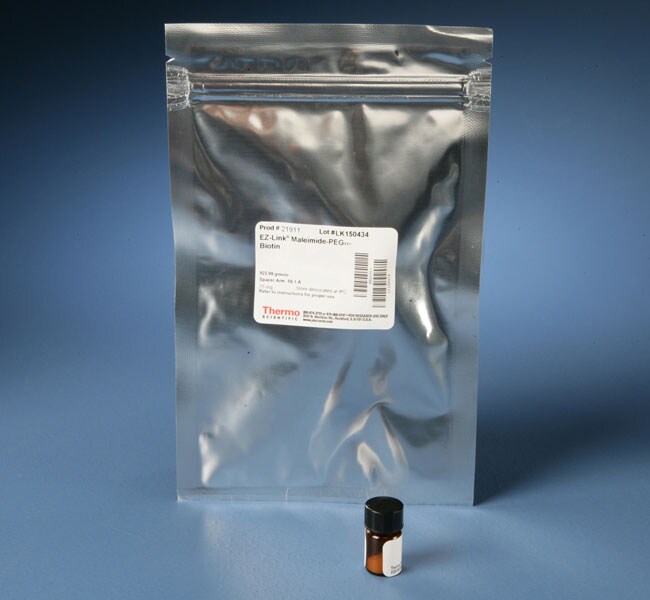
EZ-Link™ Maleimide-PEG11-Biotin
Thermo Scientific EZ-Link Maleimide-PEG11-Biotin is a long, maleimide-activated, sulfhydryl-reactive biotinylation reagent that includes an 11-unit polyethylene glycol spacer arm for深入閱讀
| 產品號碼 | Quantity |
|---|---|
| 21911 | 25 mg |
產品號碼 21911
價格 (TWD)
***
Quantity:
25 mg
價格 (TWD)
***
Thermo Scientific EZ-Link Maleimide-PEG11-Biotin is a long, maleimide-activated, sulfhydryl-reactive biotinylation reagent that includes an 11-unit polyethylene glycol spacer arm for increased water-solubility and reach.
Features of EZ-Link Maleimide-PEG11-Biotin:
• Protein labeling—biotinylate antibodies or other proteins for use in protein methods
• Thiol-reactive—reacts with sulfhydryls (-SH), such as the side-chain of cysteine (C)
• Maleimide-activated—perform reactions at pH 6.5 to 7.5 in buffers such as PBS
• Pegylated – spacer arm contains a hydrophilic, 11-unit, polyethylene glycol (PEG) group
• Enhances solubility – pegylation imparts water solubility to the biotinylated molecule, helping to prevent aggregation of biotinylated antibodies stored in solution
• Irreversible—forms permanent thioether bonds; spacer arm cannot be cleaved
• Solubility—can be dissolved directly in aqueous buffers for labeling reactions
• Long—spacer arm (total length added to target) is 59.1 angstroms
Maleimide-PEG11-Biotin enables simple and efficient biotinylation of antibodies, cysteine-containing peptides and other thiol-containing molecules. The maleimide group reacts specifically and efficiently with reduced thiols (sulfhydryl groups,—SH) at pH 6.5 to 7.5 to form stable thioether bonds. The hydrophilic, 11-unit polyethylene glycol (PEG) spacer arm imparts water solubility that is transferred to the biotinylated molecule, thus reducing aggregation of labeled proteins stored in solution. The PEG segment adds length and flexibility to the spacer arm, minimizing steric hindrance involved with binding to avidin molecules.
We manufacture biotin reagents to ensure the highest possible overall product integrity, consistency and performance for the intended research applications.
Biotinylation reagents differ in reactivity, length, solubility, cell permeability and cleavability. Three types of sulfhydryl-reactive compounds are available: maleimido, iodoacetyl and pyridyldithiol. Maleimide reagents specifically react with sulfhydryl groups (-SH) in near-neutral buffers to form permanent thioether bonds.
In proteins, sulfhydryls exist where there are cysteine (C) residues. Cystine disulfide bonds must be reduced to make sulfhydryl groups available for labeling. Hinge-region disulfide bridges of antibodies can be selectively reduced to make functional half-antibodies that can be labeled.
Features of EZ-Link Maleimide-PEG11-Biotin:
• Protein labeling—biotinylate antibodies or other proteins for use in protein methods
• Thiol-reactive—reacts with sulfhydryls (-SH), such as the side-chain of cysteine (C)
• Maleimide-activated—perform reactions at pH 6.5 to 7.5 in buffers such as PBS
• Pegylated – spacer arm contains a hydrophilic, 11-unit, polyethylene glycol (PEG) group
• Enhances solubility – pegylation imparts water solubility to the biotinylated molecule, helping to prevent aggregation of biotinylated antibodies stored in solution
• Irreversible—forms permanent thioether bonds; spacer arm cannot be cleaved
• Solubility—can be dissolved directly in aqueous buffers for labeling reactions
• Long—spacer arm (total length added to target) is 59.1 angstroms
Maleimide-PEG11-Biotin enables simple and efficient biotinylation of antibodies, cysteine-containing peptides and other thiol-containing molecules. The maleimide group reacts specifically and efficiently with reduced thiols (sulfhydryl groups,—SH) at pH 6.5 to 7.5 to form stable thioether bonds. The hydrophilic, 11-unit polyethylene glycol (PEG) spacer arm imparts water solubility that is transferred to the biotinylated molecule, thus reducing aggregation of labeled proteins stored in solution. The PEG segment adds length and flexibility to the spacer arm, minimizing steric hindrance involved with binding to avidin molecules.
We manufacture biotin reagents to ensure the highest possible overall product integrity, consistency and performance for the intended research applications.
Biotinylation reagents differ in reactivity, length, solubility, cell permeability and cleavability. Three types of sulfhydryl-reactive compounds are available: maleimido, iodoacetyl and pyridyldithiol. Maleimide reagents specifically react with sulfhydryl groups (-SH) in near-neutral buffers to form permanent thioether bonds.
In proteins, sulfhydryls exist where there are cysteine (C) residues. Cystine disulfide bonds must be reduced to make sulfhydryl groups available for labeling. Hinge-region disulfide bridges of antibodies can be selectively reduced to make functional half-antibodies that can be labeled.
For Research Use Only. Not for use in diagnostic procedures.
規格
Cell PermeabilityCell-Impermeant
Label TypeBiotin & Analogs
Product LineEZ-Link
Product TypeMaleimide-PEG11-Biotin
Quantity25 mg
Reactive MoietyMaleimide
Chemical ReactivityThiol
Label or DyeBiotin
SolubilityDMF (Dimethylformamide), DMSO (Dimethylsulfoxide), Water
SpacerExtra-long, Pegylated
Unit SizeEach
內容物與存放
Store desiccated at 4°C. Shipped at ambient temperature.
常見問答集 (常見問題)
What is the advantage of using EZ-Link HPDP-Biotin over maleimide- or iodoacetyl-containing biotinylation reagents?
引用資料與參考文獻 (1)
引用資料與參考文獻
Abstract
Identification of HIV gp41-specific antibodies that mediate killing of infected cells.
Journal:PLoS Pathog
PubMed ID:30779811
Antibodies that mediate killing of HIV-infected cells through antibody-dependent cellular cytotoxicity (ADCC) have been implicated in protection from HIV infection and disease progression. Despite these observations, these types of HIV antibodies are understudied compared to neutralizing antibodies. Here we describe four monoclonal antibodies (mAbs) obtained from one individual that target