Search
 項目搜尋
項目搜尋 結構搜尋
結構搜尋

.png-150.jpg)

Thermo Scientific Chemicals
Cerium(IV) sulfate hydrate, 98%
CAS: 95838-16-7 | CeO8S2 | 332.23 g/mol
Have Questions?
變更視圖


化學識別
CAS95838-16-7
IUPAC Nameλ⁴-cerium(4+) disulfate
Molecular FormulaCeO8S2
InChI KeyVZDYWEUILIUIDF-UHFFFAOYSA-J
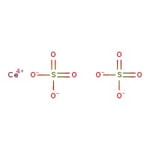
SMILES[Ce+4].[O-]S([O-])(=O)=O.[O-]S([O-])(=O)=O
檢視更多
規格 規格表
規格表
規格表Appearance (Color)Yellow or Orange
Formcrystalline powder
Assay (unspecified)>= 97.5% (REO basis)
Cerium(IV) sulfate hydrate is used as a general application for chemical intermediate.
This Thermo Scientific Chemicals brand product was originally part of the Alfa Aesar product portfolio. Some documentation and label information may refer to the legacy brand. The original Alfa Aesar product / item code or SKU reference has not changed as a part of the brand transition to Thermo Scientific Chemicals.
Applications
Cerium(IV) sulfate hydrate is used as a general application for chemical intermediate.
Solubility
Soluble in water.
Notes
Store in cool, dry conditions in well sealed containers. keep container tightly closed
Cerium(IV) sulfate hydrate is used as a general application for chemical intermediate.
Solubility
Soluble in water.
Notes
Store in cool, dry conditions in well sealed containers. keep container tightly closed
RUO – Research Use Only
General References:
- M. P. Singh; H. S. Singh; M. K. Verma. Kinetics and mechanism of the ruthenium(III) chloride catalyzed oxidation of butanone-2 and pentanone-3 by cerium(IV) sulfate in aqueous sulfuric acid medium. J. Phys. Chem. 1980, 84,(3), 256-259.
- Oxidizing agent which has been used for the generation of o-benzoquinone from catechol: Liebigs Ann. Chem., 712, 214 (1968).
- Promotes the formation of radicals from dialkyl malonates, which undergo substitution reactions with furans and thiophenes: Heterocycles, 27, 2627 (1988).
- In the presence of oxygen, oximes can be converted to the parent carbonyl compounds in good yield: Appl. Organomet. Chem., 13, 867 (1999).
- In combination with iodine in EtOH, 2-alkylcycloalkanones are ring-opened to ethyl keto esters: J. Chem. Res. (Synop.), 122 (1999).