Search
 項目搜尋
項目搜尋 結構搜尋
結構搜尋
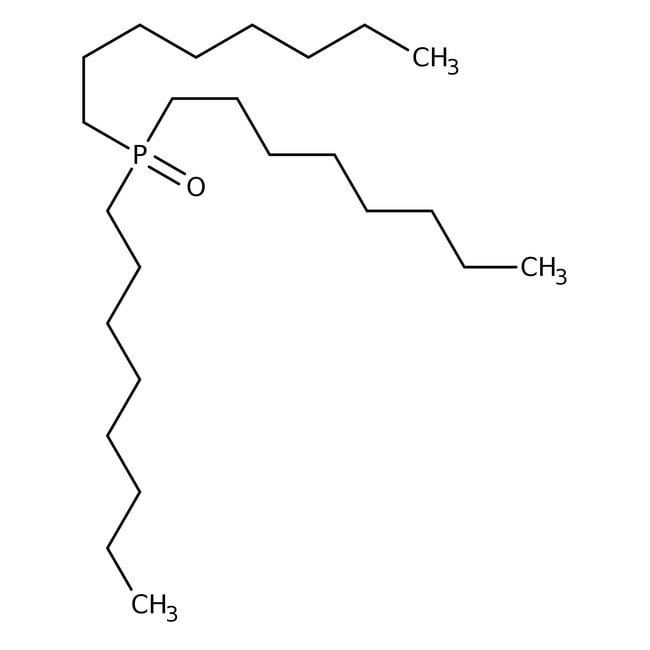


Thermo Scientific Chemicals
Tri-n-octylphosphine oxide, 98%
CAS: 78-50-2 | C24H51OP | 386.645 g/mol
Have Questions?
變更視圖


化學識別
CAS78-50-2
IUPAC Name1-(dioctylphosphoryl)octane
Molecular FormulaC24H51OP
InChI KeyZMBHCYHQLYEYDV-UHFFFAOYSA-N
SMILESCCCCCCCCP(=O)(CCCCCCCC)CCCCCCCC
檢視更多
規格 規格表
規格表
規格表Melting Point (clear melt)50-57?C
Identification (FTIR)Conforms
Appearance (Color)White to cream or pale yellow
Assay (GC)≥97.5%
FormCrystals or powder or crystalline powder or flakes and/or fused solid/chunks
Tri-n-octylphosphine oxide is a solvent used in the extraction of metals, especially uranium, zirconium and hafnium. It is also used as an auxiliary reagent in the solvent extraction of metals. It is also used to extract hydrogen bonding organic compounds. Further, it is useful as a capping ligand for the production of quantum dots, such as those consisting of cadmium selenide.
This Thermo Scientific Chemicals brand product was originally part of the Alfa Aesar product portfolio. Some documentation and label information may refer to the legacy brand. The original Alfa Aesar product / item code or SKU reference has not changed as a part of the brand transition to Thermo Scientific Chemicals.
Applications
Tri-n-octylphosphine oxide is a solvent used in the extraction of metals, especially uranium, zirconium and hafnium. It is also used as an auxiliary reagent in the solvent extraction of metals. It is also used to extract hydrogen bonding organic compounds. Further, it is useful as a capping ligand for the production of quantum dots, such as those consisting of cadmium selenide.
Solubility
Soluble in chloroform, toluene and hexane. Insoluble in water.
Notes
Incompatible with strong oxidizing agents.
Tri-n-octylphosphine oxide is a solvent used in the extraction of metals, especially uranium, zirconium and hafnium. It is also used as an auxiliary reagent in the solvent extraction of metals. It is also used to extract hydrogen bonding organic compounds. Further, it is useful as a capping ligand for the production of quantum dots, such as those consisting of cadmium selenide.
Solubility
Soluble in chloroform, toluene and hexane. Insoluble in water.
Notes
Incompatible with strong oxidizing agents.
RUO – Research Use Only
General References:
- Used in the extraction of various metals into organic solvents.
- Ren, C.; Hao, J.; Chen, H.; Wang, K.; Wu, D. Prepare core-multishell CdSe/ZnS nanocrystals with pure color and controlled emission by tri-n-octylphosphine-assisted method. Appl. Surf. Sci. 2015, 353, 480-488.
- Grimes, T. S.; Zalupski, P. R.; Martin, L. R. Features of the Thermodynamics of Trivalent Lanthanide/Actinide Distribution Reactions by Tri-n-octylphosphine Oxide and Bis(2-ethylhexyl) Phosphoric Acid. J. Phys. Chem. B 2014, 118 (44), 12725-12733.