Search
 項目搜尋
項目搜尋 結構搜尋
結構搜尋

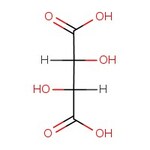

Thermo Scientific Chemicals
L-(+)-Tartaric acid, 99%
CAS: 87-69-4 | C4H6O6 | 150.09 g/mol
Have Questions?
變更視圖


化學識別
CAS87-69-4
IUPAC Name2,3-dihydroxybutanedioic acid
Molecular FormulaC4H6O6
InChI KeyFEWJPZIEWOKRBE-UHFFFAOYNA-N
SMILESOC(C(O)C(O)=O)C(O)=O
檢視更多
規格 規格表
規格表
規格表Assay (Silylated GC)≥98.5% (non-U.S. sourced material)
Appearance (Color)White to pale cream
Assay (Aqueous acid-base Titration)≥98.5 to ≤101.5% (non-U.S. sourced material)
FormCrystals or crystalline powder or powder
Assay from Supplier's CofA≥98.5% (U.S. sourced material)
檢視更多
L-(+)-Tartaric acid is widely utilized in pharmaceutical industries. It is used in soft drinks, confectionaries, food products, gelatin desserts and as a buffering agent. It forms a compound, TiCl2(O-i-Pr)2 with Diels-Alder catalyst and acta as a chelate agent in metal industries. Owing to its efficient chelating property towards metal ions, it is used in farming and metal industries for complexing micronutrients and for cleaning metal surfaces, respectively.
This Thermo Scientific Chemicals brand product was originally part of the Alfa Aesar product portfolio. Some documentation and label information may refer to the legacy brand. The original Alfa Aesar product / item code or SKU reference has not changed as a part of the brand transition to Thermo Scientific Chemicals.
Applications
L-(+)-Tartaric acid is widely utilized in pharmaceutical industries. It is used in soft drinks, confectionaries, food products, gelatin desserts and as a buffering agent. It forms a compound, TiCl2(O-i-Pr)2 with Diels-Alder catalyst and acta as a chelate agent in metal industries. Owing to its efficient chelating property towards metal ions, it is used in farming and metal industries for complexing micronutrients and for cleaning metal surfaces, respectively.
Solubility
Soluble in water, methanol and acetone.
Notes
Incompatible with oxidizing agents, bases and reducing agents.
L-(+)-Tartaric acid is widely utilized in pharmaceutical industries. It is used in soft drinks, confectionaries, food products, gelatin desserts and as a buffering agent. It forms a compound, TiCl2(O-i-Pr)2 with Diels-Alder catalyst and acta as a chelate agent in metal industries. Owing to its efficient chelating property towards metal ions, it is used in farming and metal industries for complexing micronutrients and for cleaning metal surfaces, respectively.
Solubility
Soluble in water, methanol and acetone.
Notes
Incompatible with oxidizing agents, bases and reducing agents.
RUO – Research Use Only
General References:
- Resolving agent for chiral bases. For improved resolution technique using two immiscible solvents and half equivalent of resolving agent, claimed to give higher optical purities and faster resolutions than conventional methods, see: Tetrahedron, 41, 2465 (1985).
- In combination with NaBH 4, induces asymmetric reduction of functionalized ketones with ee figures approaching those achieved with more expensive reagents: J. Chem. Soc. Perkin 1, 1826 (1990).
- Preferred acid catalyst, in combination with MgSO 4, for acetalization of unsaturated aldehydes with ethylene glycol, giving less double bond isomerization than stronger acids including tosic and succinic: J. Org. Chem., 60, 2931 (1995).
- Mostowicz, D.; Dygas, M.; Kałuża, Z. Heck Cyclization Strategy for Preparation of Erythrinan Alkaloids: Asymmetric Synthesis of Unnatural (-)-Erysotramidine from L-Tartaric Acid. J. Org. Chem. 2015, 80 (3), 1957-1963.
- Song, G.; Xu, C.; Li, B. Visual chiral recognition of mandelic acid enantiomers with l-tartaric acid-capped gold nanoparticles as colorimetric probes. Sens. Actuators B 2015, 215, 504-509.