Search
 項目搜尋
項目搜尋 結構搜尋
結構搜尋

Thermo Scientific Chemicals
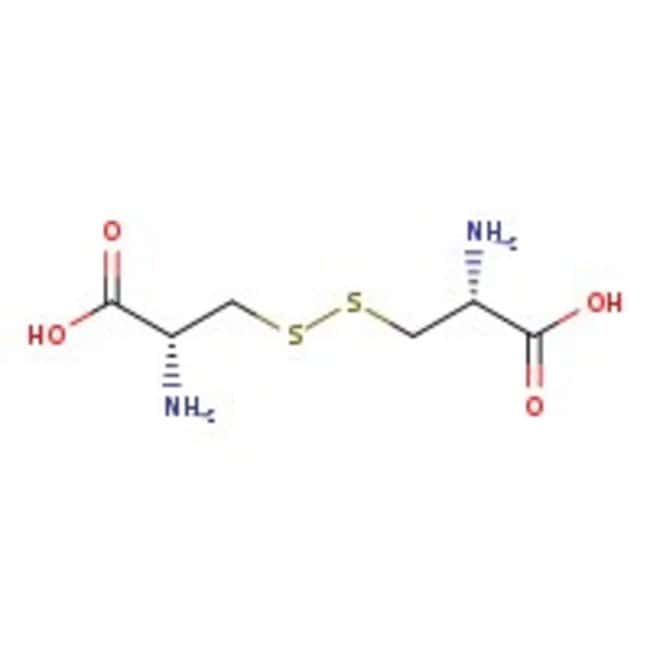
L-Cystine, 99%
CAS: 56-89-3 | C6H12N2O4S2 | 240.292 g/mol
Have Questions?
變更視圖


化學識別
CAS56-89-3
IUPAC Name(2R)-2-amino-3-{[(2R)-2-amino-2-carboxyethyl]disulfanyl}propanoic acid
Molecular FormulaC6H12N2O4S2
InChI KeyLEVWYRKDKASIDU-IMJSIDKUSA-N
SMILESN[C@@H](CSSC[C@H](N)C(O)=O)C(O)=O
檢視更多
規格 規格表
規格表
規格表Appearance (Color)White to pale cream
FormCrystals or powder or crystalline powder
Assay (Non-aqueous acid-base Titration)≥98.5 to ≤101.5%
Identification (FTIR)Conforms
Optical Rotation-205° to -224° (c=1 in 1N HCl)
L-Cystine is used as an antioxidant, protecting tissues against radiation and pollution. It finds application in protein synthesis. It is required for utilization of vitamin B6 and is useful in healing burns and wounds. It is also is required by certain malignant cell lines in the culture medium as well as for the growth of certain micro-organisms. It is useful in the stimulation of hematopoietic system and promotes the formation of white and red blood cells. It is an active ingredient in medications used to treat dermatitis.
This Thermo Scientific Chemicals brand product was originally part of the Alfa Aesar product portfolio. Some documentation and label information may refer to the legacy brand. The original Alfa Aesar product / item code or SKU reference has not changed as a part of the brand transition to Thermo Scientific Chemicals.
Solubility
Soluble in water.
Notes
Incompatible with strong oxidizing agents.
Soluble in water.
Notes
Incompatible with strong oxidizing agents.
RUO – Research Use Only
General References:
- Chen, L.; Zheng, Z.; Wang, J.; Wang, X. Mesoporous SBA-15 end-capped by PEG via L-cystine based linker for redox responsive controlled release. Microporous Mesoporous Mater. 2014, 185, 7-15.
- Liu, M.; Zhang, L.; He, X.; Zhang, B., Song, H.; Li, S.; You, W. l-Cystine-assisted hydrothermal synthesis of Mn 1- x Cd x S solid solutions with hexagonal wurtzite structure for efficient photocatalytic hydrogen evolution under visible light irradiation. J. Mater. Chem. A 2014, 2 (13), 4619-4626.