Search
 項目搜尋
項目搜尋 結構搜尋
結構搜尋
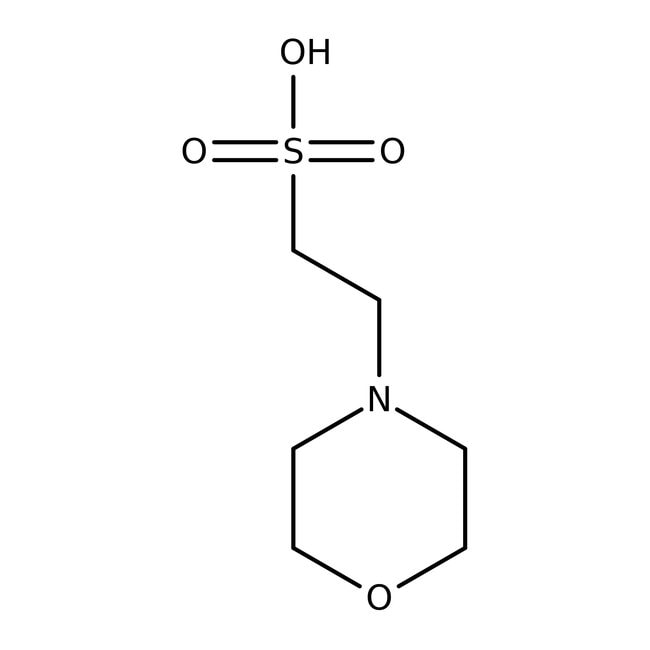

Thermo Scientific Chemicals
MES monohydrate, 98%
CAS: 145224-94-8 | C6H15NO5S | 213.248 g/mol
Have Questions?
變更視圖


化學識別
CAS145224-94-8
IUPAC Name4-(2-sulfonatoethyl)morpholin-4-ium
Molecular FormulaC6H13NO4S
InChI KeySXGZJKUKBWWHRA-UHFFFAOYSA-N
SMILES[O-]S(=O)(=O)CC[NH+]1CCOCC1
檢視更多
規格 規格表
規格表
規格表FormCrystals or powder or crystalline powder
Assay (Aqueous acid-base Titration)≥97.5 to ≤102.5% (as monohydrate)
Identification (FTIR)Conforms
Appearance (Color)White
MES monohydrate is a biological buffer often referred to as Good’s buffer. It is useful for cell culture media and protein based buffer formulations to maintain a stable environment in solution. It is also used in the purification bioprocesses of antibodies, peptides, proteins, blood components and growth factors. It is a useful resolving agent for very small proteins on bis-tris gels. Buffer solutions are used as a means of keeping pH at a nearly constant value in a wide variety of chemical applications.
This Thermo Scientific Chemicals brand product was originally part of the Alfa Aesar product portfolio. Some documentation and label information may refer to the legacy brand. The original Alfa Aesar product / item code or SKU reference has not changed as a part of the brand transition to Thermo Scientific Chemicals.
Applications
MES monohydrate is a biological buffer often referred to as Good’s buffer. It is useful for cell culture media and protein based buffer formulations to maintain a stable environment in solution. It is also used in the purification bioprocesses of antibodies, peptides, proteins, blood components and growth factors. It is a useful resolving agent for very small proteins on bis-tris gels. Buffer solutions are used as a means of keeping pH at a nearly constant value in a wide variety of chemical applications.
Solubility
Soluble in water.
Notes
Incompatible with strong oxidizing agents.
MES monohydrate is a biological buffer often referred to as Good’s buffer. It is useful for cell culture media and protein based buffer formulations to maintain a stable environment in solution. It is also used in the purification bioprocesses of antibodies, peptides, proteins, blood components and growth factors. It is a useful resolving agent for very small proteins on bis-tris gels. Buffer solutions are used as a means of keeping pH at a nearly constant value in a wide variety of chemical applications.
Solubility
Soluble in water.
Notes
Incompatible with strong oxidizing agents.
RUO – Research Use Only
General References:
- Biological buffer, pKa = 6.15 at 20°: Biochemistry, 5, 467 (1966).
- Rahman, R. N. Z. R. A.; Masomian, M.; Leow, A. T. C.; Ali, M. S. M. Influence of protein solution in nucleation and optimized formulation for the growth of ARM lipase crystal. J. Cryst. Growth 2015, 426, 234-242.
- Baumann, P.; Baumgartner, K.; Hubbuch, J. Influence of binding pH and protein solubility on the dynamic binding capacity in hydrophobic interaction chromatography. J. Chromatogr. A 2015, 1396, 77-85.