Search
 項目搜尋
項目搜尋 結構搜尋
結構搜尋

Thermo Scientific Chemicals
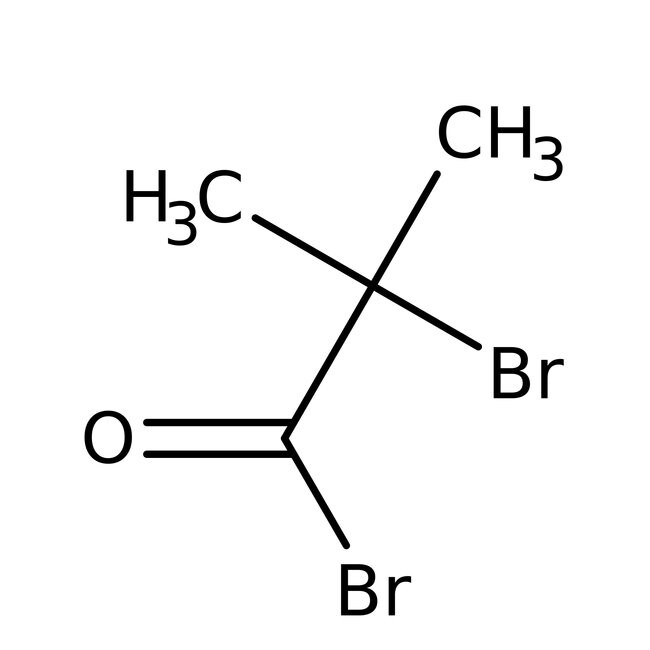
2-Bromoisobutyryl bromide, 97%
CAS: 20769-85-1 | C4H6Br2O | 229.899 g/mol
Have Questions?
變更視圖


化學識別
CAS20769-85-1
IUPAC Name2-bromo-2-methylpropanoyl bromide
Molecular FormulaC4H6Br2O
InChI KeyYOCIJWAHRAJQFT-UHFFFAOYSA-N
SMILESCC(C)(Br)C(Br)=O
檢視更多
規格 規格表
規格表
規格表FormLiquid
Assay (GC)≥96.0%
Appearance (Color)Clear colorless to pale yellow or pale pink
Refractive Index1.5075-1.5125 @ 20?C
2-Bromoisobutyryl bromide is used to prepare N-protected halodienamide, which provides four- and five-membered lactams in the presence of copper(I) and a tertiary amine. Further, it is used as atom transfer radical polymerization(ATRP) initiator for functionalization of hydroxyl groups present on the surface of graphene oxide. It is also used in preparation of polycaprolactone macroinitiators through reaction with oligomeric caprolactone diol and mesoporous silica nanoparticles with ATRP initiator anchored on the exterior surface.
This Thermo Scientific Chemicals brand product was originally part of the Alfa Aesar product portfolio. Some documentation and label information may refer to the legacy brand. The original Alfa Aesar product / item code or SKU reference has not changed as a part of the brand transition to Thermo Scientific Chemicals.
Applications
2-Bromoisobutyryl bromide is used to prepare N-protected halodienamide, which provides four- and five-membered lactams in the presence of copper(I) and a tertiary amine. Further, it is used as atom transfer radical polymerization(ATRP) initiator for functionalization of hydroxyl groups present on the surface of graphene oxide. It is also used in preparation of polycaprolactone macroinitiators through reaction with oligomeric caprolactone diol and mesoporous silica nanoparticles with ATRP initiator anchored on the exterior surface.
Solubility
Miscible with acetone and carbon disulfide.
Notes
Moisture sensitive. Incompatible with strong oxidizing agents and strong alkalis.
2-Bromoisobutyryl bromide is used to prepare N-protected halodienamide, which provides four- and five-membered lactams in the presence of copper(I) and a tertiary amine. Further, it is used as atom transfer radical polymerization(ATRP) initiator for functionalization of hydroxyl groups present on the surface of graphene oxide. It is also used in preparation of polycaprolactone macroinitiators through reaction with oligomeric caprolactone diol and mesoporous silica nanoparticles with ATRP initiator anchored on the exterior surface.
Solubility
Miscible with acetone and carbon disulfide.
Notes
Moisture sensitive. Incompatible with strong oxidizing agents and strong alkalis.
RUO – Research Use Only
General References:
- Wang, K.; Zhang, X.; Zhang, X.; Fan, X.; Huang, Z.; Chen, Y.; Wei, Y. Preparation of biocompatible and photostable PEGylated red fluorescent nanoparticles for cellular imaging. Polym. Chem. 2015, 6 (32), 5891-5898.
- Sun, N.; Meng, X.; Xiao, Z. Functionalized Si3N4 nanoparticles modified with hydrophobic polymer chains by surface-initiated atom transfer radical polymerization (ATRP). Ceram. Int. 2015, 41 (10), 13830-13835.