Search


引用資料與參考文獻 (36)
Invitrogen™
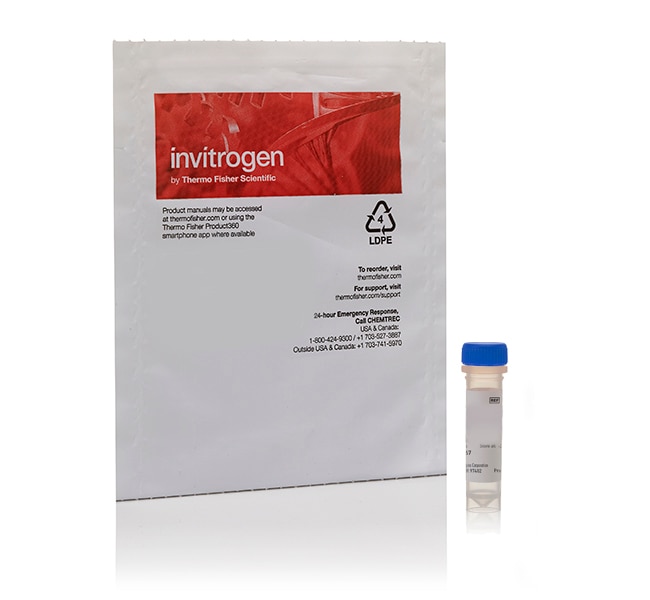
Cholera Toxin Subunit B (Recombinant), Alexa Fluor™ 555 Conjugate
Molecular Probes™ cholera toxin conjugates are made from a recombinant version of the B subunit only. This allows us to深入閱讀
Have Questions?
變更視圖

| 產品號碼 | Quantity |
|---|---|
| C34776 | 100 μg |
| C22843 | 500 μg |
產品號碼 C34776
價格 (TWD)
-
Quantity:
100 μg
Molecular Probes™ cholera toxin conjugates are made from a recombinant version of the B subunit only. This allows us to provide a very high-purity product that is completely free of the toxic A subunit. Cholera toxin B subunit (CT-B) attaches to cells by binding to ganglioside GM1, making it a powerful tool for retrograde labeling of neurons. This tracer has been used in a variety of applications, including tracing of rat forebrain afferents, projections of the parabrachial region, and neurons of the urinary bladder wall. When used in neuronal tracing applications, CT-B is typically introduced by pressure injection or by iontophoretic injection into neural tissue.
Cholera Toxin Subunit B Specifications:
• Label (Ex/Em): Alexa Fluor™ 555 (555/565 nm)
• At neutral pH, the 11.4 kDa B subunit exists as a 57 kDa pentamer
• Lyophilized product can be dissolved in buffer (e.g., PBS) for use
Cholera Toxin Subunit B for Studying Lipid Rafts
More recently, researchers have found that CT-B can be used as a marker for lipid rafts, which are membrane microdomains enriched in cholesterol and sphingolipids thought to be important in cell signaling. For lipid raft staining, cells are first incubated with fluorescent CT-B. Then, an anti–CT-B antibody is added to crosslink the CT-B in the lipid rafts into distinct patches on the plasma membrane. These patches are easily visualized by fluorescence microscopy. In addition to individual fluorescent CT-B conjugates, we also offer Vybrant™ Lipid Raft Labeling Kits that contain the Alexa Fluor™ 488, Alexa Fluor™ 555, or Alexa Fluor™ 594 dye conjugates of CT-B, an anti–CT-B antibody, and a detailed protocol for labeling and preparing cells for fluorescence microscopy.
Find More CT-B Conjugates
We offer various CT-B conjugates. Review Protein Conjugates—Section 14.7 in the Molecular Probes™ Handbook for more information on these tracers.
For Research Use Only. Not for human or animal therapeutic or diagnostic use.
Cholera Toxin Subunit B Specifications:
• Label (Ex/Em): Alexa Fluor™ 555 (555/565 nm)
• At neutral pH, the 11.4 kDa B subunit exists as a 57 kDa pentamer
• Lyophilized product can be dissolved in buffer (e.g., PBS) for use
Cholera Toxin Subunit B for Studying Lipid Rafts
More recently, researchers have found that CT-B can be used as a marker for lipid rafts, which are membrane microdomains enriched in cholesterol and sphingolipids thought to be important in cell signaling. For lipid raft staining, cells are first incubated with fluorescent CT-B. Then, an anti–CT-B antibody is added to crosslink the CT-B in the lipid rafts into distinct patches on the plasma membrane. These patches are easily visualized by fluorescence microscopy. In addition to individual fluorescent CT-B conjugates, we also offer Vybrant™ Lipid Raft Labeling Kits that contain the Alexa Fluor™ 488, Alexa Fluor™ 555, or Alexa Fluor™ 594 dye conjugates of CT-B, an anti–CT-B antibody, and a detailed protocol for labeling and preparing cells for fluorescence microscopy.
Find More CT-B Conjugates
We offer various CT-B conjugates. Review Protein Conjugates—Section 14.7 in the Molecular Probes™ Handbook for more information on these tracers.
For Research Use Only. Not for human or animal therapeutic or diagnostic use.
For Research Use Only. Not for use in diagnostic procedures.
規格
Label TypeAlexa Fluor Dyes
Product LineAlexa Fluor
Protein FormRecombinant
Protein SubtypeCholera Toxin
Quantity100 μg
Shipping ConditionRoom Temperature
ConjugateAlexa Fluor 555
FormLyophilized
RecombinantRecombinant
Unit SizeEach
內容物與存放
Store in freezer (-5 to -30°C) and protect from light.
常見問答集 (常見問題)
I injected a fluorescent tracer, but cannot detect it after tissue is fixed and sectioned. What am I doing wrong?
Do you have a tracer that will only transport retrograde?
How do I know which tracer to choose for my experiment?
What products do you have for neuronal tracing?
引用資料與參考文獻 (36)
引用資料與參考文獻
Abstract
Autoantigen Golgin-97, an effector of Arl1 GTPase, participates in traffic from the endosome to the trans-golgi network.
Journal:Mol Biol Cell
PubMed ID:15269279
'The precise cellular function of Arl1 and its effectors, the GRIP domain Golgins, is not resolved, despite our recent understanding that Arl1 regulates the membrane recruitment of these Golgins. In this report, we describe our functional study of Golgin-97. Using a Shiga toxin B fragment (STxB)-based in vitro transport assay,
Caveolin regulates endocytosis of the muscle repair protein, dysferlin.
Journal:J Biol Chem
PubMed ID:18096699
'Dysferlin and Caveolin-3 are plasma membrane proteins associated with muscular dystrophy. Patients with mutations in the CAV3 gene show dysferlin mislocalization in muscle cells. By utilizing caveolin-null cells, expression of caveolin mutants, and different mutants of dysferlin, we have dissected the site of action of caveolin with respect to dysferlin
Specialized cortical subnetworks differentially connect frontal cortex to parahippocampal areas.
Journal:J Neurosci
PubMed ID:22302828
'How information is manipulated and segregated within local circuits in the frontal cortex remains mysterious, in part because of inadequate knowledge regarding the connectivity of diverse pyramidal cell subtypes. The frontal cortex participates in the formation and retrieval of declarative memories through projections to the perirhinal cortex, and in procedural
Integrin-mediated adhesion regulates membrane order.
Journal:J Cell Biol
PubMed ID:16943184
'The properties of cholesterol-dependent domains (lipid rafts) in cell membranes have been controversial. Because integrin-mediated cell adhesion and caveolin both regulate trafficking of raft components, we investigated the effects of adhesion and caveolin on membrane order. The fluorescent probe Laurdan and two-photon microscopy revealed that focal adhesions are highly ordered;
Metastatic potential of mouse Lewis lung cancer cells is regulated via ganglioside GM1 by modulating the matrix metalloprotease-9 localization in lipid rafts.
Journal:J Biol Chem
PubMed ID:16636068
'To analyze mechanisms for cancer metastasis, we established high metastatic sublines from mouse Lewis lung cancer (P29) by repeated injection. Sublines established from the two subclones H7 and C4 commonly exhibited increased proliferation and invasion activity and reduced expression of ganglioside GM1, although they showed different preferences in their target